


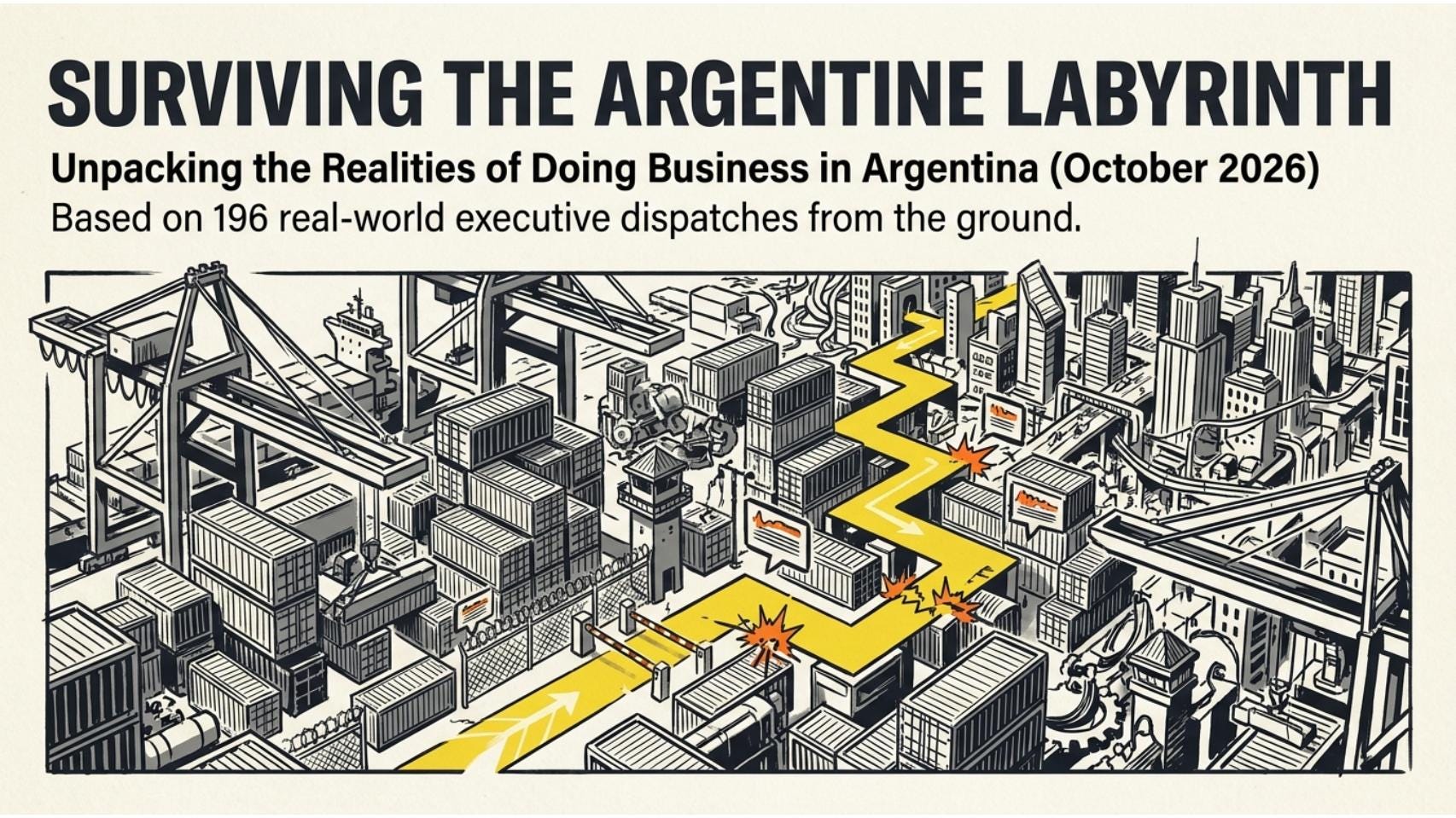
The slide deck “Argentine Executive Playbook” presents a comprehensive analysis of doing business in Argentina under the administration of President Javier Milei. Grounded in primary intelligence from 196 multinational executives, local founders, and operating managers processed through the OneBizTutor® AI engine, the playbook outlines how market liberalization has created a Deregulation Paradox. Rather than eliminating operational risk, the dismantling of federal oversight bodies has shifted corruption into discretionary extortion at local, provincial, and customs friction points.
For international C-suite executives and business development (BD) managers, the presentation provides actionable frameworks to protect corporate balance sheets, maintain compliance under extraterritorial laws (such as the US FCPAand Argentina’s Ley 27.401), and realign unit economics.
Core Economic Realities & Structural Risk Clusters
The Deregulation Paradox & Compliance Liability
Oversight Vacuum: The dismantling of federal audit entities—including internal audit units within the ARCA tax agency and the Oficina Anticorrupción—without concurrent judicial reform has transferred discretionary power to mid-level inspectors and provincial authorities.
Customs Extortion: Authorities leverage arbitrary inspections (e.g., Canal Rojo routing by ARCA, SENASA, or ANMAT) on critical spare parts to induce demurrage charges that exceed $100,000/day in operational downtime.
Extraterritorial Exposure: Parent corporations remain legally liable under US FCPA and Ley 27.401 for illicit facilitation payments made by local third-party customs brokers (Despachantes de Aduana).
Macroeconomic Squeeze (Atraso Cambiario)
Real Peso Appreciation: The government’s crawling peg exchange rate policy lags persistent domestic inflation, resulting in severe real-term peso appreciation.
Input Cost Inflation: Operating expenses, local labor, and inland freight inflate rapidly in hard-currency USD terms.
Monopoly Pricing vs. Cheap Imports: Domestic raw material monopolies (e.g., steel and aluminum) dictate above-market input prices, while deregulated finished imports undercut domestic manufacturing margins.
Infrastructure Decay (Obra Pública Zero)
Frozen Federal Works: Under the Obra Pública Zero mandate, federally funded transport and energy infrastructure maintenance has been frozen since late 2023.
Logistics Bottlenecks: Major transit corridors like Ruta Nacional 7 face severe degradation. With unreliable rail networks, nearly 90% of freight relies on trucking, inflating cargo damage and transit delays.
Power Grid Instability: Utility tariff hikes are directed toward fiscal deficit reduction rather than grid modernization, causing recurring summer blackouts that force operators to invest in costly backup power generators.
The Four Strategic Frameworks for C-Suite Operators
Minimum Viable Footprint (MVF): Restructure non-resource manufacturing and consumer businesses into skeleton entities focused strictly on brand preservation, licensing, and direct import distribution. This divests heavy capital exposure while maintaining market “option value” for future political cycles.
Regional Nearshoring & Relocation: Relocate manufacturing to stable neighboring jurisdictions. Industrial light manufacturing shifts to Paraguay under the Maquila Regime (Law 7547) to benefit from a 1% flat re-export taxand low-cost hydroelectric power. Highly regulated industries (e.g., Pharmaceuticals) shift to Brazil to leverage ANVISA transparency and market scale.
Dual-Track Logistics Re-Engineering: Avoid extortion-prone Atlantic ports during peak seasons by routing exports through Chilean Pacific ports (Valparaíso/San Antonio) via Andean passes from October to April. Build explicit 30- to 60-day buffer stocks during winter months when mountain passes freeze.
Enclave Cluster Integration: Pivot business development pipelines away from general domestic markets toward monopsonistic, RIGI-backed mega-projects in Vaca Muerta (shale gas) and lithium/copper mining. Structure all supply contracts under foreign governing law (New York or English law) with payments deposited directly into hard-currency offshore accounts.

Argentine Executive Playbook - Q4 2026
3.58MB ∙ PDF file
Unpack Argentina’s 2026 Deregulation Paradox. Discover executive strategies, compliance playbooks, and BD frameworks for C-suite managers in Argentina.

About the writer: Frank P. Neuhaus is one of the founding partners of iMB.Solutions Ltda., São Paulo, Brazil. To date, he has already founded three start-ups and is also active as a seed investor. He worked for European companies in Europe (Germany, Spain), Southeast Asia, China and Latin America, including Brazil. He studied mechanical engineer with majors in hydrodynamics and industrial plant engineering. Furthermore, he studied international business management. He also holds an International Executive MBA with a focus on Brand and Service Management. As a result of the steady increase in project content related to automation and digitization, Mr. Neuhaus has completed advanced studies as a Certified Digital Engineer. Since a couple of years, Frank P. Neuhaus executes international business development and reorganization projects missions.
Thanks for reading BizDev Circular! This post is public so feel free to share it.

leran more about iMB.Solutions Ltda.


Available for iOS and Android
Start writing today. Use the button below to create a Substack of your own