


In the early 2020s, digital transformation was synonymous with “static” chatbots - reactive, prompt-dependent tools that served as little more than sophisticated search engines. By 2026, the paradigm has shifted. We have entered the era of the “Autonomous Operator.”
We are no longer merely managing tools; we are overseeing independent systems capable of high-stakes reasoning and multi-step execution.
The urgency of this transition is fueled by two converging forces: a booming market and a tightening regulatory net. Salesforce’s Agentforce platform has already surged past $540 million in ARR, with 18,500 customers treating agents as core infrastructure. Simultaneously, the impending 2026 USMCA review has turned “compliance” into a high-velocity data challenge.
For the modern executive, the problem has evolved from “how do I use this tool?” to “how do I govern an ecosystem that orchestrates its own goal pursuit?”
Takeaway 1: The Death of “Prompting” and the Birth of Autonomous Task Execution
The era of Generative AI has matured into Agentic AI. While the former focused on pattern-based outputs, the latter—defined by frameworks like OpenAI Operator and Devin—is characterized by autonomous goal pursuit.
The radical shift here is the erosion of traditional GUI-based SaaS moats. In 2026, agents are moving beyond the chat box to navigate software interfaces directly. An agent like OpenAI Operator can autonomously navigate a browser to book the cheapest nonstop NYC-to-Paris flight using loyalty points or schedule a viewing for a pet-friendly apartment in Brooklyn.
For the enterprise, this is non-negotiable. Agents no longer wait for a human to copy-paste data between a CRM and a logistics portal; they treat the entire digital stack as an interoperable workspace. This shift from “content creation” to “task completion” means the winners of 2026 are those whose systems can orchestrate actions across the entire digital ecosystem without human micromanagement.

Takeaway 2: Operationalizing Trust—Governance as a Competitive Edge
As AI agents gain the ability to set their own goals, “classic” compliance is no longer sufficient. Governance has transitioned from a tick-box exercise to a market differentiator. Utilizing frameworks like the Singapore Model AI Governance Framework for Agentic AI and the Agentic AI Governance Network (AIGN), organizations are now “operationalizing trust.”
Two concepts are critical to this new architecture:
Action-Space: The defined boundary of tools, data, and external systems an agent is authorized to access.
Autonomy: The degree of independence granted to the system, mitigated by Agentic Escalation Playbooks.
To achieve “Certifiable Trust”, embodied by the AIGN Trust Label, organizations must address four dimensions:
Risk Assessment: Bounding “Action-Space” upfront based on the reversibility of actions.
Human Accountability: Establishing “meaningful human oversight” checkpoints for high-stakes decisions like payments or data deletion.
Technical Controls: Implementing lifecycle testing and “whitelisting” of approved services to mitigate emergent behavior.
End-User Responsibility: Providing transparency regarding the agent’s range of actions and data access.

Takeaway 3: The USMCA “Time Bomb”—Trade Compliance Meets AI Traceability
A counter-intuitive but existential shift in 2026 is the intersection of the USMCA review and Mexico’s New Customs Law (specifically Article 160). This regulatory reform has removed the liability shield for customs brokers and importers. If a client provides false information, both parties now share direct liability.
The penalties are severe: fines for smuggling range from 70% to 250%, while inaccurate documentation can lead to fines reaching 300% of the goods’ value.
To navigate this, AI agents have become the “Automated Notaries” of the global supply chain. In IMMEX operations, agents are now required to maintain interoperable traceability—managing Digital Tax Receipts (CFDIs) and Complemento Carta Porte (digital transport documentation) in real-time.
This geopolitical friction has forced a pivot from “Just In Time” to a “Just In Case” logistics mindset. Organizations are deploying agents to perform “Pre-verification at Origin,” ensuring every upstream input is screened for prohibited materials before it ever reaches a Port of Entry.

Takeaway 4: AI Fighting AI—Adversarial Debate and Logic Meritocracies
To solve the persistent problem of hallucinations, 2026 has introduced “Adversarial Debate” and “Dynamic Weighting” within multi-agent systems. Rather than relying on a single model’s output, frameworks like Maxim AI and research from MDPI utilize a “checks and balances” system.
In this multi-agent architecture:
Adversarial Debate: Different agents (e.g., a “proposer” and a “critic”) cross-verify data.
Dynamic Weighting: A “judge” agent prioritizes high-performing models, rewarding those that consistently provide factual, non-hallucinatory logic.
Entropy Compression: This technique minimizes the “hallucination surface area” by reducing context-window bloat, keeping the agent focused only on mission-critical logic.
This internal meritocracy ensures that “emergent behavior” is mitigated before an action is taken, providing a level of reliability that repetitive questioning in a single model can never achieve.

Takeaway 5: The Specialized “Evaluation” Industry is the New Gold Rush
The gap between a prototype and production is now defined by systematic Agent Simulation. Platforms like Maxim AI, LangSmith, and Arize Phoenix (built on the vendor-neutral OpenTelemetry foundation) have become mission-critical.
The necessity for “Trajectory Analysis”—evaluating the complete decision path of an agent rather than a single response—was cemented by the Air Canada legal precedent. The court established that “organizations cannot disclaim responsibility for automated system outputs.”
“AI evaluation has evolved from a ‘nice-to-have’ into mission-critical infrastructure. As organizations deploy agents at scale, the consequences of inadequate testing compound quickly.”
Today, the Customs Council and other regulatory bodies look for “Certifiable Trust” that only these specialized evaluation platforms can provide, ensuring that autonomous actions are both legally defensible and operationally sound.

Conclusion: Navigating the “Action-Space” of Tomorrow
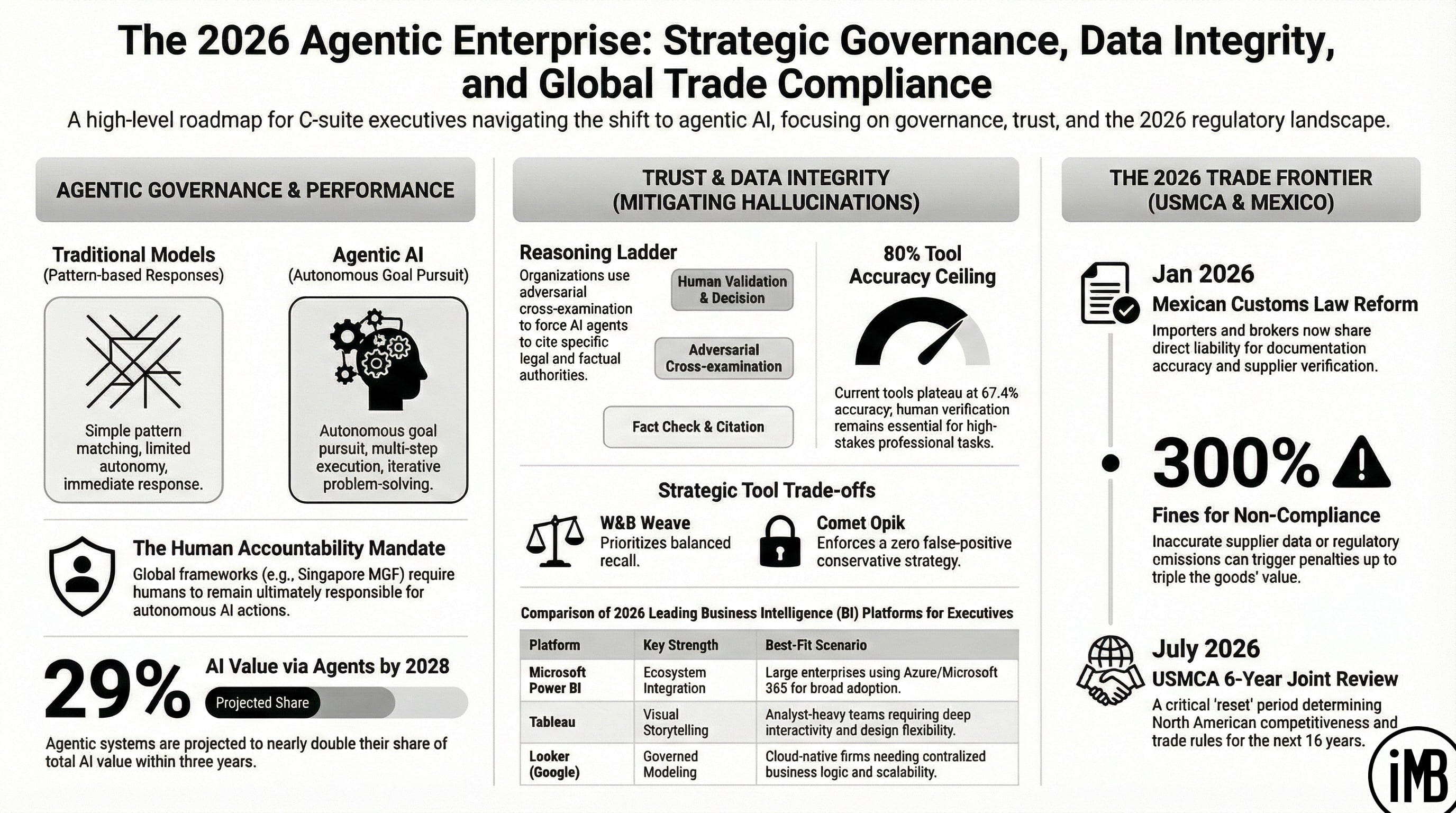
By 2026, 90% of business workflows involve some form of autonomous or multi-agent logic (AIGN/Gartner 2024). We have moved into a world where AI agents do not just assist our work; they orchestrate it.
As your organization moves deeper into the “Action-Space” of 2026, you must ask:
Is your governance framework ready to be “meaningfully accountable” for the autonomous actions taken in your name?

The winners of this new economy are not those with the largest models, but those who have mastered operationalizing trust within an integrated, evaluated agentic ecosystem. In a world of commoditized intelligence, trust is the only remaining premium.—iMB.Solutions Ltda., São Paulo, Brazil & iMB.Solutions Team Mexico, Mexico City, Mexico
Thanks for reading BizDev Circular! This post is public so feel free to share it.


Available for iOS and Android
Start writing today. Use the button below to create a Substack of your own