


Preface
This audio blog provides an authoritative, in-depth analysis of “Living Intelligence,” a concept defined by futurist Amy Webb at SXSW 2026. Living Intelligence represents the convergence of artificial intelligence, advanced sensors, and programmable biotechnology into systems that sense, adapt, and evolve in real time.
The overview highlights a groundbreaking example of this convergence through the lens of organoid intelligence: a biocomputer powered by living human brain cells that recently learned to play the video game Doom. This development signifies the collapse of traditional, linear technological trends. Instead of isolated advancements, businesses now face an “Intelligence Supercycle” where biological and digital systems fundamentally merge.
Designed for business leaders and strategists, the audio blog unpacks why organizations must transition from passive trend observation to active strategic foresight. To survive this era of “creative destruction,” leaders must abandon static planning and adopt dynamic response frameworks, preparing for a reality where biology acts as editable infrastructure and intelligence escapes the cloud to embed itself in the physical world.
The Convergence Era: A Survival Guide for Business Development, Management, and Managers
We have officially entered the “Intelligence Supercycle,” a period where the traditional, linear models of technological disruption have completely collapsed. As futurist Amy Webb recently highlighted, relying on step-by-step trend forecasting is no longer viable; instead, businesses must track “convergences”—the chaotic, simultaneous collisions of artificial intelligence, programmable biology, advanced sensors, and geopolitical shifts.
For organizations, this is a massive wake-up call. Innovation now compounds exponentially, meaning the gap between leaders and laggards will widen in months, not decades. Here is a detailed breakdown of what this shift away from linear planning means for business development, executive management, and frontline managers.
Business Development: Architecting Creative Destruction
For Business Development (BD) teams, the Convergence Era demands a radical shift from passive observation to active, purposeful disruption.
Embrace “Creative Destruction” on Purpose: Capitalism is a perpetual storm that destroys old industries and creates new ones. The most valuable BD leaders will be those willing to dismantle their own legacy systems and revenue streams before the market does it for them.
Harness “Living Intelligence”: BD teams must look beyond standard software and prepare for “Living Intelligence”—the convergence of AI, sensors, and bioengineering. This means developing partnerships and strategies for systems that can actively sense, interpret, and modify their physical environments in real-time, creating unbeatable competitive advantages.
Shift from SEO to GEO: As AI search engines increasingly provide conversational answers directly to users, the traditional “10 blue links” are dying. BD and marketing must pivot to Generative Engine Optimization (GEO), structuring content and establishing deep authority so that their brands are actively cited by AI summaries rather than relying on outdated web traffic models.
Dynamic, Hyper-Personalized Offerings: BD teams must transition from static pricing and product lines to dynamic, AI-driven models. For example, dynamic menus and pricing systems that use reinforcement learning to adjust to real-time inventory and customer preferences are becoming the new standard for maximizing revenue and loyalty.

Executive Management: The “Great Rebuild” and Dynamic Governance
At the executive level, managing this transition means abandoning slow, sequential improvement and committing to the “Great Rebuild”—architecting an AI-native tech organization from the ground up.
Killing the Excel Spreadsheet: Running complex, modern global supply chains and financial forecasts on static Excel spreadsheets is “inefficient, chaotic, costly, suboptimal and completely unfit for the modern world”. Executives must replace these legacy tools with AI “Risk Detectives.” Using machine learning and natural language processing, these systems continuously scan unstructured data—like news stories, regulatory filings, and CEO speeches—to identify hidden red flags and complex risk patterns that spreadsheets miss.
Adopting the Brazilian Non-Linear Advantage: Executives in mature economies, particularly in Europe, face massive hurdles due to legacy linear thinking and heavy regulatory frameworks like the AI Act, which categorizes AI systems by risk and demands rigorous conformity assessments. To survive, they must learn from emerging markets like Brazil. Because Brazilian leaders have historically had to navigate volatile, chaotic environments, they inherently excel at non-linear execution and rapid infrastructure adoption (like their Pix payment system), allowing them to leapfrog legacy bottlenecks.
Always Beta by Design: The defining trait of a future-ready enterprise is perpetual evolution. Executive management must institutionalize an “always beta by design” mindset, embedding adaptability into the corporate structure so the organization can pivot instantly.

The Manager’s New Reality: Orchestrating the Silicon Workforce
For middle managers and team leaders, the daily reality of work is undergoing a seismic shock. The middle office is melting; AI is automating the coordination and decision-making tasks that traditionally required human middleware, resulting in flatter and faster organizational charts.
Managing the “Silicon-Based Workforce”: Managers are no longer just supervising humans; they are orchestrating fleets of autonomous AI agents. However, 40% of agentic AI projects are predicted to fail by 2027 because companies are making the mistake of automating broken, existing processes rather than redesigning the work for machines. Managers must lead “agent-first process redesign” to tackle composite, cross-departmental tasks.
Implementing “HR for Agents”: Managers must treat AI agents like digital employees. This requires entirely new management frameworks, including specific onboarding protocols for digital workers, continuous performance tracking via immutable logs, and “FinOps” (financial operations) to rigorously monitor the compute costs and token-based pricing of continuous AI inference.
Navigating the Jagged Frontier: As AI takes over grunt work and routine coding, human workers will be pushed “up the ladder” into roles focusing on strategy, design, and complex problem-solving. The manager’s role will shift to navigating this “jagged frontier”—identifying exactly where AI agents excel and where human “agent supervisors” must step in to handle exceptions, provide ethical oversight, and inject creative intuition.

Here are the key strategies organizations must implement to make this transition:
Replace Static Data with AI “Risk Detectives”: Relying on traditional spreadsheets and past financial reports to navigate today’s converging forces is like “using a paper map in the age of GPS”. Instead, organizations should deploy machine learning and natural language processing to continuously scan unstructured data—such as news, regulatory filings, and market trends—to identify complex patterns and real-time risks that static spreadsheets miss.
Adopt “Always Beta” Dynamic Response Frameworks: Traditional step-by-step strategic planning must be replaced with dynamic response frameworks that allow organizations to pivot instantly as technologies and market conditions accelerate or decelerate. Future-ready organizations operate in continuous learning loops and embrace perpetual evolution as a core capability, remaining “always beta by design”.
Redesign Processes for an Agentic Workforce: Rather than simply using AI to automate existing manual Excel workflows, organizations must fundamentally redesign their end-to-end processes for a silicon-based workforce. For example, HPE deployed an AI agent system to handle its massive operational performance review process—underlying agents autonomously pull data from warehouses, build charts, and translate insights into structured reports, entirely bypassing legacy manual methods.
Institutionalize Strategic Foresight: Instead of linear forecasting based on isolated trends, leadership must integrate scenario planning and strategic foresight directly into their annual planning and board-level governance. By identifying where multiple forces (like AI, advanced sensors, and geopolitics) converge, leaders can anticipate volatility and uncover new opportunities before they become obvious.
Conclusion
The organizations that thrive in 2026 and beyond will not be those that simply buy the most expensive AI tools to layer over old processes. The winners will be those who possess the courage to fundamentally redesign their operations, treat AI as a collaborative silicon workforce, and replace rigid linear planning with continuous, dynamic execution.
Ultimately, surviving the Convergence Era requires organizations to shift from slow, point-in-time oversight to adaptive, continuous governance cycles that can operate at the speed of modern machines.

Listen to the audio blog cast:
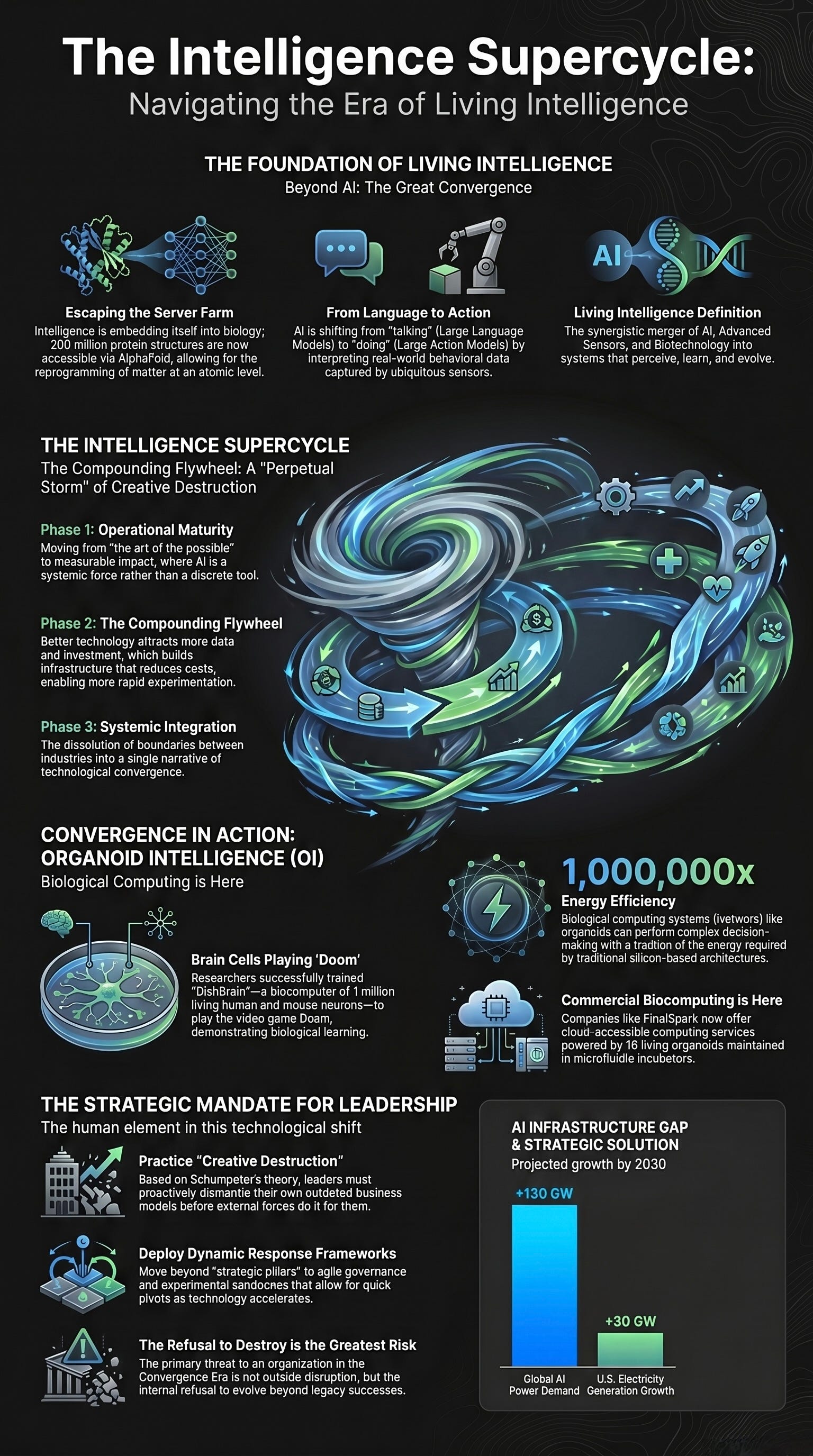
Executive Infographic Summary
About the writer: Frank P. Neuhaus is one of the founding partners of iMB.Solutions Ltda., São Paulo, Brazil. To date, he has already founded three start-ups and is also active as a seed investor. He worked for European companies in Europe (Germany, Spain), Southeast Asia, China and Latin America, including Brazil. He studied mechanical engineer with majors in hydrodynamics and industrial plant engineering. Furthermore, he studied international business management. He also holds an International Executive MBA with a focus on Brand and Service Management. As a result of the steady increase in project content related to automation and digitization, Mr. Neuhaus has completed advanced studies as a Certified Digital Engineer. Since a couple of years, Frank P. Neuhaus executes international business development and reorganization projects missions.

Thanks for reading BizDev Circular! This post is public so feel free to share it.

Available for iOS and Android