Introduction: A Real-Life Dystopia at the Heart of the Accounting System
A Look Behind the Scenes: How This Newsletter Issue Came to Be
In May 2026, I was in Brazil with a client of iMB.Solutions from the commodities and mining industry—partly for a two-day, intensive meeting at the Ministry of Energy and Mining in Brasília. But aside from the actual commodity topics, there was one topic of conversation that absolutely dominated the discussion: My client literally “grilled” me about the Banco Master case, which he had read about in the North American business press.
This burning interest is not an isolated case, as our European clients from a wide variety of industries are also increasingly confronting us with questions about this unprecedented financial thriller. Since the mainstream daily press usually only scratches the day-to-day surface here and we sensed the enormous demand for information in the market, we took the initiative.
To finally gain a rigorous understanding of the complex background, the libertarian agenda, and the criminal connections—and to present this information to you—we put our technological muscle to work: Our in-house AI bot, OneBizTutor, ran at full speed in the DataHyperCharger section to collect, sift through, and precisely structure this gigantic volume of data. Welcome to the deepest look into the abyss that you will currently find on this case in such a form.
Imagine a scenario that dwarfs even the darkest prophecies of economic collapse. We are looking at a financial system in which a mid-sized bank, despite a gaping, astronomical hole of 11 to 12 billion reais in its books, has been celebrated by the public and the markets for years as a groundbreaking, dynamic success story.
While the facade shines, in the background the state and municipal pension funds of the working population are being systematically and shamelessly plundered, leaving over a million aggrieved citizens facing financial ruin. In the executive suites, the threads connecting unscrupulous banking power brokers and top politicians of the powerful Bolsonaro clan weave into a dense web of corruption and mutual self-dealing. Particularly shocking, however, is the behavior of the regulatory authorities: Despite overwhelming warning signs over the years, the Central Bank stands idly by, but intervenes after in-depth investigations in late fall 2025—thereby triggering a systemic shock that shakes confidence in the entire Brazilian financial architecture.
This is not a fictional script for a political thriller, nor is it a theoretical dystopia penned by a left-wing critic of the system. It is the real and complete chronicle of Banco Master. It is the largest and most consequential bank fraud in Brazil’s modern history. This colossal deception took shape between 2019 and 2022 under the presidency of Jair Bolsonaro, became deeply entangled in the corridors of political power, and finally collapsed as predicted when mathematical reality caught up with the ideological house of cards.
1. The Timeline: From an Inconspicuous Relic of the 1970s to an Epic Billion-Dollar Scandal
The Historical Roots of Banco Máxima
The origins of this unprecedented scandal take us back to the 1970s, to the founding of Banco Máxima. Originally established as a traditional brokerage firm—that is, a pure securities firm—the institution led an unremarkable existence for decades. As a small, highly specialized niche bank, it operated largely outside the public eye and without any significant influence on the country’s macroeconomic structure or political landscape. It was a solid, albeit insignificant, cog in the Brazilian financial sector, operating in the shadow of the dominant major banks.

The Strategic Relaunch Under Daniel Vorcaro and the Rebranding
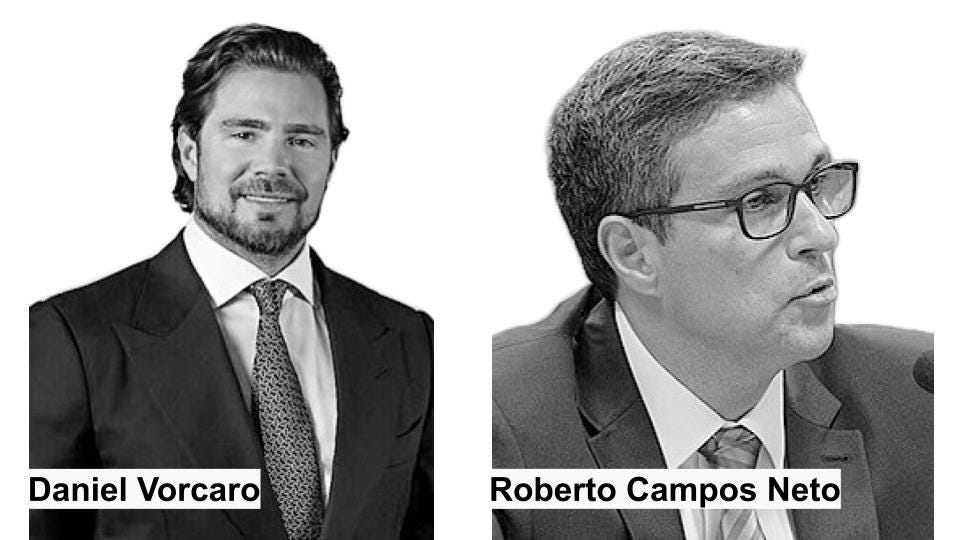
The fundamental turnaround began in 2018, when the ambitious and well-connected investor Daniel Vorcaro made repeated and forceful attempts to gain strategic and operational control of the bank. The regulatory approval from the central bank, which was absolutely necessary for this, was initially slow in coming but then followed with striking speed under the new presidency of Roberto Campos Neto—the man who had been appointed to head the central bank by the newly elected right-wing populist President Jair Bolsonaro.
In 2018 and 2019, the bank was artificially inflated through massive, sometimes opaque capital injections; the shareholder structure was radically restructured; and the institution underwent an aggressive rebranding from Banco Máxima to Banco Master.
From 2019 onward, there was no stopping it. With multi-million-dollar, omnipresent marketing campaigns, outrageously high fixed-term deposit rates, and balance sheet growth that defied the laws of nature, the bank’s unstoppable rise—hailed by politicians—began.
The Artificial Boom and the Establishment of the Ponzi Scheme
In 2019 and 2020, Banco Master destabilized the market by offering bank deposit certificates, known as CDBs, which promised utopian returns of up to 180% of the conventional interbank interest rate (CDI). These extremely above-average terms acted like a giant vacuum for liquid capital and attracted vast amounts of private and institutional funds through aggressive digital advertising campaigns.
Between 2020 and 2024, the bank expanded at a breathtaking, almost frightening pace. It borrowed on a massive scale, created seemingly rock-solid balance sheets through the deliberate and systematic overvaluation of assets, and quietly linked itself to the most sensitive areas of the public sector—the pension funds of municipalities and states.
It was precisely during this phase that the institution mutated into a fully functional, state-of-the-art Ponzi scheme. Fresh money from new investors flowed continuously into the coffers to service the exorbitant interest obligations of older creditors and conceal the massive internal shortfalls, while sophisticated accounting tricks made the outside world believe in a highly profitable reality.
Ignored Warning Signs and the Regulator’s Long Silence
As early as 2021 and 2022, the unmistakable warning signs were mounting. Both internal audit reports and external market analysts emphatically pointed to the highly toxic balance sheet structures, the grotesquely overvalued assets, and an interest rate model on the verge of mathematical collapse. Yet the central bank, under the leadership of Campos Neto, steadfastly refused to impose strict regulatory measures.
Instead, it relied on a policy of constant, toothless dialogue and extreme leniency, known in technical jargon as “regulatory forbearance.”
Any form of tough intervention was avoided, as Banco Master was regarded in the politically charged climate of the Bolsonaro era as the shining poster child for the success of a deregulated financial sector.
Putting the brakes on the bank was simply not politically expedient and was effectively prevented by chronically understaffed regulatory agencies as well as the close, almost friendly ties between central bankers and Daniel Vorcaro.
The Final Collapse and Liquidation
In November 2025, the web of lies finally collapsed under its own immense weight when the bank’s acute liquidity shortages could no longer be dismissed. A forced reassessment of the balance sheets by the public and regulators exposed the yawning chasm.
On November 18, 2025, the central bank was forced to pull the ripcord and declared the official, out-of-court liquidation of Banco Master.
With this historic step, all operations were halted with immediate effect and the entire management was removed from power. Investigations by federal authorities, which continued well into 2026, brought the full, monstrous scale of the disaster to light: a balance sheet black hole of 11 to 12 billion reais, over a million livelihoods ruined, and an irreparable loss of billions in the country’s pension funds.
2. The Anatomy of a Modern Ponzi Scheme: Balance Sheets Out of Thin Air
The Business Model of Unsustainable Returns
The fundamental principle underlying Banco Master’s success was the systematic and deliberate deception of the market. Issuing CDBs with promised returns of up to 180% of the CDI was economic madness.
No reputable bank in the world can generate such interest expenses through regular, low-risk lending transactions on the market.
From day one, the system was designed to exploit the classic mechanisms of a Ponzi scheme. Since no real, operational returns of this magnitude existed, the bank was dependent on a constant, exponentially growing inflow of new investor capital. As soon as this flow stalled, the system was mathematically doomed to collapse.
The criminal cycle system with Reag Investimentos
To conceal the massive fraud from the eyes of auditors and analysts, Banco Master employed a highly complex infrastructure of balance sheet fraud. A key role in this was played by the asset manager Reag Investimentos, which served as a strategic front partner and money laundering vehicle for the balance sheets.
The operation of this criminal circular system was marked by alarming creativity:
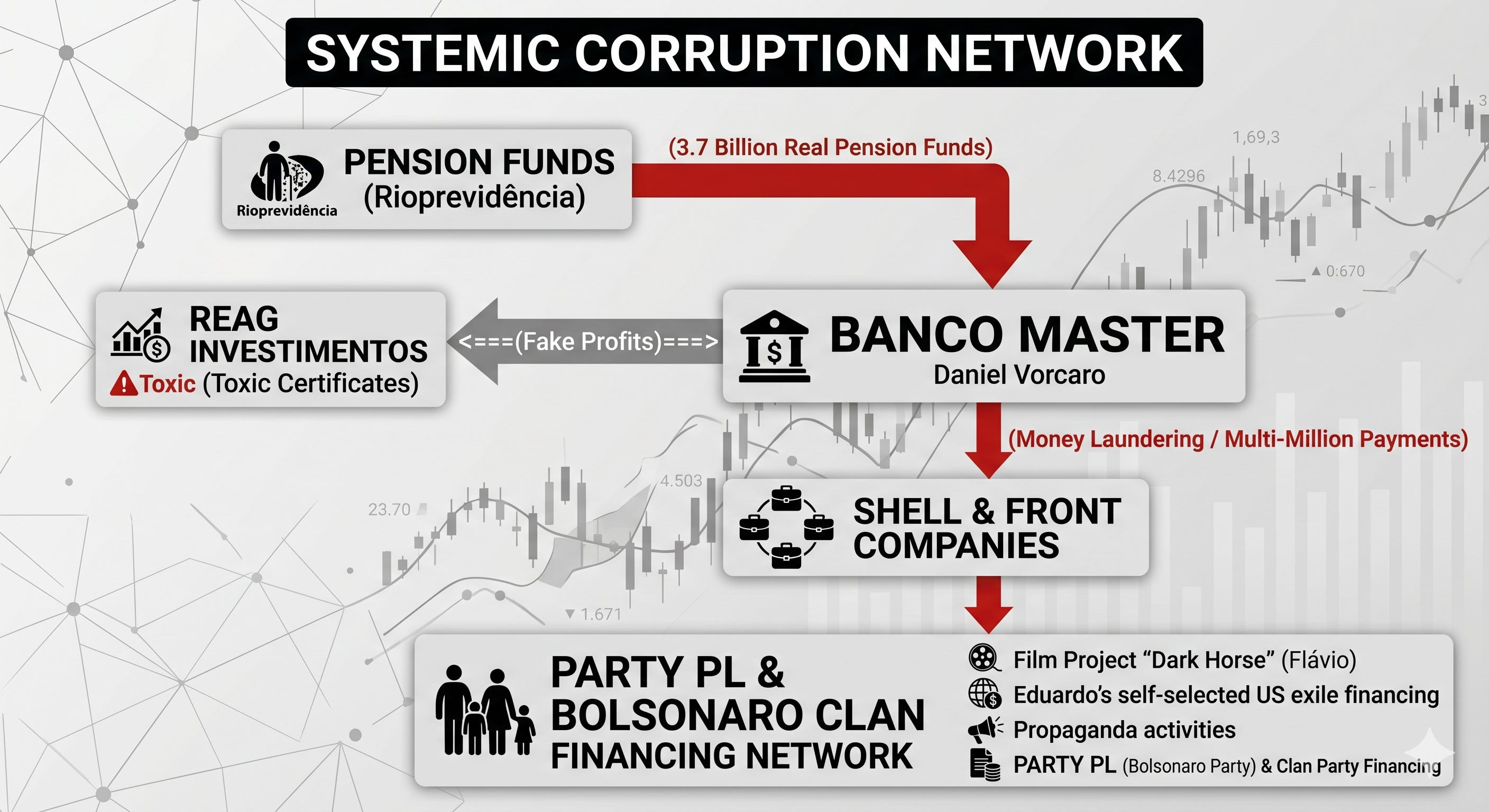
In the first step, Banco Master lent enormous sums of money to a network of liquid front companies and shell companies established specifically for this purpose.
These front companies immediately redirected the borrowed capital and invested it in special investment funds controlled by Reag Investimentos.
With this injected capital, the Reag funds then acquired completely worthless, ancient, and distressed securities—such as historical, long-depreciated certificates of the former state bank Besc—at astronomically inflated, artificially set prices.
These worthless securities, valued on paper at billions, were ultimately recorded on Banco Master’s official balance sheet as supposedly rock-solid, liquid collateral and assets.
The result of this fraud scheme was insidious: on paper, seemingly solid profits and equity gains worth millions appeared, while the bank’s actual assets consisted almost exclusively of highly toxic, unsellable junk assets.
Status of the Federal Police investigation (2026): In its current investigation files, the Federal Police describes Daniel Vorcaro as the utterly unscrupulous mastermind behind this complex web. The charges are serious and include systematic, organized credit fraud, large-scale market manipulation to influence interest rates and asset prices, international money laundering, and the strategic corruption of political decision-makers.

Why the Central Bank’s Oversight Mechanisms Failed
The fact that this system was able to operate undisturbed for years reveals a profound failure of government and regulation. On the one hand, the extreme interlocking of shell companies, the involvement of seemingly independent actors such as Reag Investimentos, and the use of historical bonds made it extremely difficult for outsiders to provide legally watertight proof of fraud. On the other hand, the central bank under Campos Neto was characterized by a deep reluctance to take tough regulatory measures, as it relied on dialogue and mutually agreed-upon conditions.
This passivity was exacerbated by a deliberate institutional downsizing: as part of cost-cutting measures, the central bank had lost around 40% of its staff in the areas of banking supervision and forensics over the course of a short period of time.
Understaffed, overburdened teams were simply no longer able to keep pace with the technological and structural ingenuity of modern financial fraudsters. The most devastating factor, however, was moral corruption:
Leading figures within the supervisory authorities acted behind the scenes as informal advisors to Vorcaro, giving him tips on how to circumvent regulations instead of fulfilling their constitutional duty to exercise strict oversight.
3. The Plundering of Pension Funds by Political Networks
The Hunt for Citizens’ Retirement Savings
The most morally reprehensible chapter of the Banco Master scandal concerns the targeted and ruthless plundering of state and municipal pension funds. The bank and its criminal affiliates deliberately targeted public-sector pension funds as their primary objective.
The reason was pragmatic: these funds held massive amounts of capital tied up for the long term, managed by local administrators who were often incompetent or corrupt. These administrators were lured in with the promise of fantastic, seemingly guaranteed returns. Through highly opaque, convoluted special funds, the workers’ hard-earned contributions were funneled directly into the toxic master structures.
The damage is of historic proportions. This resulted in losses amounting to billions in public coffers, which has permanently undermined the long-term viability of the pension system and exposed future generations of retirees to poverty in old age.
The Cláudio Castro Case and the Rioprevidência Scandal
At the center of this scheme is Cláudio Castro, the former governor of the state of Rio de Janeiro and an influential figure within Jair Bolsonaro’s inner political circle.
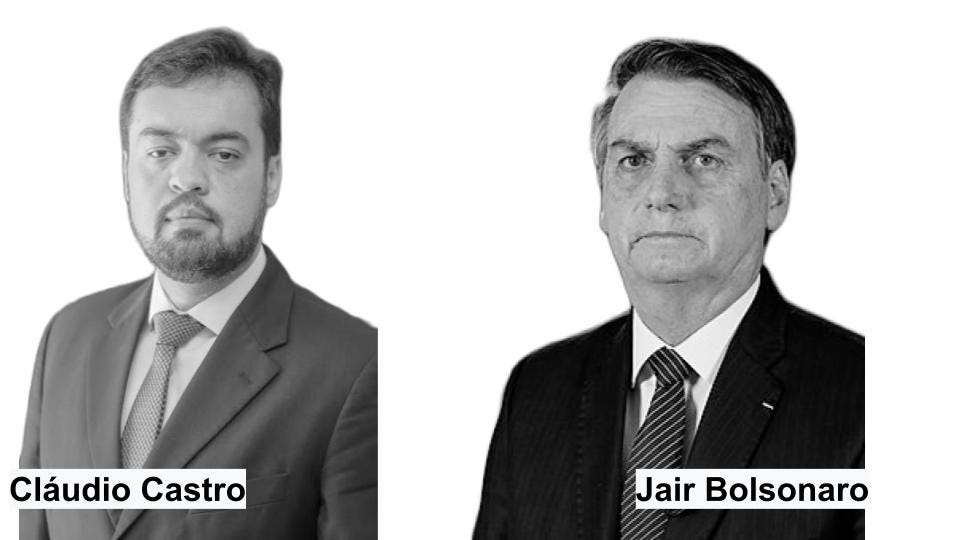
In 2026, the Federal Police are meticulously investigating serious allegations that Castro abused his massive political influence to channel an incredible 3.6 to 3.7 billion reais from the assets of Rioprevidência—the official pension fund of the state of Rio de Janeiro — directly into the high-risk and collapsing securities of Banco Master.
Investigators document an alarming closeness between the former governor and banker Daniel Vorcaro, which went far beyond professional bounds and directly dictated investment decisions.
Conservative, legally mandated investment guidelines designed to protect pension assets were deliberately and systematically disregarded in favor of Master products.
In return for this multi-billion-dollar capital transfer, substantial illegal financial benefits, bribes, and political favors were demonstrably funneled into the pockets of Castro and his political network. It was an organized and state-sanctioned plunder of society’s most vulnerable members.

4. When High Finance Meets Narco-Terrorism – “REAG Investimentos” Laundered Funds for the PCC and Comando Vermelho
Operation “Compliance Zero”: The Abyss of the Banco Master Scandal Grows Even Deeper

In November 2025, the Brazilian Federal Police (Polícia Federal) opened a new, shocking chapter in the already historic Banco Master scandal with the large-scale raid “Compliance Zero.” What had previously been regarded as sophisticated, white-collar accounting fraud and politically protected looting of pension funds has, overnight, expanded into a national security nightmare.
During a search of the offices of the asset management firm REAG Investimentos, federal investigators uncovered explosive data and crypto wallets that reveal a staggering scale:
REAG not only served as a front company to pad Banco Master’s balance sheet, but was simultaneously used as a massive, highly professional financial hub for money laundering on behalf of Brazil’s most powerful and notorious criminal syndicates—the PCC (Primeiro Comando da Capital) and the CV (Comando Vermelho).

The perfect money-laundering pipeline: From drug money to “solid” investment funds
Investigators document that the infrastructure established for Banco Master—comprising fictitious front companies, nested fund structures, and artificially overvalued assets—had formed a tailor-made alliance with organized crime.
The principle was alarmingly efficient:
Feeding in cartel profits: Hundreds of millions of reais from the international cocaine trade, protection rackets, and illegal arms dealing were fed into the REAG-controlled system in cash or via convoluted smurfing networks (many small transfers).
The transformation in the fund carousel: The same REAG funds that bought up worthless historical certificates to generate fictitious profits for Banco Master were used to mix the syndicates’ blood money with legal financial flows. The money passed through so many layers of shell companies until it reemerged as supposedly clean returns from real estate or securities transactions.
Conclusion of the Federal Police: The line between greedy, politically connected high finance and the brutal narco-terrorism of the favelas was completely erased at REAG Investimentos. The criminals on the boards of directors and the bosses of the syndicates used exactly the same criminal infrastructure.
An Explosive Legacy for the Justice System in 2026
These connections, which came to light in the wake of “Compliance Zero,” fundamentally alter the legal and political dynamics of the entire case in 2026.
For the Bolsonaro clan and implicated politicians like former Governor Cláudio Castro, the air is now finally getting thin. It is no longer just allegations of classic insider trading, bribery, or credit fraud that hang in the air—charges of supporting and financing terrorist, armed organizations now loom.
For compliance and legal professionals, this turn of events provides the most drastic illustrative example imaginable:
It painfully demonstrates that ideologically motivated, radical deregulation of the financial market and the deliberate weakening of central bank oversight do not, at the end of the day, lead to economic freedom.
They pave the way for a complete infiltration of the legitimate banking system by the most brutal form of organized crime. REAG Investimentos has shown that in the modern shadow banking system, money from a plundered pension fund and the blood money of a drug cartel end up in the same account.
5. The Bolsonaro Clan: Flávio Bolsonaro and the Trail of Dirty Money
The Leaked Audio and the Millions for “Dark Horse”
The connections in this criminal case extend directly to the heart of the Bolsonaro family’s personal and political sphere. Senator Flávio Bolsonaro, the eldest son of former President Jair Bolsonaro, is directly linked to Daniel Vorcaro through a dense network of contacts. An audio recording intercepted by investigators and leaked to the public revealed a shocking level of intimacy between the senator and the criminal bank executive. In this conversation, Flávio Bolsonaro demands the payment of millions in a bold and familiar tone.
This money was officially intended to finance a biographical propaganda film about the life of his father, Jair Bolsonaro, with the working title “Dark Horse.”

The timing of this demand for money exposes the absolute unscrupulousness of those involved: The negotiations and money transfers took place precisely at a time when Banco Master was already suffering from massive, existential liquidity problems, was plundering pension funds, and Vorcaro had long been under the scrutiny of the Federal Police.

Tactical Lies and the Trail to North America
In his public responses, Flávio Bolsonaro entangled himself in a web of contradictions and tactical lies. At first, he vehemently denied ever having met or even heard of Daniel Vorcaro. Once the burden of proof became overwhelming due to the leaked audio recordings, he was forced to grudgingly admit that he had approached Vorcaro to secure private funding for the film project. Officially, the defense insists that this was a purely private, legitimate investment involving no misuse of public funds.
However, in 2026, federal police investigators are pursuing a far more explosive lead: there is strong suspicion that funds illegally stolen from pension funds were laundered through Banco Master via shell and front companies to flow directly into the political and private projects of the Bolsonaro clan.
What’s more: Authorities are examining evidence that these Master front companies were also used to finance the luxurious lifestyle and aggressive anti-Brazil campaigns of his brother, Eduardo Bolsonaro. Eduardo Bolsonaro, also a key figure in the clan, fled to the U.S. nearly two years ago to evade the reach of the Brazilian justice system and has been operating from exile in the U.S. ever since.
This scandal has permanently shattered Flávio Bolsonaro’s image as a self-declared champion of “law and order” in the election campaign and has brought the clan’s intolerable corruption back to the center of the national debate.
Jair Bolsonaro’s Hypocritical Criticism
In a desperate attempt at damage control, supporters of the clan point to a public statement by Jair Bolsonaro, who had publicly criticized Banco Master several months before his son Flávio’s controversial negotiations. At the time, the former president attacked a highly suspicious loan transaction involving Banco Master and the state-owned savings bank Caixa Econômica Federal. The investigation files, however, paint a clear picture:
This criticism was by no means an expression of concern for the rule of law or a desire for transparency. It was the result of purely internal, blackmail-driven political power struggles and tensions between various factions within the governing coalition at the time, in which the bank was misused as a political lever.
6. The Epicenter of the Failure: Paulo Guedes, Campos Neto, and the Destructive Libertarian Agenda
Who were the architects behind the scenes?
To fully grasp the true scope and origins of the Banco Master scandal, one must not focus solely on the criminals who carried out the crimes and the corrupt senators. One must analyze the architects of the economic policy of that time: Paulo Guedes, the all-powerful Minister of Finance and Economy in the Bolsonaro administration, and Roberto Campos Neto, the President of the Central Bank.
Paulo Guedes was no unknown quantity or naive bureaucrat. As a staunch “libertarian” and co-founder of the investment bank BTG Pactual, he came directly from the inner circle of the Brazilian financial market. He knew every loophole, every trick, and every regulatory nuance of the system.
Together with Campos Neto, he formed an economic think tank at the top of the government that had all the analytical tools necessary to immediately identify the glaring irregularities surrounding Banco Master.
An experienced investment banker like Guedes should have realized immediately, upon first glance at a mid-sized bank offering returns of 180% of the CDI—figures completely out of line with the market—that a fraudulent Ponzi scheme was underway. The fact that both looked the other way was no accident—it was deliberate.

The Libertarian Agenda: More Than Just Classic Deregulation
In retrospect, the economic policy under Bolsonaro and Guedes is often mistakenly described as conventional, conservative financial market liberalization. The reality, however, went far beyond that: it was a radical, ideologically driven libertarian agenda.
The stated goal of Guedes and his supporters was not to create fair, regulated competition, but rather the systematic, deliberate dismantling and emasculation of the state as a regulatory body. Under the guise of the “more market, less state” dogma, a doctrine was established that denounced any form of state oversight as a socialist obstacle to development.
In the wake of this libertarian offensive, medium-sized banks were granted the right to drive their loan portfolios to astronomical heights without significant regulatory capital requirements or risk assessments. Aggressive, toxic financial products were allowed to be pushed onto the public without state barriers, as there was a firm belief in the supposed self-regulatory power of the free market.
The deliberate sabotage of the state’s defenses
This libertarian agenda manifested itself in a targeted, institutional sabotage of state control mechanisms. The deliberate reduction of central bank staff by a massive 40% over the course of a short period of time was not collateral damage from austerity measures, but the direct result of a policy designed to render the state incapable of action. A weakened state, bled dry of personnel, cannot uncover complex, creative fraud schemes involving front companies and nested funds.
Banco Master was celebrated internally by Guedes and Campos Neto as the ultimate success story of this libertarian era—a dynamic disruptor breaking up the supposed cartel of established big banks.
A harsh intervention or even a closure of the bank in 2021 or 2022 would have completely refuted the government’s ideological narrative.
The financial security of millions of retirees was sacrificed on the altar of a libertarian market ideology that prioritized the protection of capital over the well-being of society. It was the final proof that, in practice, radical libertarianism does not lead to freedom, but directly into organized crime and the tyranny of corrupt elites.
7. Dystopia in the Financial System: Three Scenarios of Horror
The unvarnished conclusion of the Banco Master scandal leaves a trail of destruction in its wake and serves as a prime example of a fully realized financial dystopia.
An analysis of the events can be divided into three intertwined scenarios of systemic failure:
Scenario 1: The Ideological Regulatory Failure
This scenario documents how a regulatory authority such as the central bank is politically paralyzed and rendered dysfunctional through the deliberate implantation of a libertarian ideology. When the leadership of a supervisory authority fetishizes the market and rejects government intervention on principle, supervision mutates into an accomplice to fraudsters. Regulatory forbearance did not protect the system, but rather prolonged the lifespan of a criminal Ponzi scheme.
Scenario 2: The politically orchestrated plundering of retirement funds
Here we see the ugliest face of state failure. Political networks and governors associated with the Bolsonaro clan used their institutional power to systematically plunder the protected reserves of pension funds. They diverted citizens’ funds into collapsing, toxic financial structures while regulatory authorities looked the other way. It was a transfer of public wealth into the pockets of a criminal alliance of politics and high finance.
Scenario 3: The Perfection of the Modern Ponzi Scheme
This scenario illustrates the evolution of financial fraud. Modern fraudsters no longer operate with crude promises in back rooms. They utilize the entire arsenal of the modern financial world: complex accounting tricks, sham partners like Reag Investimentos, artificially overvalued historical certificates, and nested shell companies at home and abroad. They create a seamless bureaucratic sham reality that can effortlessly deceive an understaffed and ideologically blind regulatory system for years on end.

Conclusion: The Master Conspiracy as the Ultimate Lesson in Modern System Collapse
The Banco Master case is far more than a spectacular criminal case or just another isolated Ponzi scheme in financial history.
It is the ultimate symptom of a fatal symbiosis of ideological blindness, institutional dismantling, and unscrupulous criminal energy at the very heart of political power.
When we lift the veil on this modern financial dystopia, three fundamental insights remain:
Ideology trumps oversight: Under the guise of a radical libertarian agenda (“More market, less state”) led by Paulo Guedes and Campos Neto, control mechanisms were not merely neglected—they were systematically neutered. A state that blinds itself in the name of a market utopia and knowingly decimates its own audit teams by 40% does not create fair, free competition. It creates a protected breeding ground for organized crime and obscure monopolies, which is politically exploited as a “growth success.”
The human cost of abstraction: Behind the sterile, dizzying figures of 11 to 12 billion reais of budgetary emptiness lies a brutal social reality. Under the direction of political henchmen like Cláudio Castro, the retirement savings of over a million law-abiding citizens (including via Rioprevidência) were literally burned. While the funds flowed through a perfidious system into private propaganda films and the Bolsonaro clan’s exile in the U.S., the devastating losses were unscrupulously passed on to the weakest members of society.
The Perfection of the Facade: Banco Master has proven that modern financial fraud has mastered the language of legality, balance sheets, and regulation to perfection. Through the highly complex interplay with Reag Investimentos and a web of front companies, a bureaucratic caricature was created that functioned as long as politicians looked the other way to preserve their own ideological image. Only when the mathematical foundation of the Ponzi scheme physically collapsed did the bubble burst.
The ultimate lesson for professionals: Far beyond Brazil, this scandal serves as a fundamental warning. It starkly demonstrates that behind glittering returns of 180% of the CDI and aggressive marketing campaigns, a systemic abyss often lurks.

Banco Master was no anomaly—it was the logical end product of a market without the guardrails of the rule of law.
The Banco Master case is not some distant, irrelevant, exotic scandal. It is the ultimate, contemporary lesson and case study in the inner workings of libertarian practice.
This case serves as a magnifying glass, demonstrating how complex financial structures are politically exploited, how a real-life dystopia emerges in the midst of a modern economy, and how the interconnections between politics, banks, and the collective pension system function in detail.
Anyone capable of precisely dissecting the mechanisms of this scandal, presenting them in an understandable way, and clearly identifying the deeper, ideological causes—such as the destructive libertarian agenda—has mastered the supreme discipline of modern economic and crisis communication.
Epicenter Faria Lima: Why the financial market scandal is not purely a Brasília phenomenon

Although the Banco Master case is understandably being exploited as a highly politicized scandal in the midst of the heated election campaign and dominates the headlines from Brasília, this purely political perception falls short.
We must not forget: The epicenter of this systemic earthquake lies not in the parliamentary corridors of the capital, but on Avenida Faria Lima in São Paulo—the beating heart of the Brazilian financial market.
Here, in the dense network of investment boutiques, fund managers, and trading floors, the spectacular Operation Compliance Zero began in late 2025. At its core, this is not primarily a political power struggle, but a profound crisis and criminal failure within a specific segment of the private financial sector. Faria Lima provided the technocratic know-how, the intricate infrastructure, and the unbridled greed that conceived and executed this billion-dollar fraud in the first place.
At the end of the day, Brasília, the PL party, and the Bolsonaro clan functioned “merely” as unscrupulous beneficiaries, accelerants, and political shields for a cancer whose roots are deeply embedded in the asphalt of São Paulo’s high finance. —Frank P. Neuhaus for iMB.Solutions Ltda.