


Private equity firms, in particular, have consistently been interesting clients for iMB.Solutions. Since the founding of iMB.Solutions Ltda., we have carried out projects for two North American and four European private equity firms. In Brazil, we are usually engaged for projects by lawyers representing private equity firms or by family-owned businesses with private equity backing. However, this group does not rank among our largest or most consistent clients; on average, we are awarded one project per year by a private equity firm. So far in 2026, no projects involving Brazilian private equity firms have materialized, and the overall outlook for this client segment does not look particularly promising. But it will change in 2027 fundamentally.

Here’s the main takeaway:
Brazilian private equity (PE) and venture capital (VC) activity hit a four-year low in the first quarter of 2026. Squeezed by a global exit bottleneck, sticky domestic interest rates, and caution surrounding the upcoming presidential election, fund managers are prioritizing internal debt restructuring over new capital deployment.
The Q1 Slump: PE and VC by the Numbers
Data from the Brazilian Private Equity and Venture Capital Association (ABVCap) reveals a sharp contraction across both mature buyouts and early-stage investments.
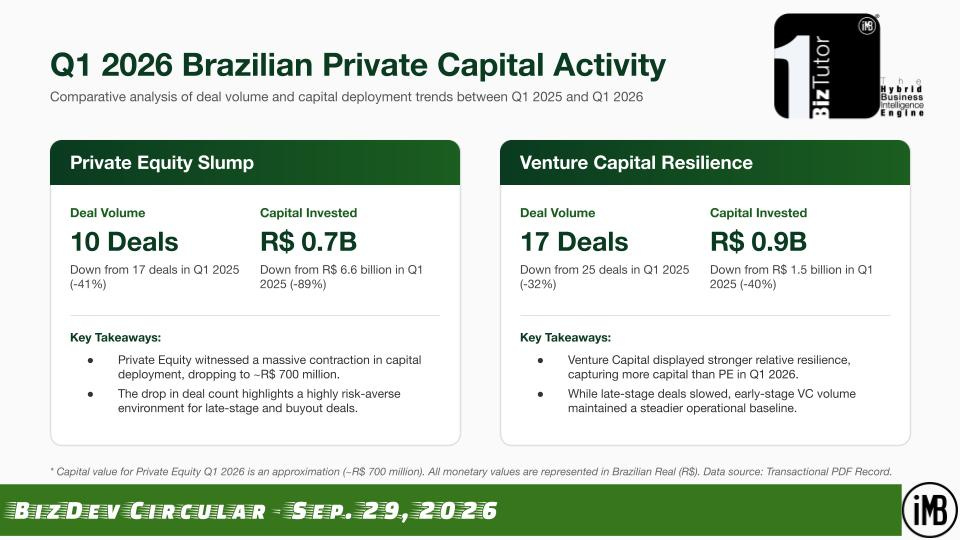
*Note: Private equity valuation comparisons are distorted by undisclosed transaction terms; only three Q1 2026 PE deals published public valuations.
The 2% Selic Hangover: How Cheap Capital Trapped Brazilian Private Equity
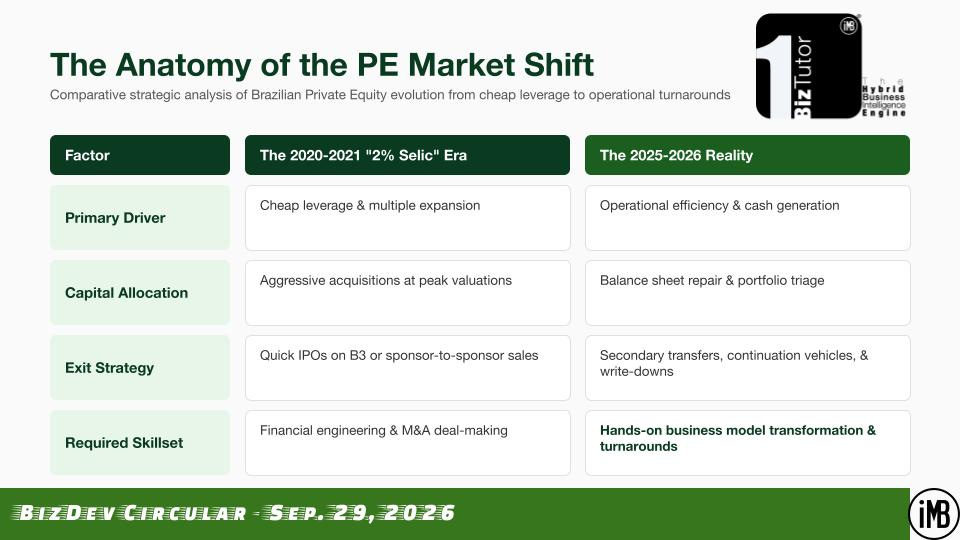
The current paralysis in Brazilian private equity is not merely a reaction to today’s high interest rates—it is the structural hangover of the 2020–2021 “2% Selic era.” Unprecedented monetary easing inflated asset valuations without building real-economy productivity, leaving fund managers holding overvalued companies with limited operational tools to turn them around.
1. The Monetary Mirage: Financial Inflation Over Real CAPEX
During the COVID-19 pandemic, the Ministry of Economy under Paulo Guedes and the Central Bank led by Roberto Campos Neto slashed the benchmark Selic rate to a historical floor of 2.0%. The policy intent was to stimulate domestic credit and corporate investment.
In practice, cheap liquidity did not translate into long-term fixed asset investments or structural productivity gains. Instead, capital flowed into financial assets, triggering sharp valuation inflation across public equities and private markets:
Distorted Multiples: Private equity (PE) and venture capital (VC) funds raised record local capital. Flush with liquidity, managers bid up company valuations to peak earnings multiples.
FOMO-Driven Dealmaking: With debt virtually free, GPs acquired targets across retail, tech, and consumer sectors under the assumption that low rates and multiple expansion would persist indefinitely.
Delayed Inflationary Reality: As cheap money made its way through the economy, broad inflation accelerated—forcing the Central Bank into one of the fastest rate-hiking cycles in Brazilian history, driving the Selic back into double digits (reaching 13.75% to over 14% in subsequent cycles).
2. The Valuation Trap: Stuck in High-Multiple Assets
When interest rates normalized, the financial engineering models that justified 2020–2021 deal prices collapsed.
Negative Financial Leverage: Companies acquired with high leverage now face crushing debt-servicing costs, consuming operational cash flow just to cover interest payments.
Multiple Contraction: Exit multiples have compressed across Latin America. However, fund managers cannot sell portfolio companies at current market prices without taking severe write-downs that would wipe out performance fees (carried interest) and hurt fund returns.
The Exit Bottleneck: The average holding period for Brazilian private equity assets has doubled to 5.6 years. Funds are deploying capital selectively while returning virtually no liquidity to Limited Partners (LPs), creating systemic market inertia.
3. The Capability Deficit: Financial Engineering vs. Operational Turnaround
The core bottleneck facing Brazilian PE managers today is operational execution.
Historically, the Brazilian PE ecosystem has been dominated by professionals with backgrounds in investment banking, M&A, and corporate finance. Their playbook relied heavily on:
Financial restructuring and tax optimization.
Buy-and-build strategies financed by cheap debt.
Multiple expansion upon exit via IPO or trade sales.
In an environment of sticky inflation and high borrowing costs, value creation requires deep operational transformation—re-engineering supply chains, restructuring business models, optimizing working capital, and driving organic margin expansion.
Because many local fund managers lack internal operational task forces or restructuring expertise, they are caught in a state of paralysis:
Unable to exit at 2021 valuations, yet lacking the hands-on operational capability to improve bottom-line performance.
The Four Headwinds Stalling Deal Flow
1. The Exit Bottleneck
The core issue facing fund managers isn’t a lack of deal opportunities—it’s an inability to sell existing holdings. High global interest rates have depressed corporate valuations, leaving fund managers reluctant to divest aged portfolio assets at discounted prices. Without asset sales to return liquidity to Limited Partners (LPs), managers lack room to deploy fresh capital.
2. Sticky Selic Rates & Weak Stock Market
Expectations for aggressive interest rate cuts by the Central Bank of Brazil (Selic) in 2026 have slowed. Concurrently, the domestic stock exchange (B3) is recovering too gradually to offer a viable initial public offering (IPO) exit window for portfolio companies.
3. Pre-Election Hesitation
The upcoming October 2026 presidential election has induced a standard “wait-and-see” posture across institutional capital. Investors are holding off on large-scale commitments until there is explicit clarity regarding the next administration’s economic platform and fiscal policy direction.
4. Portfolio Housekeeping over New Deals
Faced with elevated leverage costs, fund managers are turning inward. Rather than sourcing new transactions, teams are allocating bandwidth to address debt issues and stabilize cash flow within existing portfolio companies before bringing them to market.
Outlook: Horizon Shifts to 2027
With limited visibility for steep Selic cuts or widespread IPO revivals over the next 12 months, sector executives expect deal activity to remain subdued through late 2026. A meaningful rebound in private capital deployment is increasingly projected for 2027, contingent on post-election policy clarity and a lower interest rate environment.
This structural inertia is forcing a shakeout in the Brazilian private capital landscape. The next cycle will belong to operators (interim managers/managers on-demand), distressed asset specialists, and turnaround funds capable of extracting real productivity from companies bought during the cheap-money boom.—Frank P. Neuhaus for iMB.Solutions Ltda., São Paulo, Brazil
About the writer: Frank P. Neuhaus is one of the founding partners of iMB.Solutions Ltda., São Paulo, Brazil. To date, he has already founded three start-ups and is also active as a seed investor. He worked for European companies in Europe (Germany, Spain), Southeast Asia, China and Latin America, including Brazil. He studied mechanical engineer with majors in hydrodynamics and industrial plant engineering. Furthermore, he studied international business management. He also holds an International Executive MBA with a focus on Brand and Service Management. As a result of the steady increase in project content related to automation and digitization, Mr. Neuhaus has completed advanced studies as a Certified Digital Engineer. Since a couple of years, Frank P. Neuhaus executes international business development and reorganization projects missions.
Thanks for reading BizDev Circular! This post is public so feel free to share it.


Available for iOS and Android
Start writing today. Use the button below to create a Substack of your own