Executive Summary
The agricultural relationship between Brazil and the European Union (EU) is defined by a profound “Pesticide Paradox” and a clash of regulatory philosophies. While the EU often cites Brazilian pesticide use as a barrier to trade, the industrial reality reveals a circular dependency: major European conglomerates manufacture and profit from the very chemicals used in Brazil.
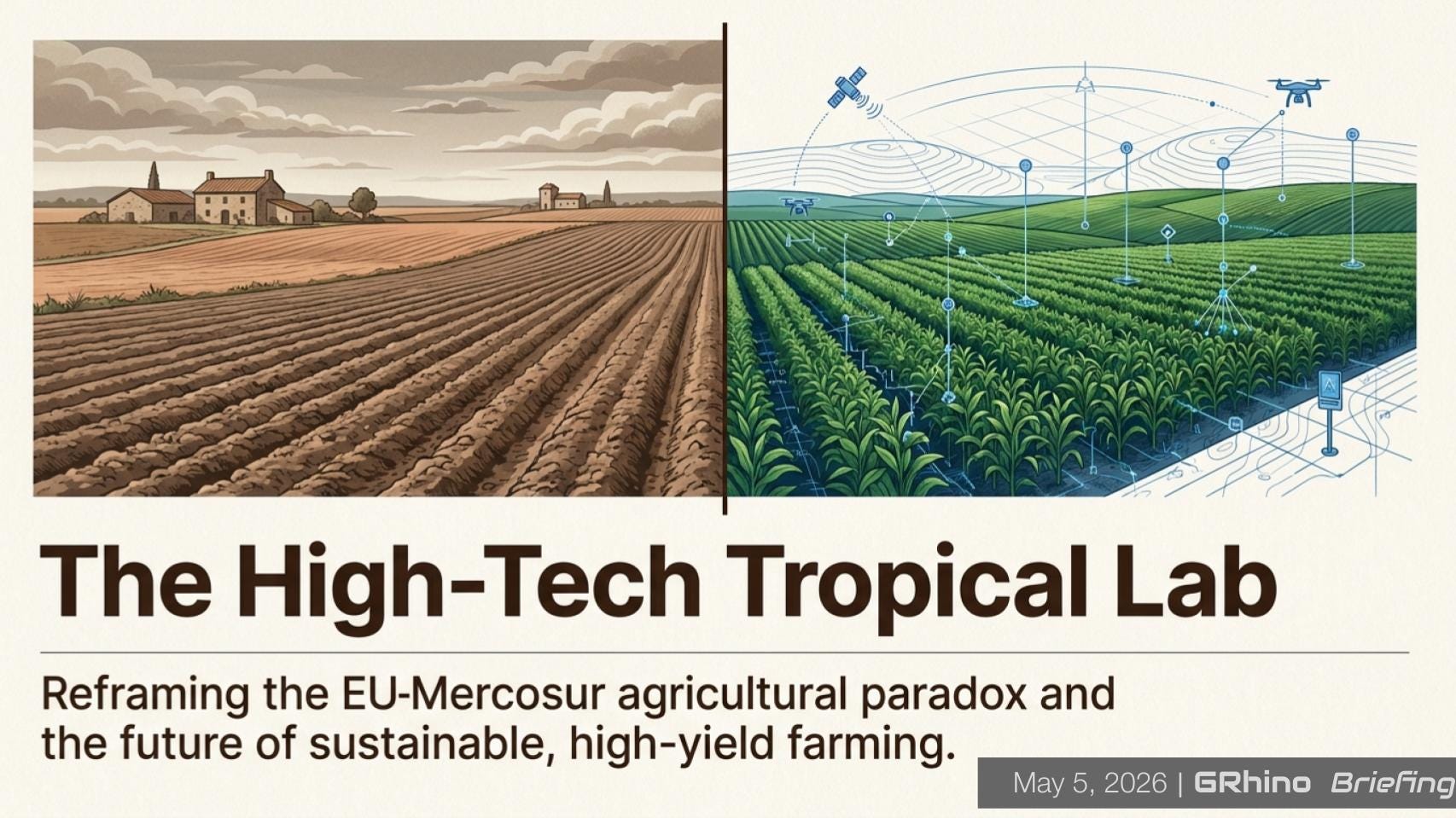
Brazil has transitioned into a “High-Tech Tropical Lab,” driven by the Brazilian Agricultural Research Corporation (Embrapa). This shift has enabled Brazil to pioneer “Tropical Agriculture,” characterized by high-efficiency soil transformation, global leadership in no-till farming, and a rapid adoption of biotechnology and biologicals that outpaces the EU’s precautionary approach. While Brazil faces ongoing challenges regarding illegal deforestation, its industrialized agricultural core is among the world’s most technologically advanced, utilizing a model of “vertical” growth that prioritizes high yields per hectare over land expansion.
--------------------------------------------------------------------------------
1. The Pesticide Paradox: Production and Consumption Dynamics
The debate over the EU-Mercosur agreement frequently centers on pesticide use, yet the source context identifies a complex industrial interdependence that complicates this narrative.
Geopolitical Tension in Manufacturing: A significant portion of the active ingredients used in Brazilian agriculture is developed and produced by major European chemical conglomerates. This creates a scenario where the EU benefits economically from the sale of these chemicals while simultaneously using their application as a justification for trade restrictions.
Volume vs. Efficiency Metrics: Although Brazil is a high-volume consumer of pesticides, this is largely a function of its status as a tropical producer capable of two to three harvests per year. When measured by production per hectare or per ton of food, Brazil’s pesticide intensity is comparable to, or even lower than, several EU member states.
--------------------------------------------------------------------------------
2. Tropical Agricultural Research and Soil Innovation
Brazil’s agricultural success is rooted in the work of the Brazilian Agricultural Research Corporation (Embrapa), which moved away from temperate-zone techniques to develop a specialized “Tropical Agriculture” model.
Soil Transformation: Embrapa developed methods for “precise liming and fertilization” to transform the acidic, nutrient-poor soils of the Cerrado (savannah) into some of the most productive land in the world.
No-Till Agriculture: Brazil leads the world in no-till farming, a method where crops are planted directly into the residue of previous harvests. This technique offers three primary environmental benefits:
Carbon Sequestration: Keeping carbon in the soil rather than releasing it through plowing.
Erosion Prevention: Protecting the soil structure.
Moisture Retention: Maintaining soil hydration more effectively than traditional European plowing methods.
--------------------------------------------------------------------------------
3. Biotechnology and Climate Resilience
While the EU maintains a restrictive “precautionary principle” regarding Genetically Modified Organisms (GMOs) and New Genomic Techniques (NGTs), Brazil has embraced biotechnology as a tool for efficiency and environmental mitigation.
Climate Adaptation: Brazilian seed technology prioritizes drought resistance and heat tolerance, which are critical for maintaining yields in a changing climate.
Operational Efficiency: Biotech crops allow for the “second harvest” (safrinha), maximizing the productivity of a single plot of land within one year. Additionally, these crops often require fewer machinery passes, leading to reduced fuel consumption.
--------------------------------------------------------------------------------
4. The Rise of “Biologicals” and Organic Inputs
One of the most significant modern shifts in Brazilian agriculture is the rapid movement toward biological alternatives to traditional chemicals.
Biopesticides: The Brazilian market for biopesticides—utilizing fungi, bacteria, and insects—is expanding at double-digit rates, significantly faster than the global average.
Bio-Inputs (Inoculants): The use of nitrogen-fixing bacteria (inoculants) in soybean farming has drastically reduced the need for synthetic nitrogen fertilizers. This is a critical development because synthetic fertilizers remain a primary source of greenhouse gas emissions in European agricultural models.
--------------------------------------------------------------------------------
5. Comparative Analysis: Brazil vs. the European Union
The following table synthesizes the diverging approaches to sustainability and agricultural management between the two regions:
Land Conservation
Brazil (Modern Tropical Model): Strict Forest Code requires farmers to preserve 20% to 80% of native vegetation on private property.
European Union (Traditional Model): Native forests were largely cleared centuries ago; “greenery” is mostly managed parkland with weak conservation mandates for farmers.
Productivity Model
Brazil (Modern Tropical Model): High-tech, large-scale efficiency focused on “vertical” growth (increasing yield on existing land).
European Union (Traditional Model): Relies heavily on Common Agricultural Policy (CAP) subsidies to sustain smaller, less efficient traditional farms.
Innovation Pace
Brazil (Modern Tropical Model): Rapid adoption of AgTech, drones, biologicals, and GMOs.
European Union (Traditional Model): Highly regulated and slower to adopt New Genomic Techniques (NGTs).
Machinery Trends
Brazil (Modern Tropical Model): Increasing use of electric vehicles (EVs) in agricultural operations.
European Union (Traditional Model): Continued reliance on traditional mechanical standards.
--------------------------------------------------------------------------------
Conclusion: Philosophical Divergence
The friction between the EU and Mercosur is not merely about environmental standards, but a clash of fundamental philosophies: the EU’s “precautionary principle” versus Brazil’s “innovation-driven productivity.” Brazil operates as a high-tech laboratory for tropical farming, emphasizing efficiency and biological innovation. While enforcement of environmental laws and illegal deforestation remain critical issues, the industrialized core of Brazilian agriculture represents a highly advanced, technologically dense sector that challenges traditional European farming paradigms.