Executive Summary:
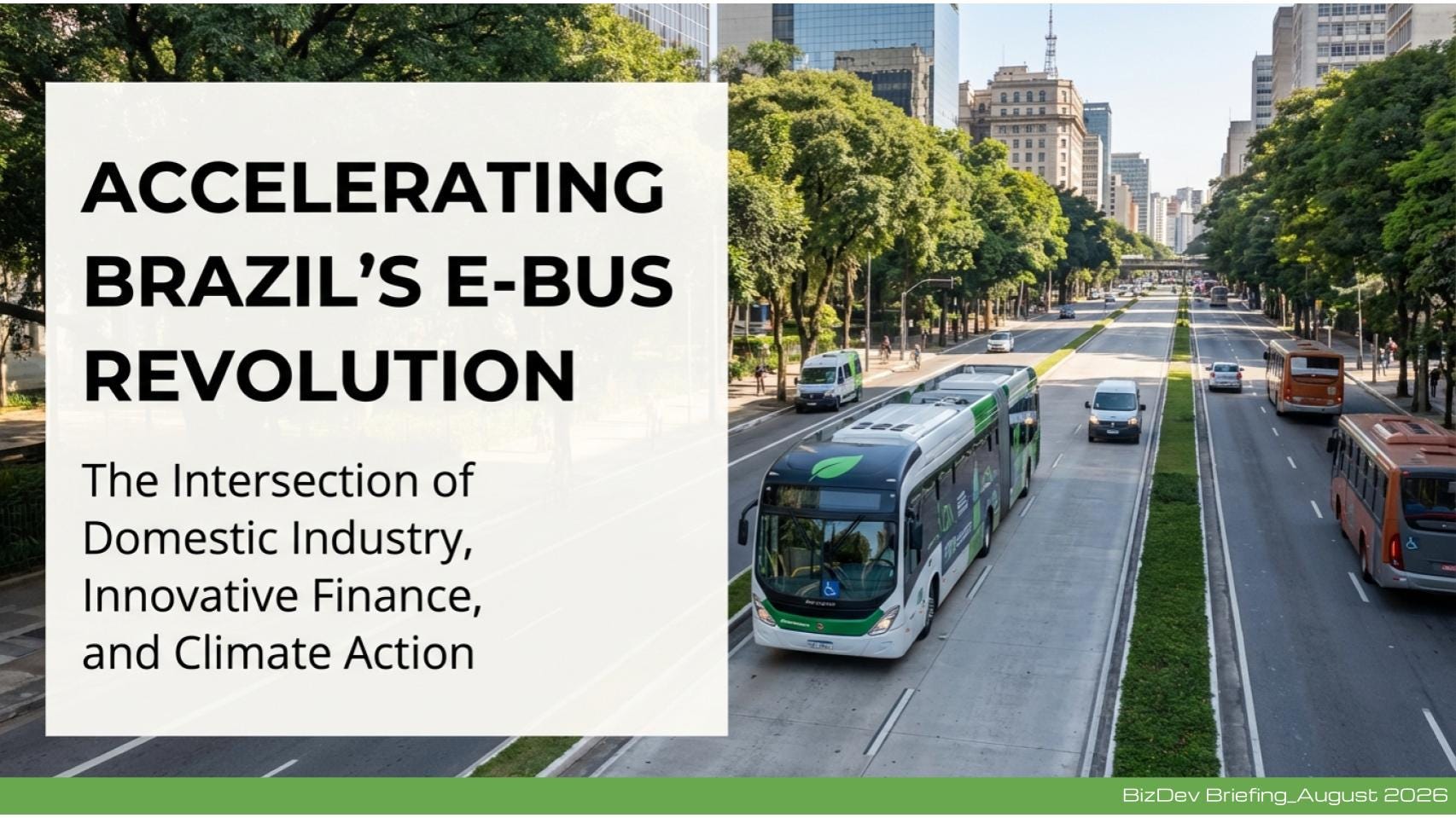
The slide deck “Brazil’s E-Bus Revolution” outlines the commercial and industrial scaling of the Brazilian electric commercial vehicle sector, which is projected to reach a market valuation of USD 1.666 billion by 2030 at a 30.04% CAGR.
For business development leaders, Tier 1 suppliers, and infrastructure developers, Brazil represents a high-barrier, high-reward ecosystem.
The market is driven by municipal decarbonization mandates targeting the replacement of over 14,000 diesel buses by 2030, underpinned by unique local-content financing structures and risk-mitigating public subventions.
Key Business Development Opportunities & Market Dynamics:
Supply Chain Localization (The BNDES Requirement): To access highly favorable financing (interest rates around 4%) through the Brazilian Development Bank (BNDES) Finame program, manufacturers must meet strict local content Accreditation Indices, which were recently adjusted to a 30% baseline. Domestic market leader Eletra (which holds a 65% national market share) achieves a nationalization rate exceeding 90% by integrating WEG electric powertrains with Mercedes-Benz and Scania chassis. For global component manufacturers, the most viable market entry strategy is establishing local production in the Greater São Paulo/ABC region to become a Tier 1 supplier to these established integrators.
Capitalizing on the “Partial Subvention” Model: The city of São Paulo has surpassed 1,000 zero-emission buses in its fleet, driven by an innovative “partial subvention” financial model. Instead of operators bearing the heavy upfront capital expenditure (CAPEX) of an electric bus, the municipal government directly subsidizes the price premium over a standard diesel bus. For B2B sales and business development, this model guarantees massive, predictable procurement volumes from private operators whose financial risks have been neutralized by the city.
Infrastructure and Fleet Management Projects: The transition requires massive grid and depot upgrades. Opportunities are surging for companies offering megawatt-scale charging systems, intelligent energy management software (EMS), and microgrid technologies. Furthermore, a newly launched EUR 80 million Brazil E-Bus Credit Enhancement Fund aims to mobilize EUR 450 million in private lending to introduce over 1,700 electric vehicles and associated charging infrastructure by 2030.
OEM Expansion and Greenfield Investments: Global giants are actively localizing to capture market share. Business developers can target procurement contracts at BYD’s new R$ 5.5 billion manufacturing complex in Camaçari, Bahia, which aims to produce electric bus chassis domestically. Similarly, Volvo Buses has centralized the production of its BZRT electric articulated and bi-articulated chassis at its Curitiba plant, recently supplying a fleet of 28-meter, 250-passenger bi-articulated buses for Goiânia’s BRT corridors.
Disclaimer
This PDF slide deck was created based on our project regarding the market entry into Brazil for a European engineering and service provider in the mobility industry. We have previously published a case study, a summary of the market feasibility study, and a podcast on this topic on the iMB.Solutions website. If you would like to learn more, please visit the “Insights” section of our website.
This slide deck was prepared and published here following consultation with and approval by our client.

Bizdev Briefing Brazil’s E Bus Revolution
2.47MB ∙ PDF file
Brazil isn't just importing electric buses—it is aggressively building a sovereign, localized supply chain. The country is targeting the replacement of 14,000 diesel buses by 2030, and the procurement floodgates are officially open. If you are a Tier 1 component supplier, an infrastructure developer, or an e-mobility investor, our newly generated slide deck "Brazil’s E-Bus Revolution" breaks down the exact B2B entry points you need to know. Key takeaways for Business Development: 🏭 The Local Moat: How BNDES "Finame" local-content rules are forcing global OEMs to build domestic supply chains—and how Tier 1 suppliers can plug in. 🤝 The Integrator Advantage: Why domestic manufacturer Eletra holds a 65% market share by partnering with WEG, Mercedes-Benz, and Scania. 💰 De-risked Procurement: How São Paulo’s brilliant "partial subvention" model covers the CAPEX premium for private operators, unlocking massive guaranteed fleet orders. Ready to position your business in the ABC industrial region?
Thanks for reading BizDev Circular! This post is public so feel free to share it.

Available for iOS and Android
Start writing today. Use the button below to create a Substack of your own