



AI: From Buzzword to Bottom-Line Reality – Why Most Companies Are Still Missing the Mark

Implementing AI in a company today is no longer a competitive advantage — it’s a basic necessity. Nearly every organization has access to powerful tools like ChatGPT, Google Gemini, or Microsoft Copilot. But turning AI into a true edge over competitors requires something far more strategic: structuring your internal data, deeply understanding it, and deliberately applying AI to it. Without that foundation, AI remains a flashy gadget rather than a transformative force.
The Danger of Undefined Goals
If leadership doesn’t have a clear vision of what they want to achieve with AI, the results will rarely move the needle on company performance or profitability.
In the current landscape, it remains far easier for organizations to use AI to cut costs than to drive revenue growth. This asymmetry highlights a critical gap in strategic adoption.
A major perception problem compounds the issue. When clients or stakeholders see AI as little more than “Control + C and a clever prompt,” interest fades quickly. Companies that position AI — or claim it as their product’s core differentiator — risk commoditizing the technology. Large language models (LLMs) have become widely accessible commodities. The real differentiator lies in how organizations integrate them into proprietary processes and data ecosystems.
C-Suite Executives Reclaiming the Wheel
A recent survey by Afferolab (a corporate education platform) in partnership with Tera (a technology education platform) reveals striking shifts in leadership behavior. The study polled 43,000 professionals across topics including organizational behavior, automation, ROI, and AI maturity.
Key finding:
25% of directors and C-level executives reported they had stopped delegating tasks in the past 180 days, stating that “with AI, they could do it faster themselves.”
Rather than using AI to redesign workflows and empower teams, many leaders are centralizing execution. This reflects the relatively low level of AI maturity. C-level executives often treat AI like a highly capable “secretary” — generating analyses and creating presentations. While not inherently wrong, this approach falls short for senior roles. As the survey notes, a CEO’s responsibility is to shift mindsets and organizational culture, not merely boost personal output. Using AI this way risks executives operating like advanced junior staff, replicating tasks their teams already handle.
Usage Patterns Reveal Shallow Adoption
The survey provides a detailed snapshot of how professionals are currently using AI:
87.5% use it for text generation
67.1% for data analysis
63.4% for strategic decision-making support
57.5% for image generation
However, only 37.8% leverage AI to automate repetitive tasks. This suggests heavy reliance on AI as a personal productivity booster rather than a systemic operational tool. Alessandra (from the research team) observes that companies are still treating AI primarily as an efficiency hack without embedding it into core workflows.
Middle management faces parallel challenges. 69% admit to using AI for tasks that could be delegated to their teams. Of these, 49.6% do so “sometimes” and 19.4% “frequently.” Only 6.7% operate at a more advanced level — actively delegating while training teams on AI. A significant barrier here is fear of replacement by automation.
Overlooking AI’s Greatest Potential
In this environment, leaders are missing AI’s highest-value applications: designing new workflows, enhancing decision-making frameworks, and orchestrating complex systems. The organizational model needs evolution, but transformation is inherently slow. It requires training across levels and stages, not a one-time initiative.
The data underscores the immaturity: Of the 73.9% of professionals who use AI tools, only 0.1% have reached the “superoperator” level — indicating sophisticated, integrated mastery.
Platform usage remains heavily concentrated:
97.4% use ChatGPT
81.5% use Google Gemini
52.7% use Microsoft Copilot
This dominance highlights both the accessibility of foundational tools and the limited exploration of broader AI applications in the workplace.
The Path Forward
AI should not be viewed solely as “menial labor” support. The technology’s power lies in enabling entirely new ways of working across all roles — from the C-suite to frontline teams. For Brazilian companies (and organizations in similar maturity stages globally), the message is clear: Stop using AI to simply do old tasks faster. Start using it to reimagine how work gets done.
Leaders who invest in data infrastructure, strategic goal-setting, comprehensive training, and workflow redesign will separate themselves from the pack. Those who continue treating AI as a personal shortcut or commodity tool risk falling behind — or worse, becoming obsolete in a rapidly evolving competitive landscape.
The survey serves as both a warning and a roadmap. AI adoption is accelerating, but true competitive advantage belongs to those who move beyond prompts and personal productivity toward organizational transformation.
What’s your organization’s AI maturity level? Are you using it to cut costs, or to fundamentally reshape how you create value? Share your thoughts in the comments or reply to this newsletter — the conversation is just beginning.
Cryptocurrencies and the Global Financial System: Threat, Opportunity, or Both? A Balanced Analysis (June 2026)

Ever since Bitcoin’s launch, the question has persisted: To what extent do cryptocurrencies benefit the international financial system? While proponents hail them as tools of financial freedom and innovation, monetary authorities in major economies see them primarily as a threat. This tension continues to shape global policy and market behavior.
Central Banks Sound the Alarm
At the recent IMF spring meeting, European Central Bank President Christine Lagarde openly denounced cryptocurrencies as “a threat to stability when they become more integrated into the international financial system.” Her primary concern is clear: as private-sector assets operating outside central bank control, cryptocurrencies erode the effectiveness of traditional monetary policy.
When crypto assets begin functioning more like money — especially as a means of payment — central banks lose precision in controlling the money supply and fighting inflation.
This raises fundamental questions:
How will interest rates behave?
What happens to sovereign bond issuance and fiscal policy?
The more widespread crypto becomes, the harder it is for central banks to steer economies.
Beyond Monetary Policy: Crime and Illicit Finance
The risks extend further. Because cryptocurrencies operate beyond direct government oversight, they have become vehicles for money laundering, drug trafficking, tax evasion, and other criminal activities. Critics argue they fuel organized crime and parallel power structures that undermine legitimate institutions.
In response, several countries are developing Central Bank Digital Currencies (CBDCs). Brazil’s Drex is one such project. However, these official digital assets face a core contradiction: they aim to offer some anonymity (like crypto) while simultaneously combating the very crimes anonymity enables.
Without breaching user confidentiality, their effectiveness against illicit finance remains questionable. If privacy is sacrificed, they may fail to achieve broad adoption.
Bitcoin’s Eternal Paradox
Bitcoin embodies a fascinating contradiction. Designed as decentralized “electronic money” free from government control, it paradoxically requires endorsement from financial institutions and regulators to gain mainstream relevance and price stability. Without institutional acceptance, its momentum fades.
Experts note that Bitcoin does not yet meet the economic, political, and institutional conditions to serve as a true global currency or classical store of value (comparable to gold or highly liquid government bonds). It remains anchored primarily in speculative price expectations rather than deep institutional backing.
Cryptocurrencies are here to stay and will grow in importance in the global economy. However, to claim that these assets are the new form of global money or that they will be the primary store of value… has no basis in reality.
Bitcoin attracts institutional investors amid favorable liquidity conditions, geopolitical uncertainty, widespread distrust in traditional institutions, rising inequality, and dissatisfaction with the current financial system. Yet its price behavior often reflects speculative cycles more than structural monetary transformation.
Bitcoin as “Technocratic Utopia”
The cryptocurrency narrative promotes a vision of apolitical, neutral money enabled by technology. In reality, money in complex economies is inherently a political institution that organizes power relations.
Bitcoin’s ideology — celebrating early adopters, technological meritocracy, and market neutrality — is itself a deeply ideological and political project disguised as technical innovation.
The El Salvador experiment provides a real-world test. After adopting Bitcoin as legal tender, the country faced low adoption rates, increased macroeconomic vulnerability to Bitcoin’s volatility, and eventual reversal of the policy in 2025. The case illustrates that even national-level adoption struggles to overcome practical and stability challenges.
Current Market Reality (Mid-2026)
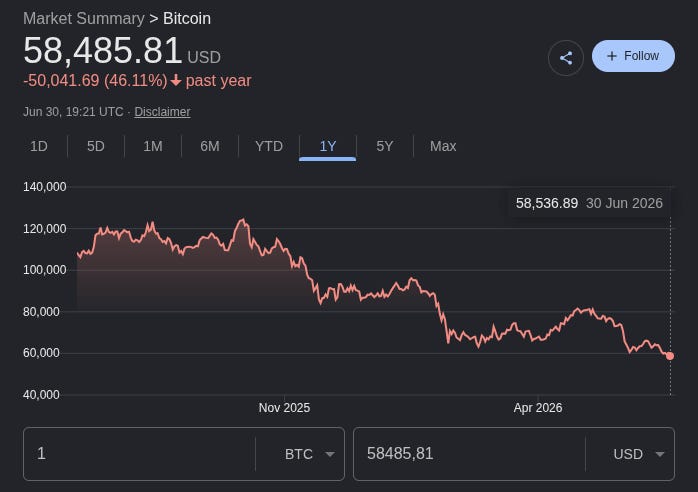
Despite periodic relief rallies — such as the ~4% gain following the US-Iran ceasefire announcement — Bitcoin remains roughly 50% below its all-time high of $126,000 reached in October 2025. Several factors weigh on sentiment:
Significant net outflows from Bitcoin ETFs (US$ 4.5 billion in May-June).
Long-term investors reducing holdings by approximately 373,000 BTC between July 2025 and Q1 2026.
Corporate treasury losses: Companies holding Bitcoin as a reserve asset saw massive markdowns, with notable impacts on Brazilian-listed OranjeBTC (down 75% since IPO) and US-based Strategy (MSTR).
Investors are rotating toward safer assets like gold amid geopolitical risks, elevated oil prices, persistent inflation concerns, and the allure of artificial intelligence-related opportunities. The US$ 60,000 level has emerged as important structural support (breached on Jun. 30, 2026), with some analysts suggesting the correction cycle may be nearing its end.
The Way Forward: Regulation Over Prohibition
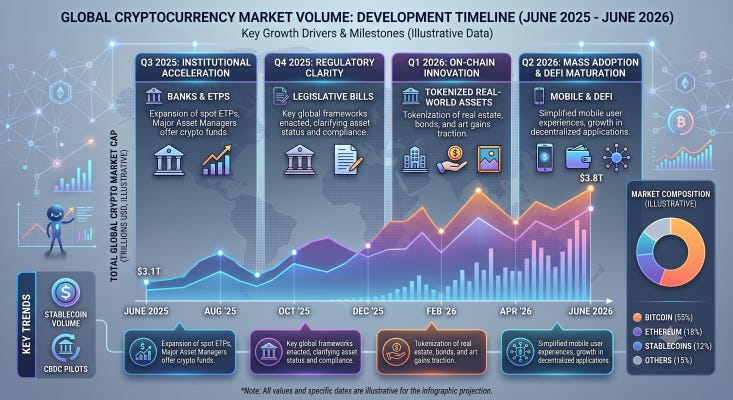
Banning cryptocurrencies outright (now numbering over 16,000 with a combined market value exceeding $3.1 trillion) appears impractical — especially as high-profile figures, including former President Donald Trump, launch their own tokens.
Lagarde and others advocate for coordinated global regulation as the most pragmatic path. The goal should be mitigating systemic risks and criminal misuse while preserving innovation and legitimate use cases.
Final Thoughts
Cryptocurrencies bring real benefits — faster cross-border payments, financial inclusion for the unbanked, and technological innovation — but they also introduce genuine risks to monetary sovereignty, stability, and governance. They are unlikely to replace the existing financial architecture but will likely coexist and evolve within a regulated framework.
The future of crypto will depend less on ideology and more on how successfully regulators, institutions, and innovators can reconcile decentralization with stability and accountability.
What are your thoughts on the role of cryptocurrencies in the global financial system? Do you see Bitcoin maturing into a reliable reserve asset, or will it remain primarily speculative? Share your perspective in the comments or reply to this edition.
São Paulo’s Startup Ecosystem: The Hidden Tech Powerhouse the World Is About to Discover

The startup ecosystem in São Paulo is exceptionally vibrant — and it’s time the rest of the world took notice.
International business visitors arriving at iMB.Solutions often express genuine surprise at the depth, sophistication, and energy of Brazil’s technology scene. While many still picture Brazil primarily through the lens of its famous beaches and natural beauty, a new narrative is rapidly taking shape:
São Paulo is emerging as one of the world’s most dynamic hubs for innovation and entrepreneurship.
Beyond Carnival: Brazil’s Tech Awakening
São Paulo stands at the center of Brazil’s thriving startup ecosystem. As the country’s largest economic engine, it concentrates talent, capital, infrastructure, and ambition like few other cities in Latin America. Yet globally, awareness remains surprisingly low.
This perception gap represents both a challenge and a massive opportunity. Changing the story — from “beautiful beaches and lush nature” to “the birthplace of the world’s next breakthrough technologies” — is the next strategic chapter for São Paulo and the entire Brazilian startup community.
And this shift is already underway.
A Brazilian Flag Flying High in North America
One standout Brazilian startup sector is currently making waves by expanding into North America and establishing strong roots there. This move is expected to serve as a powerful catalyst — opening eyes across the United States and Canada to the quality and ambition of Brazilian innovation.
The timing couldn’t be better. In the financial sector, American and Canadian companies have traditionally felt secure in their technological leadership. That confidence is about to be tested.
Latin America’s Fintech Leadership
The world is on the verge of realizing that some of the most advanced fintech solutions are coming out of Latin America. From pioneering open banking initiatives in Uruguay to cutting-edge innovations emerging from Brazil, the region is proving itself as a fertile ground for financial technology.
São Paulo, in particular, is well-positioned to lead this charge. With a massive domestic market, young and tech-savvy population, regulatory progress, and increasing access to global capital, the conditions are ripe for Brazilian startups to scale regionally and internationally.
Why This Matters Now
The global tech narrative has long been dominated by Silicon Valley, Europe, and parts of Asia. However, the next wave of innovation will be more geographically diverse. Brazil’s combination of large-scale challenges and creative problem-solving is producing solutions with genuine global relevance — especially in fintech, but increasingly across other high-potential sectors.
For international investors, partners, and corporations, the message is clear: it’s time to look south. The talent is here. The ambition is here. The technologies that will shape the future are being built here.
The Brazilian ecosystem is no longer just surviving — it is ready to thrive on the global stage.
As São Paulo and Brazil continue to build momentum, expect to see more homegrown unicorns, strategic international expansions, and groundbreaking solutions that challenge conventional wisdom about where great technology comes from.
The next chapter is being written right now — in Portuguese, with a Brazilian accent, and with global ambitions.
Are you already engaging with the Brazilian tech ecosystem, or is this the first time you’re hearing about São Paulo’s rise as a startup powerhouse? Share your thoughts below or reply to this newsletter. The future of innovation is more distributed than ever — and Latin America is ready to play a much bigger role.
Iguatemi Scales Back Its Digital Marketplace: A Strategic Pivot in Brazil’s Luxury Retail Sector
Digital Platform Helps Foreign Brands Test the Local Market

In a notable shift for Brazilian retail, Iguatemi — one of the country’s largest shopping mall operators — has significantly reduced the number of brands on its digital platform, Iguatemi 365. Once an ambitious virtual mall, the platform now operates with fewer than 10% of the brands it carried at its peak. This move reflects broader challenges in e-commerce profitability and a renewed industry focus on physical retail experiences.
The Rise and Recalibration of Iguatemi 365
Launched in 2019, Iguatemi 365 was designed as a sophisticated marketplace. The goal was to extend the reach of the group’s luxury brands — including names like Gucci and Tiffany — to consumers across Brazil, even in cities without physical Iguatemi stores. The concept gained strong traction during the pandemic, attracting numerous brands eager to expand their digital footprint.
However, reality proved more complex than the vision. High technology and logistics costs, combined with a surge in unprofitable listings, prevented the platform from achieving sustainable profits. What began as an exciting growth opportunity quickly turned into a resource-intensive operation.
Major Overhaul: From 550 to 35 Brands
Significant changes started in 2023. The company reduced participating retailers from 550 to around 100 and outsourced platform operations, resulting in more than 100 layoffs. A further round of cuts has now brought the number of active brands down to approximately 35.
This is not merely cost-cutting. It represents a deliberate strategic redesign. Iguatemi 365 is transitioning away from being a broad “virtual mall” competing directly with e-commerce giants like Amazon. Instead, it is evolving into a more curated platform focused on:
Brands directly managed or curated by Iguatemi
Foreign retailers seeking to test the Brazilian market before committing to physical store openings
This curation approach allows the platform to maintain a premium positioning while reducing operational complexity and improving profitability prospects.
A Wider Industry Trend
Iguatemi is not alone in this retreat from digital marketplaces. Most major shopping mall operators in Brazil have reversed course on their online ambitions. A prominent example is Delivery Center, a joint venture between Multiplan and BrMalls, which was discontinued in 2021.
The broader lesson is clear: while the pandemic accelerated e-commerce adoption, many traditional retail players have struggled to achieve profitability in direct online competition with specialized giants.
Physical retail spaces — with their experiential, social, and sensory advantages — remain core to luxury and premium consumer behavior in Brazil.
Strategic Implications
For foreign brands, the repositioned Iguatemi 365 offers a lower-risk entry point into the Brazilian market. It serves as a sophisticated testing ground to gauge demand, build brand awareness, and refine local strategies before making larger investments in brick-and-mortar locations.
For Iguatemi, the move protects margins, preserves brand prestige, and allows the company to focus resources on what it does best: operating high-quality physical shopping destinations while selectively supporting digital extensions.
The Future of Luxury Retail in Brazil
This strategic pivot highlights the maturing Brazilian retail landscape. Success increasingly depends on hybrid models that intelligently combine the strengths of physical presence with targeted digital initiatives — rather than attempting to replicate full-scale e-commerce operations.
As Iguatemi refines its digital strategy, it signals a more realistic and sustainable path for traditional retailers navigating the post-pandemic era.
What’s your take? Will hybrid models like the new Iguatemi 365 become the standard for luxury brands entering emerging markets, or do you see further consolidation in retail e-commerce ahead? Share your thoughts in the comments or reply to this newsletter.
Stay informed on the evolving Brazilian retail and luxury market. The intersection of physical and digital commerce continues to offer both challenges and opportunities for brands and investors alike.
Thanks for reading CyberSynth Circular! This post is public so feel free to share it.
WE
We’re an agile team of independent consulting and project experts based in São Paulo, Brazil, specializing in cutting-edge technologies like blockchain 2.0, smart contracts, and generative AI. Our diverse team includes forward-thinking specialists in blockchain development, smart contract architecture, dApp design, and GenAI algorithms for OT. Committed to innovation, we thrive in São Paulo’s vibrant tech and entrepreneurial ecosystem. What sets us apart is our passion for applying emerging tech to solve complex challenges and drive meaningful change. Whether it’s decentralized solutions, smart contract optimization, or creative use of generative AI, we approach each project with creativity and expertise. Collaboration is central to our ethos—we blend diverse skills to deliver tailored solutions that exceed expectations. Seeking innovative solutions at the intersection of blockchain, smart contracts, and generative AI? Let’s connect and shape the future together, one project at a time. We are the tech arm of iMB.Solutions if it comes to digitization, generative AI and smart contract project missions.


Available for iOS and Android
Start writing today. Use the button below to create a Substack of your own