


The High Cost of Fast Thinking: Why Executive AI Summaries Are Killing Intellectual Depth
There is a growing realization quietly taking hold in boardrooms around the world: artificial intelligence cannot replace a human leader’s intellectual repertoire. While AI promised to give CEOs back valuable hours, it is now stealing time from where it matters most—the uninterrupted space required to read, synthesize, and truly grasp complex information.
At iMB.Solutions, we have observed a deeply concerning trend among international executives:
Full management reports are increasingly left unread, pushed directly into AI chatbots to produce neat, bite-sized summaries.
On paper, this looks like peak efficiency. In reality, it is the wholesale outsourcing of human thought.
As the adoption of generative and agentic AI accelerates, the exact opposite approach is needed.
Speed is a commodity; human curation of data and knowledge is becoming the ultimate competitive advantage.
The Death of Nuance in High-Stakes Environments
This loss of depth is particularly glaring in the financial markets, where economic data is frequently tangled with ideological agendas and rigid economic models.
An investment banker in São Paulo captured the core issue perfectly during a recent conversation with me in our gym:
“…While initially we lost only nuances of reality, we are currently losing the originality of arguments, profound lines of reasoning, and the ability to think in terms of scenarios detached from ideological bubbles. Our young colleagues are particularly affected, as they also believe the world and the economy operate according to the linearity of Excel spreadsheets…”
When decision-makers rely entirely on distilled summaries, they lose the edge cases, the quiet contradictions, and the non-linear realities that standard models fail to capture.
Heavy Lifting vs. True Understanding
To fix this, we must clearly define what AI can and cannot do:
What AI Does Best: Accelerates raw data collection, structures unstructured information, and identifies potential macro patterns. It performs the heavy lifting.
What Human Thought Requires: Synthesizing context, testing assumptions, spotting hidden contradictions, and giving strategic direction to ideas.
Articulating a fast answer is not the same as having developed an answer. A summary gives you facts, but only the process of reading and wrestling with details forms a genuine, defensible opinion.
The Remedy - A Return to Slow, Profound Reading
The solution is not to abandon technology or become a hermit surrounded by stacks of paper. It is about recognizing the exact boundary where speed takes over and devours necessary depth.
Reclaim Deep Reading: Set aside non-negotiable time to read foundational reports, research, and proposals in full.
Engage Outside Your Bubble: Actively seek out conversations with people whose perspectives challenge your default framework.
Allow Time for Reflection: Treat the gap between receiving information and making a decision as a strategic necessity, not wasted time.
Developing the Human Spark
If every executive relies on the same algorithms to synthesize the same data, everyone inevitably produces the same strategy. Originality vanishes, and the human spark of genius fades into algorithmic consensus.
In an era of rapid AI expansion, the time spent reading, reflecting, and forming an independent perspective is more valuable than ever. The mandate for modern leadership is clear: we must not only rediscover our capacity to curate information, we must dramatically elevate it.—Frank P. Neuhaus for CyberSynth Circular - powered by iMB.Solutions
Fedora vs. Zorin OS: The Ultimate Linux Desktop & Notebook Comparison
Choosing the right Linux distribution often comes down to a fundamental tradeoff: do you want the latest open-source innovations as soon as they are compiled, or do you want a polished, low-maintenance environment that feels instantly familiar?
Fedora Linux and Zorin OS represent two distinct philosophies within the desktop Linux ecosystem. Fedora, backed by Red Hat and IBM, acts as the cutting-edge testing ground for enterprise Linux technology, bringing modern standards like Wayland, PipeWire, and the newest GNOME desktops directly to users. Zorin OS, developed by Ireland-based Zorin Group, is built on top of Ubuntu LTS (Long Term Support) and focuses on user transition, aesthetic refinement, and out-of-the-box Windows application compatibility.
Technical Overview & Core Architecture
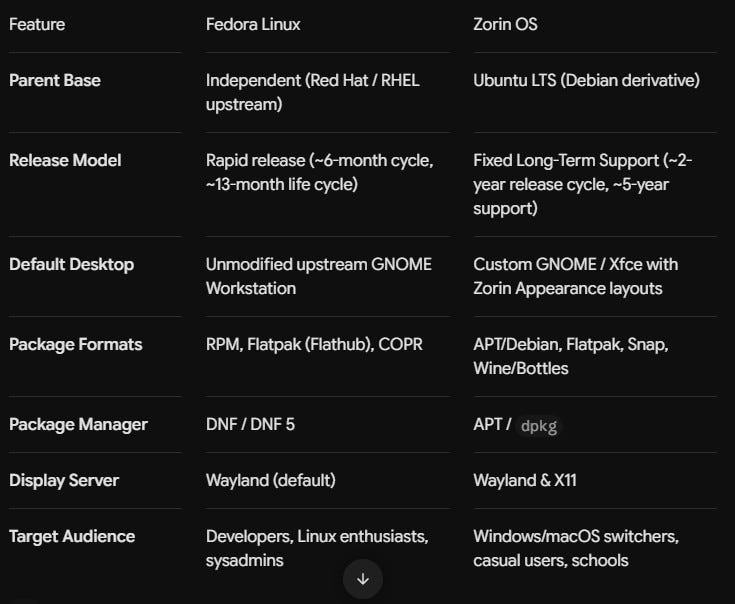
Pros and Cons Breakdown
Fedora Linux
Pros
Bleeding-Edge Kernel and Drivers: Fedora routinely ships with the latest stable Linux kernels and Mesa graphics drivers. This guarantees top-tier performance and hardware detection for newly released CPUs, GPUs, and wireless chipsets.
Pure Upstream Experience: Ships vanilla GNOME without heavy extensions or modifications, resulting in a lightweight, stable, and cohesive interface.
Modern Linux Standards First: Fedora pioneers foundational Linux technologies, including early adoption of PipeWire for low-latency audio, Btrfs with transparent compression, and Wayland by default.
Developer & Container Ecosystem: Unmatched out-of-the-box integration with tools like Podman, Flatpak, toolbx, and SELinux enterprise security.
Cons
Frequent System Upgrades Required: With a 13-month support lifecycle per version, users must upgrade their OS version roughly once a year.
Strict Free-Software Stance: Proprietary drivers (like NVIDIA) and non-free multimedia codecs are not included in default repositories, requiring users to manually enable RPM Fusion or third-party repositories.
Steeper Learning Curve: GNOME’s gesture-heavy, workflow-driven UI can feel jarring to users transitioning directly from traditional Windows taskbar layouts.
Zorin OS
Pros
Instant Familiarity: The Zorin Appearance tool lets users switch desktop layouts to resemble Windows 10/11, macOS, GNOME, or ChromeOS with a single click.
Long-Term Stability: Built on Ubuntu LTS foundations, Zorin OS requires major system upgrades only once every few years, backed by 5 years of security updates.
Seamless Windows Application Support: Integrates Wine and Bottles out of the box. Double-clicking a
.exeor.msifile prompts the system to configure the runtime environment or suggest native Linux alternatives.Out-of-the-Box Driver & Codec Integration: NVIDIA drivers, Wi-Fi firmware, and proprietary codecs are bundled directly into the installation media.
Cons
Older Software Repositories: System packages, libraries, and core utilities are tied to Ubuntu LTS bases, meaning command-line applications and deep system tools lag behind Fedora.
Paid “Pro” Edition Tier: Key layout templates (such as macOS and Windows Classic layouts) and extended pre-installed software suites are locked behind the paid Zorin OS Pro edition.
Delayed OS Upgrades: Major Zorin version updates lag months behind official Ubuntu LTS releases.
App Store Completeness & Software Management
The software center experience differs significantly in software availability and configuration between the two distributions.
Zorin OS: The All-in-One Aggregator
Zorin OS provides one of the most comprehensive app store experiences in desktop Linux. By default, Zorin’s Software Center indexes:
Ubuntu APT Repositories: Access to tens of thousands of Debian/Ubuntu packages.
Flathub (Flatpak): Enabled out of the box for sandboxed, current desktop apps.
Canonical Snapcraft (Snap): Pre-enabled for snap packages.
Windows App Support: Built-in hooks run Windows software installers natively through Wine/Bottles.
If a software application exists for Linux, Zorin OS almost certainly finds it in its graphical app store without requiring terminal commands or repository tweaks.
Fedora: Streamlined & Flatpak-Centric
Fedora’s app ecosystem is managed via GNOME Software, backed by DNF and RPM repositories.
Flatpak Integration: Fedora treats Flatpak from Flathub as a first-class citizen for graphical desktop software.
Native RPMs: System utilities and CLI tools are sourced from Fedora’s official RPM repos.
Third-Party Repositories: During initial setup, Fedora offers a toggle for third-party repositories (providing Google Chrome, NVIDIA drivers, and Steam), but full multimedia playback and proprietary software require adding the community-maintained RPM Fusion repository.
App Store Verdict: Zorin OS wins on out-of-the-box completeness for average users due to multi-source aggregation (APT, Flatpak, Snap, Wine). Fedora wins on software freshness and clean packaging, offering faster dependency resolution with DNF 5 and a strictly verified, flatpak-forward environment.
Laptops vs. Desktops: Which System Fits Best?
Notebooks & Laptops
Zorin OS is ideal for:
Older & Mid-Range Laptops: Zorin OS Lite (Xfce) can revive older laptops with limited RAM and older dual-core processors.
Battery Efficiency out-of-the-box: Pre-tuned power saving and fractional display scaling work reliably on standard 1080p and 4K laptop displays.
Touchscreen Convertibles: Zorin’s customized GNOME shell includes large touch targets and intuitive multi-finger gesture support.
Fedora is ideal for:
Brand-New Laptop Hardware: If you bought a laptop released within the last 6 to 12 months (featuring Intel Core Ultra, AMD Ryzen 8000/9000 series, Wi-Fi 7, or cutting-edge touchpads), Fedora is superior. Its modern kernel ensures power management, suspend/resume states, and wireless chipsets function immediately without waiting for LTS backports.
Desktop PCs
Fedora is ideal for:
Custom Desktop Rigs & Gaming: Fedora delivers the newest Linux kernel updates, Mesa graphics drivers, and Wayland improvements. This provides lower input latency, variable refresh rate (VRR/FreeSync) support, and better performance for modern gaming via Steam/Proton.
Developer Workstations: Fedora provides native access to modern toolchains, compilers, Podman container tools, and system libraries directly from upstream.
Zorin OS is ideal for:
General Office & Family Desktops: Perfect for shared home computers, office workstations, or systems where users want to set up the OS once and let it run reliably for years without major version upgrades.
When to Choose Which
Choose Linux Fedora if:
You are a software developer, system engineer, or tech enthusiast.
You are using brand-new computer hardware that requires the latest kernel drivers.
You prefer standard, uncustomized desktop environments (vanilla GNOME, KDE Plasma, etc.).
You want modern system features like Wayland, Btrfs, and PipeWire integrated at the platform level.
You don’t mind upgrading your OS version once a year.
Choose Zorin OS if:
You are switching from Windows or macOS and want a familiar user interface out of the box.
You rely on Windows-specific executable files (
.exe/.msi) and want automated wine launcher helpers.You want a setup-and-forget OS with long-term stability and minimal maintenance.
You need proprietary GPU drivers (NVIDIA) and media codecs pre-installed without extra configuration steps.
You are reviving older desktop or laptop hardware.
The Final Verdict
Neither operating system is universally “better”; they target opposite ends of the Linux user spectrum.
Fedora Linux is the premier choice for modern power users, developers, and gamers who demand the newest software stack, bleeding-edge performance, and standard open-source architectures. It requires slightly more post-installation setup for proprietary software, but rewards you with an up-to-date system.
Zorin OS is the undisputed champion for accessibility, ease-of-use, and seamless transitions from proprietary operating systems. Its unified app store, built-in Windows app integration, and customizable layouts make it the most polished desktop Linux option for beginners and general everyday computing.
Move over, OpenAI? The open-source AI revolution is heating up
Now, we’re diving into a massive shift happening in the artificial intelligence landscape.
For the past couple of years, the AI narrative has been dominated by tech giants building highly secretive, proprietary models behind closed doors. But a new wave of open-source AI is catching up quickly—and it’s rewriting the rules of the game for companies, countries, and the global economy.
Here’s why the AI playing field is suddenly leveling out.
David vs. Goliath: Open vs. Closed AI
Open artificial intelligence models are advancing at breakneck speed. While they might not quite outsmart the absolute cutting-edge closed models from companies like OpenAI and Anthropic just yet, the performance gap is shrinking fast.
The superpower of open models isn’t just their intelligence; it’s their accessibility. By making trained mathematical parameters (open-weights) available to the public, these models allow companies and nations to download, customize, and run AI on their own local servers.
As Anderson Soares, scientific coordinator at UFG’s Center of Excellence in AI, perfectly puts it:
“Without a doubt, it’s a commercial threat... It lets this engine of solutions be used to build new, similar, and competitive cars. They won’t be a Ferrari, but they will be competitive, and many people will gladly accept them.”
By turning Large Language Models (LLMs) into accessible commodities, big tech’s plans for global market dominance are being seriously disrupted.
Doing More With Less: The China Factor
The clash between open and closed models is deeply intertwined with the geopolitical AI race between the U.S. and China. Facing severe U.S. restrictions on advanced chips (like Nvidia’s), Chinese firms have been forced to get creative—learning to do a whole lot more with much less high-powered hardware.
And it’s working. As of mid-2026, China isn’t just participating in the open AI race; it’s setting the pace.
DeepSeek: Shook the U.S. stock market back in early 2025 by building a highly competitive model for a fraction of what Silicon Valley spends. In April 2026, they launched DeepSeek V4—a massive 1.6-trillion-parameter model that costs a fraction of GPT-5.5’s API and runs efficiently on Huawei’s Ascend chips.
Moonshot AI (Kimi): Backed by Alibaba and Tencent, their Kimi K3 model made headlines in July when it took absolute first place in Arena.ai’s frontend code ranking, beating out the heaviest models from OpenAI and Anthropic. Hundreds of gigabytes were released for anyone to download.
Why It Matters: National Sovereignty
For countries outside the U.S. and China—like Brazil and others in the Global South—open-source AI isn’t just about saving money. It’s about technological sovereignty.
Relying entirely on foreign corporate decisions for tech that will eventually run public services and critical economic sectors is a massive risk. Victor Pavarin Tavares, research coordinator at InternetLab, points out that open models create highly competitive alternatives and eliminate the need for multi-billion-dollar ground-up investments.
The winning playbook for the Global South? Fine-tuning. Instead of spending billions to train a model from scratch, countries can take these powerful open models and train them on local, culturally relevant datasets. However, Tavares warns that true openness requires transparency in the training data, not just the code.
The New Gold Rush: Infrastructure
So, if the AI brain itself is becoming a free, commoditized public good, where is the money going?
Physical infrastructure.
As the software layer gets cheaper, the economic bottleneck is shifting rapidly toward hardware: silicon chips, energy grids, data processing, and massive data centers.
Kenneth Corrêa, MBA professor at FGV, summarizes the new reality perfectly:
“Having the model for free without the infrastructure to process it is like receiving the blueprints for the world’s best refinery, but lacking both the crude oil and power plant to run the machinery.”
The Takeaway: The AI wars are no longer just about who has the smartest algorithm. It’s about who has the power, the chips, and the data centers to actually run them.
What do you think about the rise of open-source AI? Hit reply and let us know!
WE
We’re an agile team of independent consulting and project experts based in São Paulo, Brazil, specializing in cutting-edge technologies like blockchain 2.0, smart contracts, and generative AI. Our diverse team includes forward-thinking specialists in blockchain development, smart contract architecture, dApp design, and GenAI algorithms for OT. Committed to innovation, we thrive in São Paulo’s vibrant tech and entrepreneurial ecosystem. What sets us apart is our passion for applying emerging tech to solve complex challenges and drive meaningful change. Whether it’s decentralized solutions, smart contract optimization, or creative use of generative AI, we approach each project with creativity and expertise. Collaboration is central to our ethos—we blend diverse skills to deliver tailored solutions that exceed expectations. Seeking innovative solutions at the intersection of blockchain, smart contracts, and generative AI? Let’s connect and shape the future together, one project at a time. We are the tech arm of iMB.Solutions if it comes to digitization, generative AI and smart contract project missions.

Available for iOS and Android
Start writing today. Use the button below to create a Substack of your own