


agentic ai
The Age of the Digital Colleague - How Agentic AI is Rewiring the Knowledge Economy
We are standing at the precipice of a new industrial shift. While the world spent the last few years marveling at the creative prowess of Generative AI, a quieter, much more profound revolution has been taking root: the rise of Agentic AI.
According to recent estimates, over 60 million Agentic AI applications are currently deployed as advanced digital assistants—a staggering figure that has doubled in just the last six months. What was once a theoretical next step in artificial intelligence is now unfolding at a pace that vastly outstrips earlier projections.
Perhaps the most surprising element of this boom is who is leading the charge. Fortune 500 and Global 2000 companies, entities traditionally known for their cautious, red-tape-heavy approach to technological innovation, are embracing Agentic AI with unprecedented enthusiasm.
But what exactly is driving this massive enterprise adoption? And what does it mean for the future of work? To understand this, we first have to understand the fundamental leap from Generative to Agentic AI.
Generative AI vs. Agentic AI: From Co-creator to Autonomous Operator
To grasp the magnitude of this shift, we must distinguish between where we have been and where we are going.
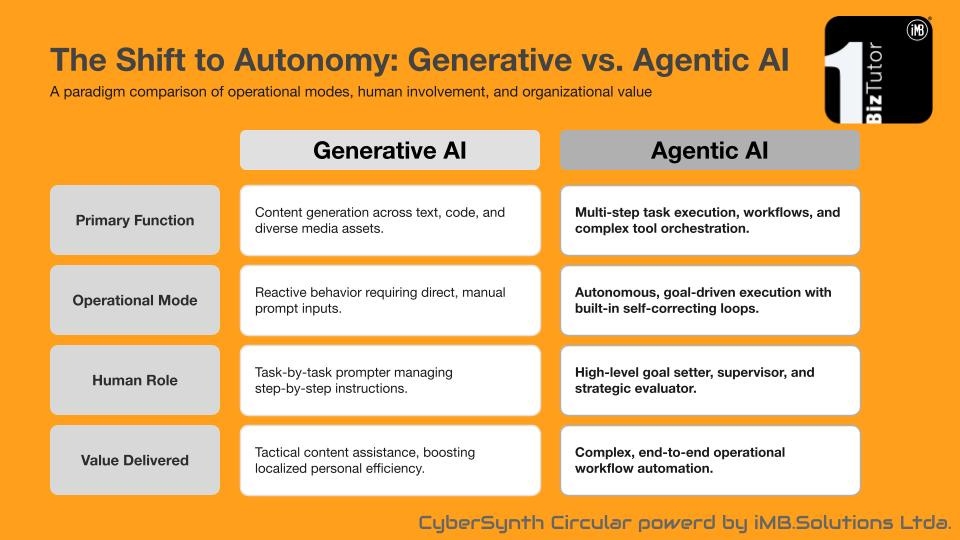
Generative AI is a conversationalist and a creator. You give it a prompt, and it produces an output—a block of code, a marketing email, an image, or a summary of a document. It is highly reactive; it requires a human to steer it, task by task, prompt by prompt. It is a brilliant tool, but it is passive.
Agentic AI, on the other hand, is goal-oriented and autonomous. You don’t just give it a prompt; you give it an objective. An Agentic AI can break a complex goal down into a multi-step plan, select the right tools for the job, execute the tasks, evaluate its own progress, and self-correct if it hits a roadblock. If Generative AI is a talented intern waiting for your exact instructions, Agentic AI is an experienced chief of staff who takes your high-level directive and makes it happen.
This evolution from generating content to executing workflows is the catalyst birthing an entirely new tech industry centered on the automation of complex, multi-layered tasks.
The Knowledge Economy Paradigm Shift
Nowhere is the impact of Agentic AI more visible than in the knowledge economy, particularly in fields like management consulting and financial services.
For decades, the lifeblood of consulting has been manual data processing and presentation building. Creating complex Excel spreadsheets, running traditional data analyses, and meticulously formatting PowerPoint slide decks were rites of passage for analysts. Today, these traditional skills are rapidly losing relevance.
Why spend 40 hours manually scrubbing data and formatting charts when an Agentic AI assistant can accomplish the “heavy lifting” of raw data analysis and structuring in minutes?
This doesn’t mean human workers are obsolete—far from it. Instead, the focus of human value is shifting dramatically up the cognitive ladder. In this new era, the premium is placed on the ability to leverage these advanced digital assistants effectively. The value proposition of a consultant or knowledge worker is no longer about producing the data, but about evaluating the AI’s results within the proper human, business, or societal context.
It is about taking the highly structured data provided by the Agentic AI and translating it into forward-looking scenario generation, strategic foresight, and nuanced decision-making.
A Surprising Job Market Boom
Historically, major leaps in automation bring fears of mass unemployment. Yet, the data paints a highly optimistic picture of the current job market. The deployment of Agentic AI has yielded a net-positive impact on employment so far.
What we are seeing is not the replacement of the worker, but the elevation of the role. A surge of newly created positions is flooding the market, though they come with a new prerequisite:
A higher level of proficiency in managing, directing, and collaborating with Agentic AI applications.
We are transitioning into a workforce of “managers of AI,” where employees act as orchestrators of autonomous digital agents.
The Bottom Line
We are still in the infancy of the Agentic AI trend, but the writing is on the wall.
The Fortune 500 have already realized that Agentic AI is not just another software tool; it is a new class of digital colleague. As these 60 million-plus digital assistants continue to proliferate, the businesses and professionals who learn to harness their autonomous power will be the ones who define the next decade of the knowledge economy.
Google news

Google Gaia: Bringing Brazilian DNA to Open-Source AI
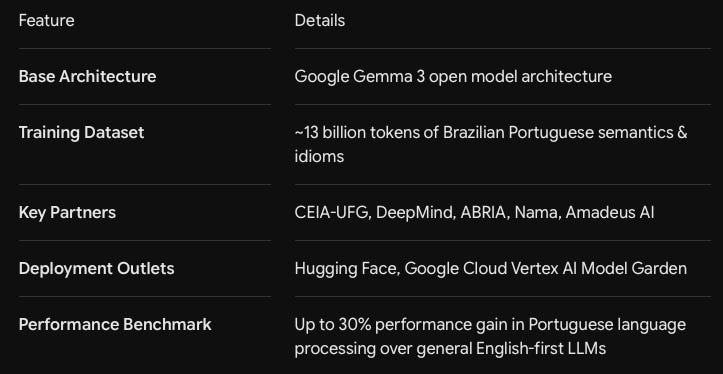
Google, in partnership with the Center of Excellence in Artificial Intelligence at the Federal University of Goiás (CEIA-UFG), Google DeepMind, ABRIA, and local tech startups Nama and Amadeus AI, introduced Google Gaia. Built on Google’s open Gemma 3 architecture, Gaia is an open-weight AI model continuously pre-trained on roughly 13 billion tokens of Brazilian Portuguese data to capture regional semantics, idioms, and cultural context.
Current Stage of Development
Gaia is currently in an enterprise pilot and open-source deployment phase. Rather than launching as a consumer-facing chat web app, its raw model weights were published on Hugging Face and Google Cloud’s Vertex AI Model Garden for developers to build upon. Early real-world implementation includes:
TeleSíntese
Public Governance: Municipal and state auditing courts (TCM-GO and TCE-GO) deploy Gaia to parse public records, run document analysis, and spot auditing patterns.
aiotbrasil.com.br
Healthcare & Enterprise: Health network Unimed uses the model to parse and validate diagnostic medical records, while technology institutes like CESAR integrate it into software workflows.
Key Challenges & Future Outlook
Computational Demands: Pre-training required heavy hardware clusters (Nvidia DGX H100 systems), making localized re-training and continuous updates resource-intensive for local research institutions.
aiotbrasil.com.br
Integration Overhead: Because Gaia is released as model weights (”the engine”) without a built-in consumer UI, adoption hinges on developer teams building custom front-ends and API layers.
UFG - Universidade Federal de Goiás
Future Outlook: Gaia demonstrates up to a 30% performance increase in Portuguese language processing over general English-first LLMs. It provides a blueprint for regional sovereign AI, enabling specialized legal, public sector, and healthcare automation tailored specifically to Brazil.
Google Beam: Spatial Copresence for Enterprise Collaboration
Alongside localized LLMs, Google is advancing spatial communication with Google Beam, the commercial evolution of its long-running research venture, Project Starline.
What Google Beam Is
Google Beam is an AI-first 3D video communication platform that renders life-sized, real-time spatial video without requiring VR/AR headsets or smart glasses. It relies on light-field rendering, multi-camera depth sensing, and real-time spatial audio to reproduce eye contact, micro-expressions, and depth cues, simulating true physical presence in remote meetings.
Development & Integration Status
Commercialization: Beam has moved from an internal Google prototype into full-scale enterprise commercialization.
Hardware Partnerships: Google partnered with HP to manufacture and distribute commercial Beam units for physical office meeting rooms.
Software Integration: The platform connects directly into enterprise collaboration stacks, integrating with Google Workspace and Google Meet alongside enterprise partners like Schwarz Digits and Huntington Bank.
Google has reintroduced its futuristic 3D video calling system — now named Beam (formerly Project Starline). Designed to make virtual meetings feel lifelike, Beam combines AI, depth-sensing cameras, light field displays, and real-time holographic rendering.
No longer a prototype, Beam is now being commercialized in partnership with HP. It’s smaller, office-ready, and being tested by companies like Salesforce and Duolingo. With features like live translation, screen sharing, and natural presence, this tech is redefining how we connect across distances.
But will it become mainstream? Watch now to find out!
ai in Brazilian law

JusBrasil - The AI Engine Navigating Brazil’s Hyper-Litigious Legal System
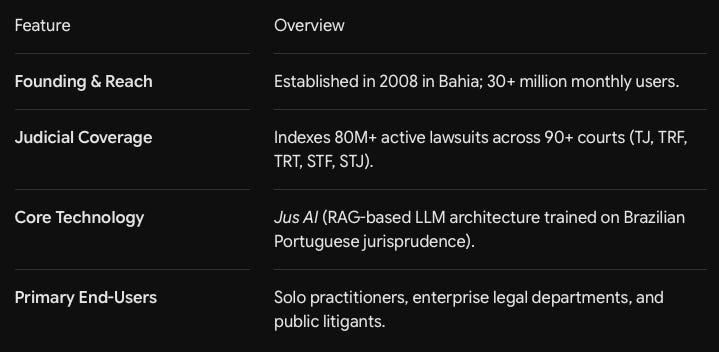
Founded in Salvador, Bahia, in 2008, JusBrasil set out to organize the vast, fragmented web of Brazilian jurisprudence. Today, as Latin America’s largest legaltech platform reaching over 30 million monthly users, it is widely recognized as the “Google of legal proceedings.”
The Brazilian Legal Landscape
Brazil operates one of the most complex and overburdened judicial systems in the world. With over 80 million active lawsuits distributed across more than 90 distinct judicial bodies—including state courts (TJ), federal courts (TRF), regional labor courts (TRT), and superior courts (STF and STJ)—retrieving procedural updates and relevant case law was historically a manual, time-consuming challenge. Public legal information remained locked inside fragmented daily court gazettes (Diários Oficiais) and disparate digital portals, creating friction for legal practitioners and opacity for citizens seeking justice.
Strengths & Weaknesses
Strengths:
Comprehensive Data Aggregation: Unmatched repository indexing procedural movements, precedents, and court publications across over 100 public sources.
Domain-Specific AI Architecture: Proprietary systems like Jus AI utilize fine-tuned Large Language Models (LLMs) combined with Retrieval-Augmented Generation (RAG) engineered specifically for Portuguese legal syntax.
SBBD
High Market Penetration: Serves as the primary search standard for lawyers, corporate legal departments, and individual litigants.
Weaknesses:
Data Privacy Friction: Surfacing public court records containing individual names leads to ongoing compliance challenges under Brazil’s General Data Protection Law (LGPD).
External Dependency: Operational efficiency depends on scraping stability and data availability from third-party court servers.
Freemium Paywall Tension: Placing advanced document previews and automated alerts behind subscription tiers can draw criticism from users seeking free access to public records.
AI Potential & Strategic Application
The integration of specialized AI within Brazil’s legal sector offers massive efficiency gains. By grounding generative models in verified court data, platforms like Jusbrasil can:
Automate Legal Drafting: Generate structured initial pleadings, defenses, and appeals through guided question workflows.
YouTube
Validate Citation Accuracy: Automatically cross-reference attached case documents against active jurisprudence to eliminate hallucinated legal citations.
Summarize Case Timelines: Compress long procedural movement histories into digestible summaries for clients and legal teams.
In a system burdened by sheer case volume, AI transforms legal work from manual processing to high-level strategic analysis and dispute management.
To explore how the company engineered its platform to handle millions of judicial records, check out The Technology That Built Jusbrasil. This video provides valuable context on how Jusbrasil built specialized search and AI capabilities to transform Brazil’s legal landscape.
Eighteen years ago, six friends in Salvador decided to build a search engine focused on Brazilian law. Today, Jusbrasil is the largest legal platform in Latin America, reaching 30 million users every month.
In this first episode of *Café com Jus*—a special edition podcast celebrating Jusbrasil’s 18th anniversary—Jairo Jair (JJ), the company’s Engineering Director, recounts how the technology team had to design solutions from scratch to develop a specialized legal search tool. That tool has since evolved into a comprehensive work platform featuring Artificial Intelligence via Jus IA.
JJ discusses what it means to build cutting-edge Brazilian technology outside the Rio-São Paulo axis, the challenges of keeping the company at the forefront of innovation since day one, and how Artificial Intelligence has transformed—and continues to transform—what Jusbrasil delivers to legal professionals, companies, institutions, and the general public.
Thanks for reading CyberSynth Circular! This post is public so feel free to share it.
WE
We’re an agile team of independent consulting and project experts based in São Paulo, Brazil, specializing in cutting-edge technologies like blockchain 2.0, smart contracts, and generative AI. Our diverse team includes forward-thinking specialists in blockchain development, smart contract architecture, dApp design, and GenAI algorithms for OT. Committed to innovation, we thrive in São Paulo’s vibrant tech and entrepreneurial ecosystem. What sets us apart is our passion for applying emerging tech to solve complex challenges and drive meaningful change. Whether it’s decentralized solutions, smart contract optimization, or creative use of generative AI, we approach each project with creativity and expertise. Collaboration is central to our ethos—we blend diverse skills to deliver tailored solutions that exceed expectations. Seeking innovative solutions at the intersection of blockchain, smart contracts, and generative AI? Let’s connect and shape the future together, one project at a time. We are the tech arm of iMB.Solutions if it comes to digitization, generative AI and smart contract project missions.

Available for iOS and Android
Start writing today. Use the button below to create a Substack of your own