


Team iMB.Solutions Mexico 🇲🇽, Mexico City, Mexico
Pretext
In the 20th century, it was Cuba. Today, it’s El Salvador. A small Latin American country is once again captivating a global audience — not for its beaches or culture, but for its authoritarian model, its media-savvy leader, and the possibility of exporting its heavy-handed governance abroad.
Once, it was leftist revolutionaries and idealists who journeyed to Havana, turning a blind eye to political prisoners and empty store shelves while admiring socialist schooling and healthcare. Today, the tourists lean hard right — think Tucker Carlson, Matt Gaetz, Donald Trump Jr., even Elon Musk — and the destination is Nayib Bukele’s El Salvador: the self-declared world capital of Bitcoin and mass incarceration.
The president himself declares himself to be the coolest dictator in the world and the king of philosophers.
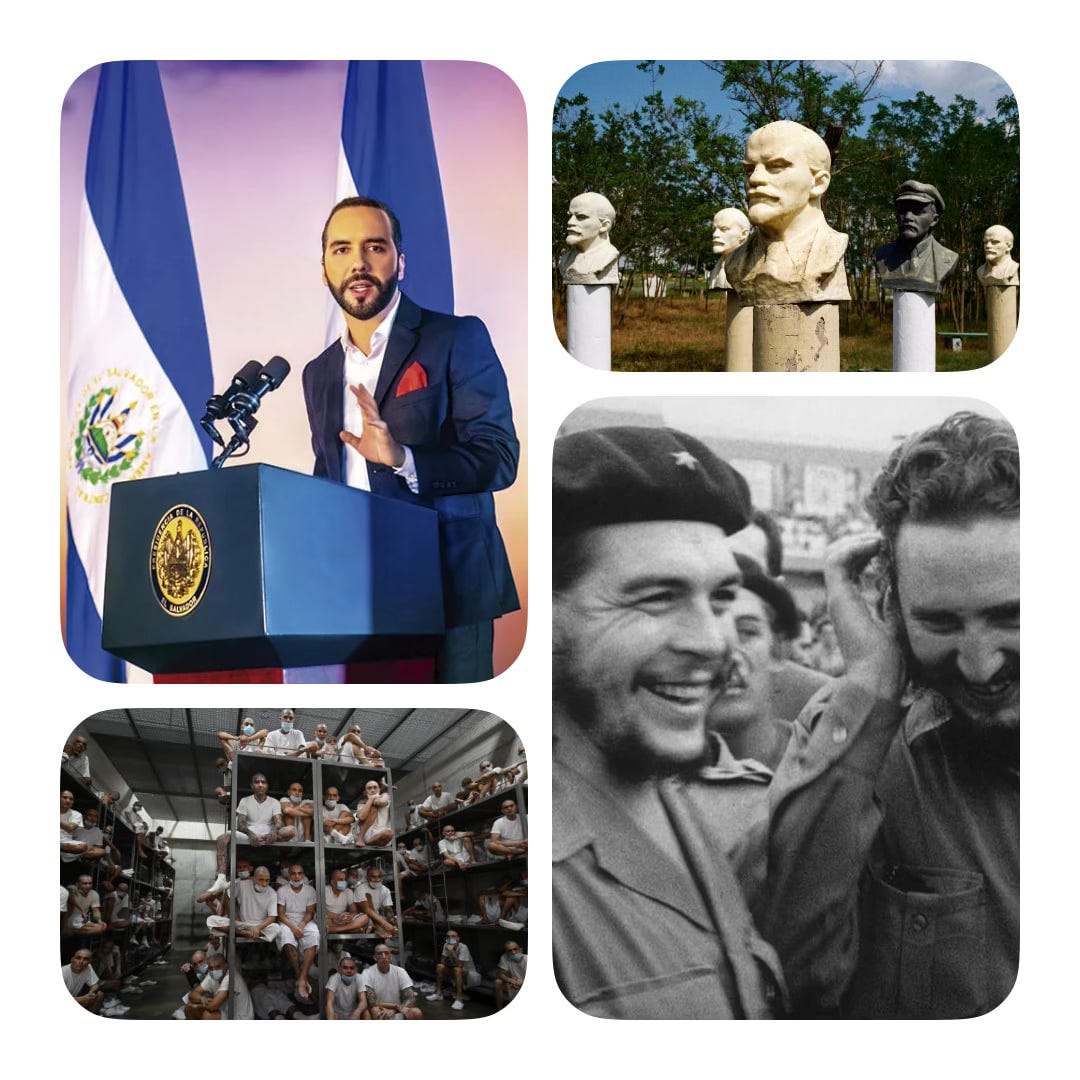
What’s on display to these modern-day pilgrims?
A shiny narrative of law and order. A crime-ridden nation supposedly rescued by a bold leader who’s not afraid to toss out constitutional norms, suspend due process, and build a mega-prison to house thousands — sometimes without trial, charge, or even explanation. For admirers, it’s a clean, dramatic solution to a very real problem: gang violence. For critics, it’s authoritarianism with a PR team.
Bukele’s PR machine is world-class. Surf cities and cryptocurrency headlines mask a darker reality: overcrowded prisons where detainees die every four days, disappearances, torture allegations, and a legal system where criticism is surveilled or silenced — not debated. Approximately 20% of Salvadorans now struggles with hunger - tendency growing, even as government spending on opaque contracts soars. The director of prisons has been sanctioned by the U.S. Treasury for back-channel deals with gang leaders — the very ones the regime claims to be crushing.
But Bukele’s true innovation may lie in his model’s exportability.
Already, parts of his approach are being emulated. The recent transfer of over 200 Venezuelan migrants from the U.S. to Bukele’s mega-prison — including many with no criminal record — echoed his tactics exactly. Some detainees were arrested for tattoos of football clubs or relatives' names. Some were deported in defiance of court orders. It’s not just admiration anymore. It’s mimicry.
And Bukele’s influence reaches further. He maintains high-profile allies abroad and cultivates sympathy at home, even amid growing repression. Though over 60% of Salvadorans now report fear of political discussion, he remains popular — especially among those who remember life under the rule of gangs as even more terrifying than today's police state.
But history may yet temper the fervor. Many foreign admirers of Cuba’s revolution would eventually recant, or retreat into embarrassed silence, as the revolution decayed into hypocrisy and hardship. The Cuban model left a legacy of dysfunction, most visibly in Venezuela, whose regime borrowed Havana’s tactics to entrench itself in power.
Will El Salvador be next?
Bukele’s foreign fans may one day reflect with similar regret. For now, they remain entranced — by the illusion of security, the allure of simple answers, and the seductive image of a strongman who gets things done. But beneath the surface, the risks — and the costs — are mounting. Just like Cuba, there’s another El Salvador they don’t want to see.—iMB.Solutions MEX Team🇲🇽
Trump Administration Drops Charges Against MS-13 Leaders in Controversial Move
The Trump administration has initiated the dropping of charges against key leaders of the notorious Salvadoran gang Mara Salvatrucha-13 (MS-13), who were previously incarcerated in the United States on serious charges including terrorism, murder, narcotrafficking, and the attempted assassination of an FBI field officer. This development marks a significant shift from the administration's earlier aggressive stance against the gang.
Background: Joint Task Force Vulcan and MS-13 Crackdown
In 2019, the Trump administration launched Joint Task Force Vulcan, a multi-agency law enforcement initiative involving the Department of Homeland Security and prosecutors from five countries. The task force successfully captured 27 MS-13 leaders across New York, Mexico, Guatemala, and El Salvador, with nine high-profile figures prosecuted in U.S. courts. The operation was initially hailed as a major victory in the fight against transnational gang violence.
Charges Dropped Amid Geopolitical Considerations
Recently, Interim U.S. Attorney for the Eastern District of New York, John J. Durham, petitioned the court to drop charges against two prominent MS-13 leaders: Antonio López Larios ("Greñas") and Vladimir Antonio Arévalo Chávez ("Vampiro"). Durham cited overriding "geopolitical" and "national security" interests as reasons to halt prosecutions, suggesting these considerations outweighed the imperative to hold gang leaders accountable.
El Faro, a Salvadoran media outlet, reported that Greñas had his charges dropped in March 2025 and was promptly deported to El Salvador, while motions have been filed to prevent Vampiro’s deportation. Durham sought to keep the legal proceedings and deportation plans confidential, warning that public disclosure could damage U.S. relations with the Salvadoran government under President Nayib Bukele.
Allegations of a Quid Pro Quo with El Salvador
Experts and investigative reports suggest that these legal reversals are tied to a secretive arrangement between the Trump administration and Bukele’s government. The deal appears aimed at preventing MS-13 leaders from testifying about Bukele’s alleged power-sharing agreements with organized criminal groups, including MS-13 itself. Since 2019, Bukele’s administration reportedly maintained a covert pact with the country’s main gangs, including MS-13, to maintain political stability and control.
U.S. Secretary of State Marco Rubio is reported to have negotiated with Bukele to accept Venezuelan deportees at El Salvador’s notorious CECOT prison in exchange for the release of MS-13 members held in the U.S. This prison has become a central site in the Salvadoran government’s crackdown on gangs, where deported gang members are confined under harsh conditions.
Shift in U.S. Enforcement Priorities
Following the high-profile MS-13 takedown, the Vulcan Task Force has largely shifted focus away from MS-13 investigations. It is now tasked with coordinating efforts against the Venezuelan gang "Tren de Aragua," reflecting a change in strategic priorities within U.S. law enforcement.
Human Rights Concerns in El Salvador
The Bukele administration’s approach to gang violence has drawn international criticism for serious human rights violations. The government’s prolonged state of emergency grants security forces broad powers for warrantless arrests and surveillance, leading to fears of repression against civil society. A recent poll found that 60% of Salvadorans believe that criticizing Bukele’s government could result in imprisonment, highlighting a climate of fear and limited political freedom.
Conclusion
The Trump administration’s decision to drop charges against MS-13 leaders represents a controversial pivot from its earlier hardline stance on gang violence. While framed as a matter of national security and international diplomacy, the move raises questions about the intersection of U.S. foreign policy, gang-related crime, and human rights in El Salvador. The secretive nature of the agreements and the implications for justice and transparency continue to fuel debate among experts and observers.—iMB.Solutions MEX Team🇲🇽
Disclaimer
At GreyRhino Newsletter, we generally refrain from commenting on overtly political topics. However, in light of our business engagements, we believe it is important to share context that may affect market dynamics and decision-making.
In 2025, our team undertook three business trips to El Salvador to explore the potential for a project mission in the textile sector. Throughout these visits, extensive conversations with local stakeholders revealed a concerning and deteriorating situation within the country.
We observed a growing sense of unease among entrepreneurs, many of whom shared reports of employees abruptly ceasing to show up for work, as well as accounts of neighbors and acquaintances being arrested in the early hours of the morning. Allegations of association with drug gangs—often based solely on denunciations—have led to numerous detentions. Alarmingly, mere denunciation, regardless of evidence, appears sufficient to trigger enforcement actions, ostensibly in the name of national pacification.
Our reflections draw parallels between the current atmosphere in El Salvador and past experiences in similarly volatile environments such as Venezuela.
Given these circumstances, our Team Mexico has made the strategic decision to suspend any plans for business activities in El Salvador at this time, prioritizing the safety of our personnel and partners.
This commentary is intended solely to provide insight into the factors influencing our business decisions. It does not constitute a political statement nor an exhaustive analysis of the situation in El Salvador. We encourage readers to seek multiple sources to form their own understanding.—iMB.Solutions MEX Team🇲🇽

