

Prime Story

Brazil-USA Trade - Untangling the Trade Imbalance - A Q&A Blog in 11 Questions
Regular readers of our newsletters, blogs and case studies will know that in recent years we have been/are intensively involved in project missions in Mexico with a view to the USMCA economic area and of course in our home market Brazil for the same clients. These project missions were particularly intensive for a European supplier to the automotive industry, for whom we have already been active in Argentina, Brazil and Mexico. For years, we have also repeatedly been at our client's side as a sparring partner in strategic planning. In a flash project mission, the question was how the economic relationship between Brazil and the USA could possibly develop. In this context, we gathered facts to create a basis and generate possible strategic scenarios in the subsequent phase. Subsequently, after consultation with our client, we generated a generic extract in the form of a Q&A blog.

The economic relationship between Brazil and the United States is a key one in the Western Hemisphere. However, a persistent trade imbalance exists. Let's delve into the details.
Q1: What's the overall story of Brazil-USA trade over the last decade?
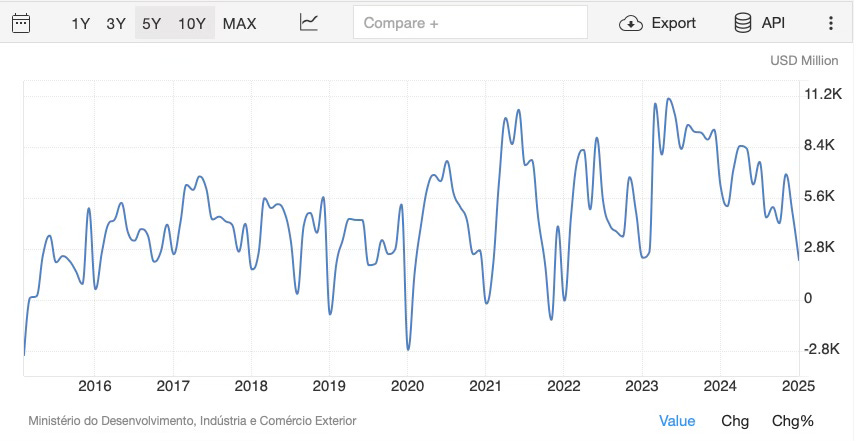
A: For the past decade, the United States has generally exported more to Brazil than it imports, resulting in a trade balance that favors the U.S. by nearly 12%. While there have been fluctuations, this imbalance reflects the different economic structures of the two nations.
Q2: Can you give me some key figures on what each country exports?
A: Absolutely. In 2023:
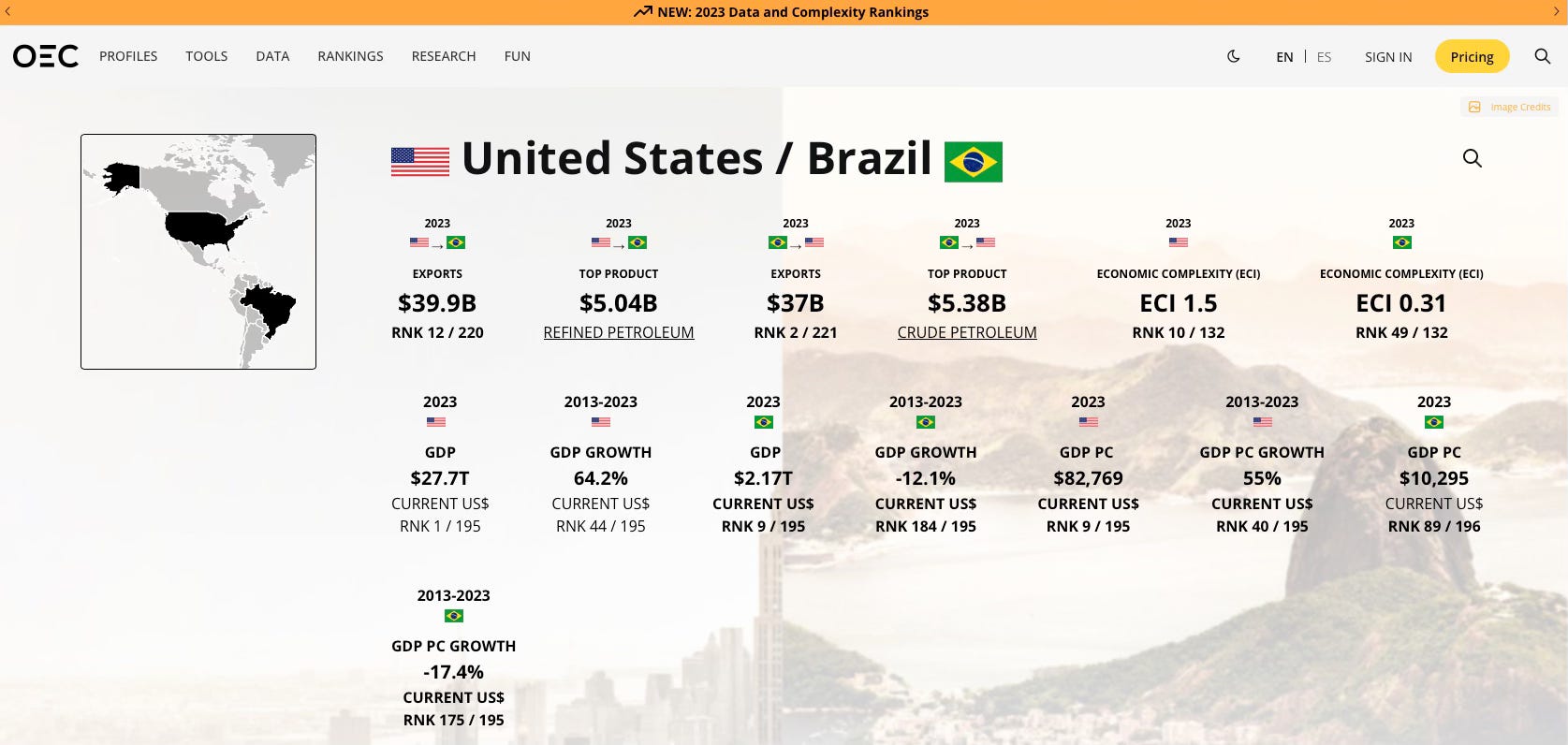
U.S. Exports to Brazil: $39.9 billion, growing at an annual rate of 3.11% since 2018. Leading exports include refined petroleum ($5.04 billion), gas turbines ($4.66 billion), and coal briquettes ($1.78 billion).
Brazil Exports to the U.S.: $37 billion, growing at a faster annualized rate of 4.87% since 2018. Key exports were crude petroleum ($5.38 billion), refined petroleum ($1.94 billion), and semi-finished iron products ($1.7 billion).
Q3: What about services? Does that play a role?
A: Yes, a significant one. In 2017, the U.S. exported $23 billion in services to Brazil, including travel and financial services. Critically, Brazil did not export any services to the U.S. This lack of service exports from Brazil further contributes to the trade imbalance.
Q4: What are the main reasons behind this trade imbalance?
A: Several factors are at play:
U.S. Dominance in High-Value Exports: The U.S. excels in exporting machinery, refined petroleum, and chemical products, which are high-value goods.
Brazil's Reliance on Commodities: Brazil's exports are heavily weighted towards commodities like crude petroleum and iron, which often have lower value.
Lack of Brazilian Service Exports: As mentioned earlier, the absence of significant service exports from Brazil limits its ability to balance goods imports.
Q5: How do the countries compare in terms of economic complexity?
A: There's a significant difference. The U.S. ranks 10th globally on the Economic Complexity Index (ECI), indicating a highly advanced and diversified industrial base. Brazil ranks much lower, at 49th, reflecting its greater reliance on raw materials and less complex goods.
👉🏼 Read also: 👇🏼
The U.S. Trade Deficit: How Much Does It Matter?
U.S. Department of State, Jan. 20, 2025: U.S. Relations With Brazil
Q6: What are the implications of this imbalance for Brazil?
A: The persistent trade deficit highlights a need for Brazil to:
Diversify its export portfolio: Move beyond commodities and invest in high-value industries.
Enhance service exports: Develop its service sector to offset goods imports.
Q7: What are the implications for the U.S.?
A: The surplus underscores the U.S.'s competitive advantage in industrial goods and services. Furthermore, strong ties with Brazil ensure access to important raw materials like crude petroleum and iron.
Q8: Has this trade balance always favored the US?
A: Not always.
Early 2010s: Brazil often had trade surpluses with the U.S., driven by strong commodity exports.
Post-2008 Financial Crisis: The balance shifted towards the U.S. as American exports recovered faster.
2015-2019: Trade flows became more balanced.
2020-2021: The U.S. surplus increased significantly due to a surge in U.S. exports.
2022-2023: Adjustments occurred, with declines in both U.S. exports and imports, but the U.S. generally maintains a trade surplus.
👉🏼 Read also: 👇🏼
United States Census Bureau: Trade in Goods with Brazil
Q9: Which industries in Brazil are most affected by this trade deficit?
A: Several industries face challenges:
Manufacturing: High import costs and competition from U.S. goods.
Agriculture: Fluctuations in commodity prices and competition from U.S. agricultural products.
Energy: Impacted by global oil price fluctuations and competition from U.S. energy exports.
Service: Underdeveloped compared to the U.S., leading to a deficit in service trade.
Q10: What steps can Brazil take to reduce its trade deficit with the U.S.?
A: Brazil can implement several strategies:
Diversify Export Portfolio: Expand high-value exports and promote agribusiness growth.
Enhance Trade Agreements: Negotiate bilateral agreements and mutual recognition agreements.
Improve Domestic Competitiveness: Invest in infrastructure and simplify tax systems.
Boost Service Exports: Develop sectors like financial services and technology solutions.
Leverage Global Trade Opportunities: Expand into new markets and strengthen regional trade.
Focus on Regulatory Alignment: Share good regulatory practices and expand digital documentation.
Promote Investment Cooperation: Encourage foreign direct investment from the U.S.
Q11: What are the main reasons driving this imbalance?
A:
Brazil's economy is heavily reliant on commodity exports
Brazil is one of the most closed economies among large nations
High Costs of Doing Business
The strength of the U.S. dollar as a global reserve currency makes Brazilian exports relatively more expensive
Brazil has limited service exports
Brazil has historically adopted protectionist policies
By addressing these issues, Brazil can work towards a more balanced trade relationship with the United States.


The LatAm Story
Discover Dengo - The Heart of Brazilian Chocolate
Dengo, a pioneering Brazilian chocolate brand, stands out for its unique business model that combines quality, sustainability, and social impact. By monitoring cacao production and selecting beans directly from small producers in Bahia, Dengo ensures fair remuneration and promotes environmental conservation.
Quality Standards
Bean-to-Bar Expertise: Dengo crafts chocolates with high-quality Brazilian ingredients, blending tropical fruits and nuts for unique flavors.
Sustainable Practices: Over 60% of expenditure goes into prime materials, with minimal added sugar and no artificial additives.
Innovative Packaging
100% Recyclable: Dengo introduced truffle packaging made from recyclable materials, featuring aluminium bands and no plastic, aligning with the 2030 Agenda for sustainability.
Dengo's packaging is highly artistic and colorful, reflecting the vibrant spirit of Brazil. The brand's designs often incorporate elements inspired by the Atlantic Forest, where their cacao is sourced, such as leaves and seeds, creating a connection to nature and Brazilian culture.
The use of dynamic shapes and colors in their packaging, like the award-winning Dengo 80g bar, adds an artistic touch, making each piece feel like a sculpture. This blend of natural motifs and modern design embodies the Brazilian soul, known for its warmth and creativity. Additionally, Dengo's commitment to sustainable packaging, such as using paper and aluminum, aligns with Brazil's rich environmental heritage.
Global Positioning
Premium Market Presence: Dengo competes with premium chocolates globally while maintaining affordable prices, thanks to its efficient sourcing and production methods.
Expanding Reach: With 18 stores across Brazil, Dengo is rapidly growing its presence in upscale markets.
Dengo's International Expansion
Dengo, a Brazilian chocolate brand, is rapidly expanding its presence globally. Key highlights include:
Paris Launch: Dengo opened its first international store in Paris during Easter 2023, with plans for two more in the city. The brand aims to leverage local partnerships and adapt its products to European tastes.
Future Plans: Expansion is targeted towards Asia, the U.S., and the Middle East. Dengo plans to increase its Paris stores and enter the U.S. market by 2026.
Norway and Beyond: A case study explores Dengo's potential entry into Norway, emphasizing sustainable marketing strategies and the appeal of Norway's open trade policies.
Investment and Growth: Dengo is investing $20 million in a new factory to boost production by 500%, aiming to increase its global footprint significantly.
Experience the authentic taste of Brazilian cacao with Dengo, where every piece is a testament to love, respect, and sustainability. #DengoChocolates #BrazilianCacao #SustainableLuxury (iMB.Solutions, São Paulo, Brazil)


Milei’s High-Stakes Gamble - Ending Argentina’s Currency Controls
Can Argentina’s Economy Handle the Shock?
Javier Milei has launched his boldest economic move yet: dismantling Argentina’s strict currency controls by the end of 2025. These controls, known as el cepo, have shaped Argentina’s financial landscape for nearly a decade, limiting access to dollars and distorting exchange rates. While Milei’s radical free-market agenda has drawn foreign investment interest, the removal of controls presents a major risk.

Why It Matters
Argentina remains the IMF’s largest debtor, owing over $40 billion. The country’s financial system is fragile, and a sudden lifting of controls could trigger a run on the peso, reigniting inflation and undoing Milei’s recent economic stabilization. His administration has already reduced monthly inflation from 26% in December 2023 to under 3%, a key factor in his 50% approval rating. The cost: financial and fiscal autocrathy - the entire economy controlled by the government and private capital transfered to the state.
Milei is negotiating with the IMF for an $11 billion loan to help cushion the transition, but he insists that, with or without the Fund’s support, controls will end on January 1, 2026. The question is: can Argentina afford it?
The Risks of Cutting the Wrong Wire
Eliminating el cepo is not just about economic philosophy—it’s a high-stakes operation. Economists warn that lifting the wrong restriction at the wrong time could:
✅ Create a dollar-buying frenzy, draining Argentina’s central bank reserves.
✅ Devalue the peso if the government can’t meet demand.
✅ Spark volatility in parallel currency markets, undermining financial stability.
The problem is that Argentina had these controls for so long that they don’t know how the market will react.
Milei’s IMF Dilemma
The IMF supports some of Milei’s policies, praising Argentina’s first budget surplus in 14 years. However, the Fund is pushing for a structured, gradual removal of controls, rather than an abrupt shock.
Key IMF concerns include:
🔹 Multinational profit restrictions: $10 billion in corporate funds are trapped in Argentina.
🔹 Agricultural export regulations: The central bank has lost $12 billion in potential reserves due to current rules.
🔹 Peso devaluation policy: The currency has appreciated 40% in real terms, adding pressure on exporters.
While an agreement with the IMF seems likely, the real challenge is timing. With midterm elections in October, Milei may delay any drastic moves until after securing more congressional support.
The Road Ahead
Milei’s success depends on carefully managing market expectations while securing IMF backing. If he miscalculates, Argentina risks another economic crisis. But if he pulls it off, he could redefine the country’s financial future. (iMB.Solutions ARG Team)
👉🏼 Read also: 👇🏼
Argentina’s Bold Plan to End Currency Controls by 2026
Will Milei’s gamble pay off—or will Argentina’s economy take another hit? Share your thoughts! ⬇️


From the Newsroom of Industry
Brazilian ethanol industry
Brazil is mulling a reduction of its 16% ethanol import tax in February 2025, reportedly to align with Trump’s trade preferences and boost bilateral ties. The move could favor U.S. ethanol exporters, pleasing the administration while stirring domestic backlash from Brazilian producers. It reflects Brazil’s delicate balancing act between economic diplomacy and protecting local interests. No final decision has been confirmed, but the proposal underscores Trump’s influence on global trade dynamics. (iMB.Solutions, São Paulo, Brazil)

Brazil's Thriving Beauty Industry - Growth, Innovation, and Professional Training
The beauty sector in Brazil continues to expand, fueled by the increasing pursuit of well-being and self-esteem. Ranking fourth globally in beauty and personal care markets—behind the United States, China, and Japan—Brazil holds the top spot in Latin America. In 2018, the industry generated R$45 billion in revenue, with continued growth expected in the coming years.
A Booming Market for Aesthetic Procedures
Brazil is a leader in aesthetic procedures, with over 1.5 million performed annually, according to the Brazilian Society of Plastic Surgery (SBCP). This surge in demand reflects the growing interest in beauty treatments from both women and men. The increasing popularity of minimally invasive procedures, such as Botox—applied around 400,000 times per year—demonstrates the evolving landscape of the industry.
The Role of Professional Training
With a competitive market, technical expertise is crucial. Many professionals are turning to postgraduate training in aesthetics to gain a competitive edge. According to Dr. Franciely Follmann, an expert in the field, hands-on mentoring is a key differentiator, allowing professionals to bridge the gap between theory and practical application. "Guidance from experienced mentors transforms how knowledge is applied in practice," she emphasizes.
Technology and Innovation Driving the Industry
The beauty sector is also experiencing significant technological advancements, ensuring safer and more effective treatments. "Adopting advanced and certified technologies is essential to providing high-quality services and staying ahead of industry trends," says Dr. Follmann.
Opportunities for Growth and Career Development
As the sector evolves, so does the demand for well-trained professionals. Dr. Follmann highlights that continuous education is crucial for those looking to build a solid career in aesthetics. "Professionals who invest in training stand out by offering personalized, high-quality services to a diverse clientele," she notes.
A Dynamic and Expanding Industry
Brazil’s beauty industry reflects a strong desire for innovation and excellence. Ongoing professional development is the foundation for keeping up with market trends and providing solutions that prioritize safety and efficiency. For those looking to thrive in this growing sector, investing in education and technology is the key to long-term success. (iMB.Solutions, São Paulo, Brazil)

Deep dive - check out the following sources:
https://www.mordorintelligence.com/industry-reports/brazil-cosmetics-products-market-industry
https://www.grandviewresearch.com/horizon/outlook/cosmetics-market/brazil
Moto Morini Enters the Brazilian Market - A New Era for Motorcycles
In a significant move to expand its global presence, the Italian motorcycle manufacturer Moto Morini has announced its entry into the Brazilian market, with plans to start local production in 2025. This strategic decision marks a new chapter for Moto Morini, as it aims to strengthen its position in South America and cater to the growing demand for premium motorcycles in Brazil.
Background and Investment
Moto Morini, founded in 1937, is renowned for its high-quality motorcycles, ranging from medium to high displacement models. The brand is currently part of the Chinese group Zhongneng, but it maintains its headquarters and development center in Italy. In 2025, Moto Morini will invest US$ 42 million over three years to establish a production line in the Manaus Free Trade Zone, Brazil. This investment will cover the setup of the production chain, distribution network, and strategic positioning of the brand in the country.
Models to Be Produced
Moto Morini has selected three models for its Brazilian debut, all of which will be assembled locally. These models include:
X-Cape 650: Known for its adventure capabilities, this model is particularly popular in Europe.
Seiemmezzo 650: Available in both street and scrambler versions, this model offers versatility and style.
Calibro 700: A custom model that has garnered attention for its robust design and power.
These models reflect Moto Morini's commitment to offering premium motorcycles with a competitive price-to-performance ratio, targeting the growing medium-displacement segment in Brazil.
Production Strategy
The production strategy involves importing motorcycles in a semi-assembled state (CKD) from China and completing the assembly in Manaus. This approach allows Moto Morini to maintain control over quality while benefiting from competitive pricing due to reduced import duties. Additionally, this strategy ensures a stable supply of parts, mitigating the risk of shortages and enhancing customer satisfaction.
Market Expansion
Initially, Moto Morini will focus on the Southeast region, with sales operations planned in cities like São Paulo, Campinas, Sorocaba, and São José dos Campos. The brand aims to expand nationally by 2027, further solidifying its presence in the Brazilian market.
Impact on the Brazilian Market
Moto Morini's entry into Brazil is expected to invigorate the premium motorcycle segment, offering consumers more exclusive options. The brand will compete with established players like Triumph, BMW, KTM, Ducati and Harley-Davidson, potentially reshaping the market dynamics with its unique blend of Italian design and competitive pricing.
In conclusion, Moto Morini's decision to start local production in Brazil marks a significant milestone for both the company and the Brazilian motorcycle market. With its focus on quality, innovation, and customer satisfaction, Moto Morini is poised to make a lasting impact in the region. (iMB.Solutions, São Paulo, Brazil)

Short Cuts from Industries
Mexico, growing market for generative ai experts
Mexico Triples Demand for AI Experts in Latin America
Mexico is experiencing a significant surge in demand for Artificial Intelligence (AI) and data science specialists, outpacing the average demand across Latin America. This trend marks a historical high for the country, with job offers expected to increase by 95% in 2024. Our Mexican iMB.Solutions colleagues explore the current landscape, key job profiles in demand, and the implications of this growth for Mexico's economy.
Key Trends and Job Profiles
Demand for AI Experts: The demand for AI and data science specialists in Mexico is three times the average for job offers in Latin America. This growth is driven by the increasing integration of AI in key sectors such as finance, banking services, and software development.
Most In-Demand Profiles
Data Analysts: Companies are seeking professionals who can interpret data and draw significant conclusions for strategic decision-making.
Business Intelligence: There is a strong need for experts who can convert data into actionable insights that drive innovation and business growth.
Data Engineers: Mexican firms are investing heavily in building robust data infrastructures, highlighting the importance of data management.
Industry Impact
Financial Sector: AI is becoming increasingly crucial in the financial sector, with institutions like Citibanamex leading the way in implementing AI tools. Citibanamex has made over 300 job offers in AI-related fields in 2024.
Manufacturing and Consulting: AI is optimizing production processes in manufacturing and providing customized solutions in consulting, marketing, and advertising services.
Future Outlook
Global Trends: AI and Big Data are among the top capabilities expected to grow rapidly by 2030. Almost half of global employers plan to reorient their businesses to leverage these technologies.
Workforce Reskilling: As AI redefines business models, employers are focusing on improving worker capabilities to adapt to these changes. This includes reskilling efforts to ensure workers remain relevant in an AI-driven economy.
👉🏼 Read also: 👇🏼
In conclusion, Mexico's AI market is poised for significant growth, driven by a strong demand for AI and data science specialists. As the country continues to invest in digital transformation, the need for skilled professionals will only increase, making AI a critical component of Mexico's economic future. (iMB.Solutions MEX Team)
Chile, mining industry
BHP Advances $2 Billion Concentrator Upgrade at Escondida Copper Mine
BHP has announced plans to proceed with a significant US$2 billion upgrade of its concentrator at the Escondida copper mine in Chile. This initiative marks the first phase of BHP's decade-long investment strategy, which totals US$10.8 billion and aims to bolster the country's economy, particularly in the Antofagasta region.
Background on Escondida Copper Mine
Located in the Atacama Desert, approximately 170 kilometers southeast of Antofagasta, Escondida is recognized as the world's largest copper mine. BHP operates and owns a 57.5% stake in the mine, with Rio Tinto holding 30% and Japan-based JECO owning the remaining 12.5%. The mine plays a crucial role in Chile's economy, contributing significantly to the country's GDP.
Investment Strategy and Economic Impact
BHP's decision to invest in the upgrade is part of a broader strategy to maintain production levels and capitalize on the growing demand for copper, driven by the global transition to cleaner energy. The investment is expected to benefit not only the mine's operations but also the local economy, as emphasized by Escondida President Alejandro Tapia.
Chilean Finance Minister Mario Marcel highlighted that most foreign investment in Chile comes from existing operators reinvesting their earnings into new projects and expansions. This trend underscores the importance of ongoing investments by major mining companies like BHP in driving economic growth in the region.
Environmental Permits and Future Plans
BHP plans to submit the upgrade plan for environmental permitting shortly, ensuring that the project aligns with environmental regulations and standards. The company's long-term vision includes significant investments in Chile, with a focus on meeting the anticipated global copper deficit of ten million tonnes over the next decade.
Global Copper Market Outlook
The global copper market is experiencing a period of low supply growth due to reduced investment in new mining projects over recent years.
However, with the increasing demand for copper in renewable energy technologies and electric vehicles, companies like BHP are positioning themselves to capitalize on this trend through strategic investments and expansions.
In summary, BHP's US$2 billion upgrade at Escondida represents a significant step in its decade-long investment plan in Chile, aimed at maintaining production levels and supporting economic growth in the region. As the global demand for copper continues to rise, such investments are crucial for meeting future supply needs and driving sustainable economic development. (FPN)
👉🏼 Read also: 👇🏼
BHP to proceed with $2bn optimisation plan at Escondida copper mine in Chile
Published by Frank P. Neuhaus, founding partner of iMB.Solutions. Following his Executive MBA at the Universidad Católica de Chile, Frank worked in the project department at the HQ of the mining company La Escondida in Santiago de Chile in the 1990s. Frank still maintains close contacts in Chile and in the industrial sector of the mining and raw materials industry.

Argentina, tourism industry
Tourism Trends in Argentina and Neighboring Countries
Argentina's tourism sector faced significant challenges in 2024, primarily due to macroeconomic factors and government interventions in the exchange rate. The iMB.Soutions project team in Argentina explores the decline in inbound tourism to Argentina, contrasting it with the growth experienced by neighboring countries like Chile and Peru.

Decline in Inbound Tourism to Argentina
In 2024, Argentina witnessed a substantial drop in foreign visitors. The number of international tourists decreased by 18.5% compared to the previous year, with only 10.93 million visitors entering the country, down from 13.40 million in 2023. This decline was particularly pronounced among day-trippers, who fell by 28.7%. In October, the number of foreigners visiting Argentina plummeted by 36.6% year-on-year, with just 754,900 visitors.
The primary reasons for this decline include the strengthening of the Argentine peso and high inflation rates, which have increased costs for foreign tourists and diminished their purchasing power. Additionally, the exchange rate, which was once favorable, is no longer attractive to visitors from neighboring countries like Chile and Uruguay.
Growth in Tourism in Chile and Peru
In contrast, both Chile and Peru reported significant increases in tourism in 2024. Chile saw an impressive 38.8% rise in international tourists, welcoming 4,085,940 visitors, surpassing even pre-pandemic levels. Peru also experienced a 34.1% growth, with 2,720,719 tourists visiting between January and October. These countries have benefited from more stable economic conditions and favorable exchange rates.
Outbound Tourism from Argentina
While inbound tourism struggled, Argentina experienced a surge in outbound travel. In October, 1,124,400 residents left the country, marking a 38.2% increase from the previous year. The main destinations for Argentines were Chile and Brazil, which offered better value due to exchange rate dynamics.
Impact of Exchange Rate Changes on Tourism in Argentina
The recent changes in Argentina's exchange rates have had a mixed impact on tourism, reflecting both challenges and opportunities.
Challenges
Initial Decline in Inbound Tourism: Prior to the introduction of the new tourist exchange rate, Argentina's tourism sector faced significant challenges due to unfavorable exchange rates. The strengthening of the peso made Argentina less attractive to tourists from neighboring countries like Uruguay and Chile, leading to a decline in visits.
High Inflation and Price Increases: Despite exchange rate adjustments, high inflation has kept prices high for tourists, making Argentina less competitive compared to other destinations like Brazil.
Opportunities
Introduction of the "Foreign Tourist Dollar": In an effort to boost tourism, Argentina introduced a preferential exchange rate for foreign tourists using credit and debit cards. This "foreign tourist dollar" offers a more favorable exchange rate, making the country cheaper for tourists who use cards for transactions.
Increased Safety and Formal Transactions: The new exchange rate encourages tourists to use cards instead of cash, reducing reliance on unofficial currency exchanges and enhancing safety.
Potential for Growth: The improved exchange rate could attract more tourists, potentially increasing tourism revenue and helping the sector recover from previous declines.
Conclusion & Future Outlook
Argentina's tourism sector faces significant challenges due to economic instability and unfavorable exchange rates. As the country seeks to stabilize its economy and attract more foreign visitors, it must address these underlying issues. Meanwhile, neighboring countries are capitalizing on their more stable economic environments to boost tourism.
While the new exchange rate offers advantages, Argentina still faces challenges due to high inflation and competition from neighboring countries. The success of these measures will depend on how effectively they can offset these challenges and attract more tourists in the long term. (iMB.Solutions ARG Team)
👉🏼 Read also: 👇🏼
INBOUND TOURISM IN ARGENTINA WENT DOWN BY 18.5% IN 2024

Ups & Downs
In the past year 2024, a total of 72 M&A operations were completed in the Brazilian electrical energy generation sector - a new record. Compared to 2023, this represents an increase of +41%. The main motives for this brilliant growth are the trends towards decarbonization, increasing energy security and the new reality of serving customers in the national market.
The month of January 2025 also registered another new record in the production of motorcycles in Brazil. January 2025 is the strongest month in the last 13 years. More than 166,000 units were produced, an increase of +17.6% compared to January 2024. A comparison of 12/2024 with 01/2025 even shows an increase of 34%. According to the industry association, manufacturers are currently increasing their production capacities.
The price of new vehicles in January 2025 set a new monthly record compared to the last two years in Brazil. Compared to 12/2024, the price rose again by +0.21%. Strong demand is cited as the main reason.
The port of Santos in Brazil set a new monthly record for container shipments in January 2025. Almost 461,000 TEUs were loaded, an increase of +12.1% compared to January 2024. However, the total volume decreased by -2.5% to 11.6 million tons.
Online sales of health and beauty products recorded a strong increase in Brazil in January 2025. Compared to January 2024, sales for health products increased by +72%, for beauty products by +8.3% and for babies by almost +53%. The entire industry sector mixed an increase of almost 43% to USD 0.52 billion.
In February 2025, the confidence index of Brazilian entrepreneurs fell by -0.3 points to 94.7 points. This is the fourth decline in a row. The ICE index of the Fundaçāo Getulio Vargas covers industry, services, trade and construction.
In a monthly comparison of December 2024 with January 2025, industrial production in Brazil fell to 48.9 points. Values below 50 points indicate a decline compared to the previous period. The decline is normal, as January is the vacation period in the Brazilian summer. The national industry association notes that the decline this time was noticeably less than in previous years.
The number of arrears in Brazil's largest city - São Paulo - fell again in February 2025 to 19%. This development reflects the robust situation on the labor market with the lowest unemployment rate in history.
According to the Argentine government, monthly inflation in Argentina fell to 2.2% in January. This would be the lowest value since July 2020. y-o-y inflation is currently reported to be 84.5%, which is the lowest value since January 2023. On the other hand, all inflation figures for energy, consumer prices, rents, etc. vary between +4% and 5.3%. Argentina is currently one of the most expensive countries in the world. Furthermore, interest rates (currently around 25%), exchange rates and strategic prices continue to be strictly controlled and determined by the government. There is still no free movement of capital. Inflation figures are therefore no longer truly measurable, as the massive government intervention now makes it impossible to measure true inflation. Argentina can be described as a “financial/fiscal autocracy”.

News from iMB.Solutions
Substack vs. LinkedIn: Why We’re Making the Switch
In today’s digital age, choosing the right communication platform is essential. After extensive testing, we’ve found that Substack delivers superior results compared to LinkedIn. Here’s why:
Direct, Personalized Outreach
Substack lets us deliver tailored content straight to your inbox—creating a direct, personal connection. On LinkedIn, your feed is crowded, making it hard to stand out.
Higher Engagement Rates
With Substack, our content lands directly in your inbox, boosting read rates and engagement. While global LinkedIn conversion rates have dipped to 0.08% recently, Substack enjoys an impressive 8–12% conversion rate.
In-Depth, Quality Content
Free from the constraints of social media algorithms, Substack allows us to share detailed articles, analyses, and case studies that truly showcase our expertise—something quick-scroll platforms just can’t match.
Enhanced Visibility Through AI
Our content is now officially integrated with generative AI tools like OpenAI and Google Gemini, increasing its visibility and relevance as AI-driven browsing grows.
Seamless Integration and Quality Standards
Substack’s robust platform supports professional newsletter creation and integrated content distribution, backed by a high-quality recommendation system that LinkedIn no longer provides.
What This Means for You
Your subscription is in a process to be seamlessly transferred to Substack. The GreyRhino newsletter will now be exclusively available here, ensuring you continue to receive our latest blogs, updates, and in-depth insights without interruption. (iMB.Solutions, São Paulo, Brazil)
If you haven’t signed up yet, register here to stay in the loop!

Stay tuned for more exciting strategies and insights—Substack is just the beginning.

Get Out
Xenia França: A Rising Star in Brazilian Music
Xenia França is a name that resonates with the vibrant and diverse sounds of contemporary Brazilian music. Born on February 27, 1986, in Candeias, Bahia, Xenia has carved a niche for herself as a singer-songwriter, blending genres like pop, R&B, soul, and jazz to create a unique and captivating sound.
Early Life and Career Beginnings
Xenia's journey into music began in her teenage years when she moved to São Paulo in 2004. Initially working as a model, she soon found her true calling in music. By 2008, she was singing in bars and collaborating with notable artists like Emicida, a Brazilian rap artist who invited her to contribute to his EP "Sua Mina Ouve Meu Rep Tamém" and his album "Emicídio".
Breakthrough with Aláfia
In 2011, Xenia joined the band Aláfia, a collective known for its fusion of Afro-Brazilian rhythms and contemporary sounds. Her time with Aláfia was instrumental in shaping her musical identity and honing her skills as a performer.
Solo Career and Acclaim
Xenia's solo career took off in 2017 with the release of her debut album, "Xenia." The album was a critical success, earning her nominations for the 2018 Latin Grammy Awards in the categories of Best Contemporary Pop Album and Best Portuguese-Language Song for her track "Pra Que Me Chamas?".
In 2019, Xenia became the first Brazilian artist to perform on the world-renowned COLORS YouTube channel, further cementing her status as a rising star in the global music scene.
Recent Work and Achievements
Xenia's most recent album, "Em Nome Da Estrela," released in 2022, showcases her growth as an artist and her commitment to exploring new musical territories. The album features collaborations with former members of Aláfia and Lourenco Rebetez and won the Latin Grammy Award for Best Portuguese Language Contemporary Pop Album in 2023.


Impact and Legacy
Xenia França's music is more than just a blend of genres; it's a celebration of Afro-Brazilian culture and a testament to her artistic vision. Her work continues to inspire and empower listeners, particularly black women, as she uses her platform to advocate for representation and equality in the music industry.
In a world where music often transcends borders and languages, Xenia França stands out as a beacon of creativity and cultural pride. Her journey is a reminder that with passion and perseverance, one can truly make a mark on the world stage. (FPN)
Contact
