Is the libertarian shock therapy working or failing?
Inflation spiking, GDP shrinking, stats office chief resigns in protest, and foreign investors fleeing. Was Argentina’s libertarian shock therapy a historic success—or just a temporary statistical spike?
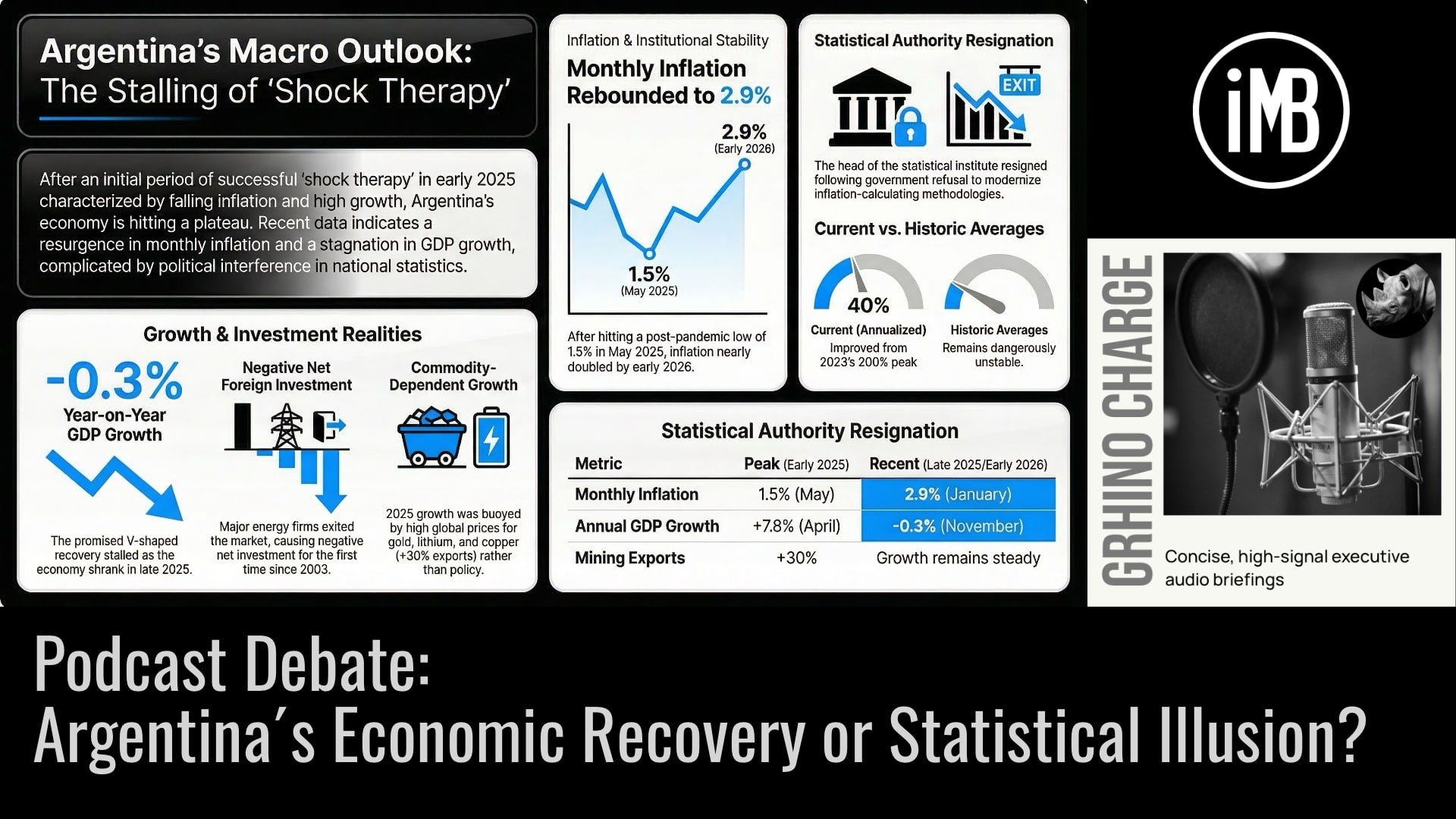
Our podcast experts go to war in the most explosive debate of the year.
The audio blog presents a critical assessment of Argentina’s economy under President Javier Milei, highlighting that initial successes in taming inflation through austerity and currency devaluation have stalled. Recent data shows inflation rising again alongside stagnant growth, undermining hopes for a rapid V-shaped recovery.
A major controversy involves political interference in official statistics. The government blocked the National Institute of Statistics and Censuses (INDEC) from updating its outdated 2004 household spending survey to reflect current consumption patterns (particularly higher spending on services). This update would have produced higher official inflation figures. Milei’s administration ordered the agency to delay the methodological change until “disinflation is consolidated,” without providing a timeline. As a result, the head of the statistical authority resigned in protest, and current official inflation numbers are likely understated.
On the growth front, Argentina’s notable industrial gains in mining (and energy) are portrayed as superficial. Mining exports surged 30% year-on-year in 2025, driven primarily by rising global prices and demand for commodities like gold, silver, lithium, and copper. While this has supported headline GDP, the boom has not translated into broader economic confidence or widespread investment. Despite some commitments from companies like Rio Tinto and Glencore, major multinationals such as Exxon, Petronas, and Total have sold off Argentine assets. Consequently, net foreign direct investment turned negative in the past year for the first time since 2003, reflecting persistent concerns over the country’s history of political and economic instability.
Overall, the audio blog argues that Milei’s pro-market reforms have not yet overcome deep-rooted structural problems. Isolated commodity-driven booms are insufficient to drive a sustainable recovery amid declining foreign investment and ongoing macroeconomic fragility.
🎙️ New episode out now!