Prime Story

Brazil’s Silent Revolution: Why 14,000 Buses Are About to Go Electric—And Why the World is Watching
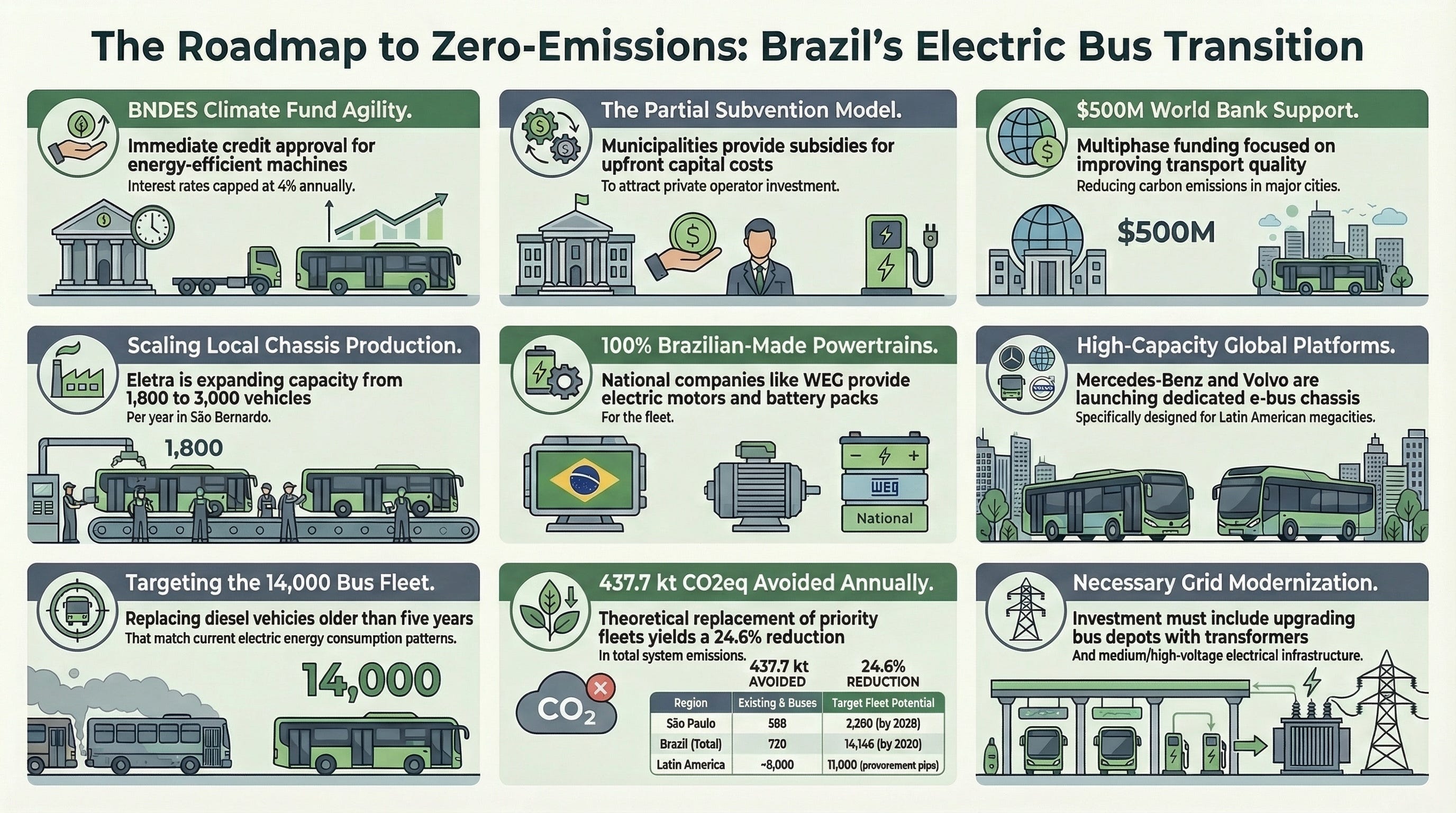
For decades, Brazilian cities have been defined by the roar of diesel engines and clouds of exhaust. Today, that reality is changing fast. Brazil is leading one of the most ambitious electric bus transitions in the Global South, with plans to replace 14,000 diesel buses with modern, zero-emission e-buses. This is not just another pilot project — it’s a strategic industrial and environmental transformation that positions Brazil as a model for emerging markets worldwide.

According to a landmark study by the Institute for Transportation and Development Policy (ITDP) titled “Accelerating the Transition”, 14,146 diesel buses (mainly older Euro III to Euro V models) operating in Brazil’s 18 largest metropolitan areas are ready for immediate replacement. These vehicles offer perfect operational compatibility with current domestic electric bus models, requiring no changes to routes or fleet size while delivering an immediate 24.6% reduction in greenhouse gas emissions.
Why This Matters for Brazil and the World
Brazil is leveraging its strong domestic manufacturing ecosystem to make this transition economically viable. Companies like Eletra (market leader with over 60% share), Mercedes-Benz do Brasil, Volvo, and WEG are scaling production of electric chassis, powertrains, and batteries. Strategic policy shifts, such as the new 30% Accreditation Index replacing the old Nationalization Index, allow manufacturers to import key high-tech components while still accessing low-interest BNDES financing.
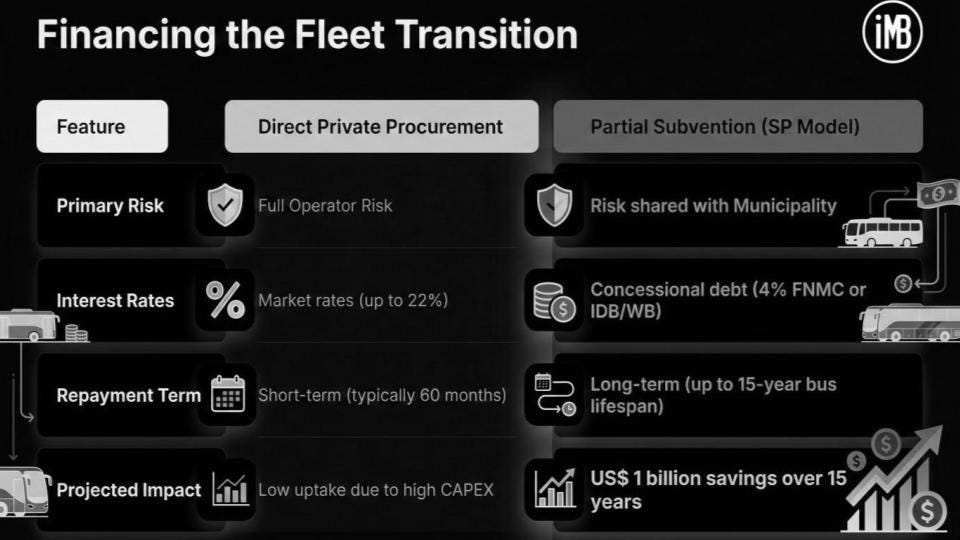
In São Paulo, the innovative Partial Subvention Model is breaking the upfront cost barrier that has slowed electrification elsewhere. By shifting from expensive private financing to municipal sovereign credit and reallocating resources from volatile diesel OPEX subsidies to smarter CAPEX investments, the city is projected to save US$ 1.0 million) over 15 years.
Beyond emissions and savings, the Total Cost of Ownership (TCO) for e-buses is rapidly becoming superior thanks to:
30% lower energy and maintenance costs
15-year service life (vs. 10 years for diesel)
Rapidly falling battery prices (7% annual drop)
New revenue from carbon credit monetization via Caixa Econômica Federal
This electric bus revolution also drives social inclusion. Under programs like REFRATA and PAC, the transition is expected to create 280,300 new direct jobs by 2030 in high-skilled manufacturing and tech sectors, while offering retraining pathways for workers displaced by electronic ticketing.
As Brazil races to lead Latin America’s electrified fleet by 2026 — supported by the US$500M World Bank MPA project — cities worldwide are taking notice. The question is no longer if emerging markets can electrify transit, but how fast they can follow Brazil’s proven path.
About three weeks ago, the city government of São Paulo received an additional 500 electric e-buses from Elektra and Volkswagen Trucks & Buses, bringing the total number of vehicles in operation to 1,700. By the end of 2028, at least 2,200 e-buses are expected to be in service in São Paulo.
In a conservative estimate for Brazil, the ICCT concludes that by 2030, at least 21% of all public transit vehicles sold will be electric buses; by 2024, this figure will reach at least 62%, and by 2050, it will have risen to 92%.
According to information from Volkswagen Trucks & Buses Brazil, the company is preparing its local operations for the export market. The Mexican market is already being targeted, as are other South American countries.
Ready to understand the future of sustainable urban mobility? Read the full analysis of Brazil’s groundbreaking electric bus strategy.

The LatAm Story
Hyundai Weighs Major Mexico Expansion: Potential US$2 Billion New Plant Under Consideration
Hyundai Motor is evaluating a significant Hyundai Mexico expansion with a potential US$2 billion plant that could produce 250,000 to 300,000 vehicles annually. This strategic move would strengthen the South Korean automaker’s footprint in one of North America’s most important manufacturing hubs.
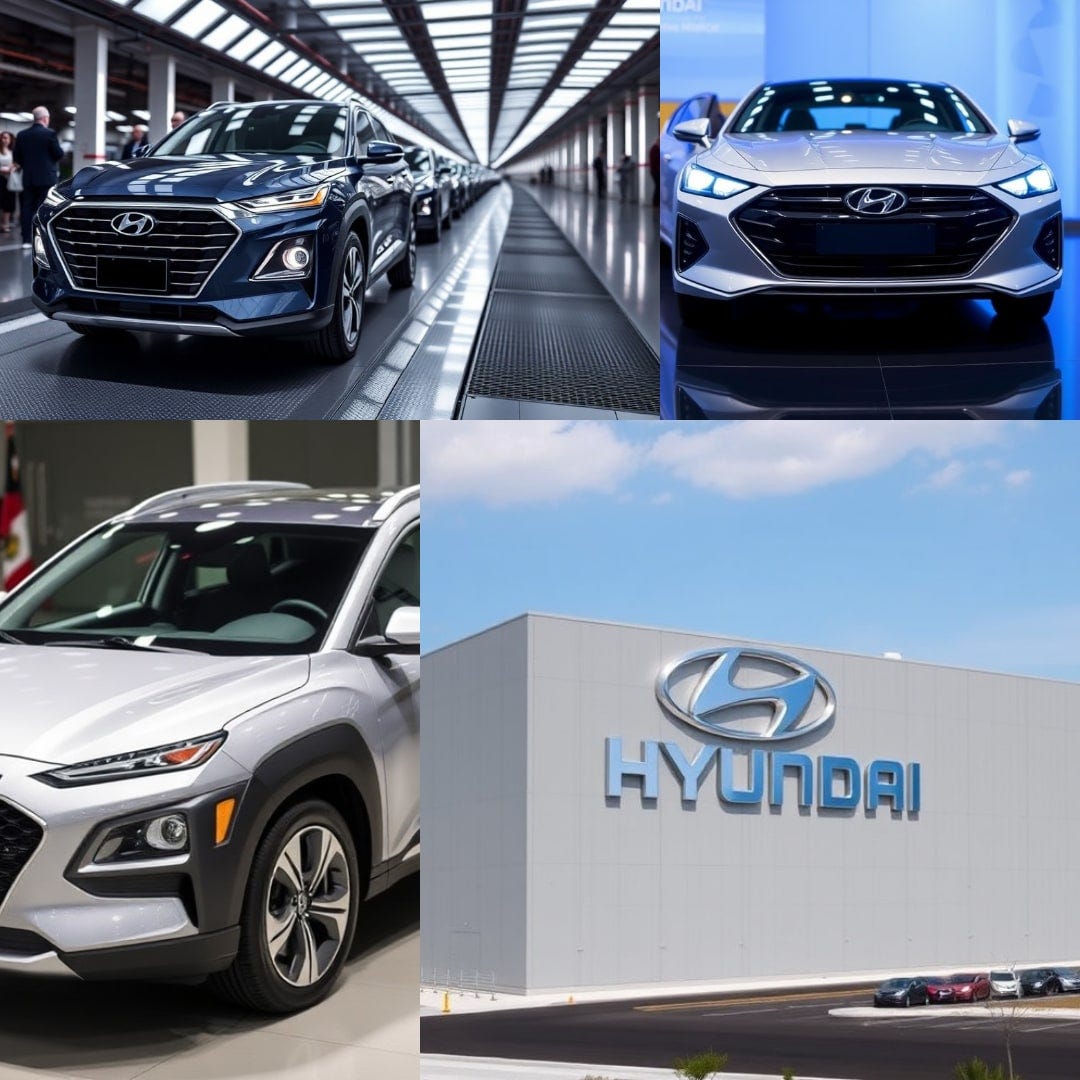
According to Hyundai Mexico CEO Edgar Carranza, the decision depends heavily on the upcoming USMCA review and progress toward a Mexico-South Korea free trade agreement. Favorable outcomes in both areas would create an attractive environment for this major automotive investment in Mexico.
Hyundai has already invested over US$2.5 billion in Mexico, supporting more than 12,500 direct jobs. A new plant would generate additional employment and boost the local supply chain, reinforcing Mexico’s role as a key nearshoring destination for global automakers.
Despite recent import tariffs affecting non-FTA vehicles, Hyundai maintains strong performance in the Mexican market. From January to May 2026, the brand sold 21,454 vehicles (up 2.5% YoY) and holds a 3.4% market share, ranking among the top 10 brands.

Generative AI Tools in Project Missions
Step into the AI Arsenal: the cutting-edge generative tools we deploy in client projects, internal operations, and partner collaborations—tested, trusted, and ready for battle.
Avoid the #1 Pitfall in AI Agent Development: Why “Build Me an Agent” Is a Red Flag (And How to Fix It in 2026)
In the accelerated world of agentic AI in 2026, countless teams rush into building AI agents only to end up with underperforming pilots that drain resources without delivering real value. If you’ve ever heard—or said—”Just build me an agent,” you’re not alone. But here’s our clear opinion: this phrase isn’t a solid requirement. It’s a glaring symptom of a deeper issue in your AI agent strategy.
The truth?
Jumping straight to development without strategic groundwork is one of the most common mistakes in AI agents. Industry insights from 2026 show that up to 50% of enterprise AI initiatives stall due to vague goals and poor planning.
The result?
Abandoned projects, skyrocketing costs, and missed opportunities in an era where AI agent best practices can drive 40-80% efficiency gains in workflows like customer support, sales automation, and internal processes.
So, what’s the solution-oriented path forward?
Shift to an outcome-driven AI agent approach. Before coding or prompting, anchor everything in these three powerhouse questions—the foundation of successful AI agent development in 2026:
What outcome are we truly changing? Pinpoint the exact business impact. Is it reducing resolution time in customer service by 50%? Boosting lead conversion through personalized outreach? Or accelerating R&D with data insights? Specificity here transforms generic agents into high-ROI powerhouses.
What’s the current baseline? Measure today’s reality ruthlessly—cycle times, error rates, costs, and bottlenecks. Without this, you can’t prove value or track progress. This step alone prevents the “prototype purgatory” that plagues many AI agent projects.
What does wild success actually look like? Define ambitious yet measurable wins: 90% automation accuracy, new revenue streams unlocked, or capabilities that were impossible before. This vision aligns teams and fuels motivation.
By leading with these questions, you’ll craft purpose-built AI agents that scale reliably, integrate seamlessly, and deliver compounding returns. Organizations mastering this AI agent strategy in 2026 aren’t just experimenting—they’re engineering breakthroughs that outpace competitors.
Ready to elevate your AI agent best practices and avoid costly pitfalls? Dive deeper into this transformative framework—it’s the proactive edge your team needs today.
Get Out

One of the most iconic staircases in the world
As part of a project assignment for a client in the mining and commodities industry, I have been visiting the capital, Brasília, regularly over the past few months. After many years, I finally took the time to explore the city’s architecture a little more closely. One of the most impressive buildings is undoubtedly Brazil’s Ministry of Foreign Affairs—the Itamaraty.
Step into architectural poetry. This breathtaking cantilevered staircase floats inside the Itamaraty Palace (Ministry of Foreign Affairs) in Brasília, designed by the legendary Oscar Niemeyer.
A perfect blend of brutalist concrete, dramatic lines, and light that feels almost sculptural — it’s not just a way to go upstairs, it’s a statement of modern Brazilian design and ambition.
Would you climb it?

Contact

🚀 Fast Impact, No Strings Attached: Why iMB.Solutions Is Your Next Strategic Move

Unlock Immediate Impact with iMB.Solutions
📍 When timing, precision, and execution matter most—our manager on-demand (interim and project management for business development, reorganization and business model transformation for international project missions) step in with zero ramp-up, 100% focus, and full accountability.
Why Work With Us?
✅ Immediate Availability – We’re ready when you are
✅ Quick Start-Up – Projects kick off in days, not weeks
✅ Focused Execution – Sharp minds. No distractions.
✅ Goal-Oriented Delivery – We solve, not circle
✅ Updated Expertise – Managers with up-to-date skills and vision
✅ Cost Clarity – Transparent pricing, no hidden costs
✅ Efficient Reporting – Milestone-driven, results-focused
✅ No Termination Costs – No severance, no HR entanglements
Our Collaboration Process
🔹 Step 1: Compatibility Meeting
Meet with your potential manager on-demand—on your premises if possible—to test cultural fit, skills, and creativity. You discuss your situation, simulate potential solutions, and assess alignment.
🔹 Step 2: Strategic Snapshot
Want more certainty? We offer an in-depth diagnostic using our proprietary tools (business development, commercial, reorganization + plant operations). In 3–7 days, we deliver a feasibility study and actionable report—fast, focused, and fixed-fee.
🔹 Step 3: Let’s Execute
If it’s a match, we define the mission scope, set milestones, agree on reporting and confidentiality terms, and negotiate a fair, value-based compensation. It’s your roadmap to results.
What You Get:
🎯 Rapid onboarding
🎯 Zero HR complexity
🎯 Precision-driven delivery
📩 Ready for a high-impact partnership?
Let’s start the conversation. Your challenge deserves more than consultants—it deserves hands-on leadership.
👉 Contact Us
independent management on-demand | interim management | business development | reorganization | transformation | LatAm | Brazil | Mexico/USMCA
| stay safe on your project trail |
Discover What Matters Most to You—Backed by 150+ Project Missions!
Curious about the impact of our insights at iMB.Solutions? We put our articles, blogs, and case studies to the test—running three independent AI-driven queries with Perplexity, Google Gemini, and Mistral. The result? A powerful keyword cloud reflecting the topics that truly resonate.
Do you see yourself in these trends? Let’s connect and explore how our expertise—shaped by 150+ project missions over two decades—can drive your success.