


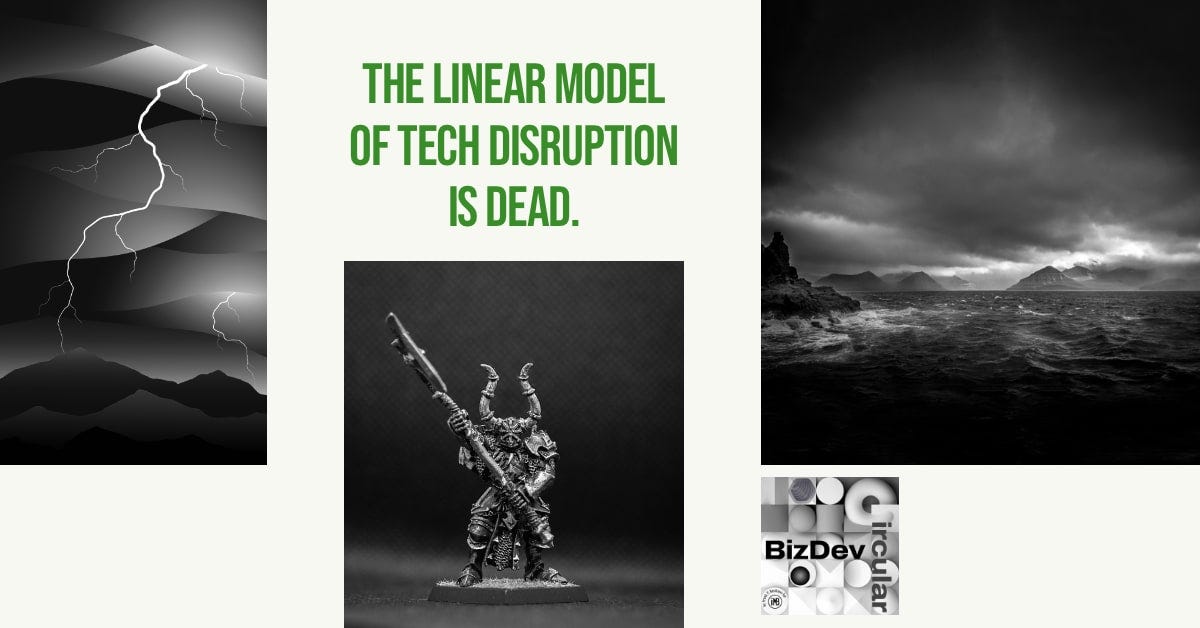
At SXSW 2026, futurist Amy Webb opened her session not with a standard presentation, but with a funeral. Complete with mourning music, candles, and tissues, she officially “killed” her marquee Emerging Tech Trend Report—a format she helped define nearly two decades ago.
The reason for this symbolic death is profound for corporate business development: the linear model of technological disruption has collapsed. We no longer live in a world where a single technology emerges, slowly gains traction, and sequentially reshapes a market. Instead, we have entered the “Convergence Era” (or “Intelligence Supercycle”), where forces like artificial intelligence, programmable biology, geopolitical pressures, and capital flows are colliding simultaneously.
This reality is strikingly reminiscent of chaos theory and chaotic systems found in thermodynamics and fluid dynamics. In hydrodynamics, you cannot predict the behavior of a turbulent river by studying a single drop of water; the system is defined by extreme sensitivity to initial conditions and the non-linear, compounding interactions of multiple forces. Webb uses a similar meteorological analogy: tracking individual trends is like looking at isolated temperature or wind speed data. But when these forces interact, they create massive, unpredictable “storm systems” or convergences.
For corporate business development, surviving this perpetual storm requires a radical departure from traditional forecasting. It demands a completely new approach from both a strategic and tactical perspective.
Strategically, the convergence of AI, biotechnology, and advanced sensors (what Webb calls “Living Intelligence”) means that organizations can no longer afford to be passive observers of their own disruption. The strategy must shift from defensive moat-building to proactive dismantling.
Embracing Schumpeter’s Storm: Drawing on economist Joseph Schumpeter’s concept of “creative destruction,” leadership must recognize that capitalism is a perpetual storm that destroys old industries from within. The greatest threat to an enterprise is the refusal to destroy its own outdated systems.
Burning Down the Empire: Strategic business development now requires the discipline to view yesterday’s greatest strengths as tomorrow’s most dangerous liabilities. Leaders must ask an extraordinarily difficult question:
“What are we willing to let die on purpose so that something more valuable can live?”.
The most valuable leaders will be those willing to burn down their empires at the exact right moment to build again.
Foresight as Governance: Strategy cannot simply be a list of trendy pillars on a slide. It requires institutionalizing foresight at the board level. This means allocating capital that balances short-term returns with long-term investments in emerging tech, and integrating dynamic scenario planning to map risks from unexpected, non-linear convergences.

The Tactical Perspective: Rebuilding for the Silicon Workforce
Tactically, executing this strategy means abandoning the impulse to simply apply new technology to broken, legacy systems. Innovation is compounding exponentially, and the S-curves of adoption are compressing.
Agent-First Process Redesign: We are moving into the “Agentic Economy,” defined by a silicon-based workforce. However, 40% of agentic AI projects are predicted to fail by 2027 because companies are making the mistake of “paving the cow path”—automating existing, human-centric workflows rather than redesigning processes from the ground up. Tactically, business development teams must conduct value stream mapping to build agent-native operations, utilizing multi-agent orchestration to handle complex, composite processes across departments.
HR and FinOps for Agents: Because AI agents operate autonomously and continuously, they must be managed like a workforce. Organizations need to deploy “HR for agents,” which includes strict onboarding protocols, performance tracking, and life cycle management. Furthermore, because continuous AI inference racks up massive computing costs, deploying strict “FinOps” (financial operations) frameworks is critical to monitor and control agent-driven expenses in real time before they erode ROI.
The AI Infrastructure Reckoning: The economics of AI are chaotic. While the cost per AI token has dropped 280-fold, overall AI consumption has exploded so fast that enterprise cloud bills are hitting tens of millions of dollars a month. Tactically, businesses must pivot from default “cloud-first” strategies to strategic hybrid architectures. This means using the public cloud for elastic experimentation, but migrating heavy, continuous production inference to on-premises hardware, and utilizing edge computing for latency-critical decisions.
Self-Healing Supply Chains: In logistics and manufacturing, the convergence of AI, sensors, and global volatility is birthing “Liquid Logistics Networks”. Rather than relying on rigid procurement, these systems are self-healing—using predictive analytics and deep learning to autonomously reroute shipments days before a geopolitical event or climate disaster strikes, entirely without human intervention.
What is the "New Labor Equation" for business development?
The New Labor Equation is a fundamental structural shift in the economic logic of business, defined by the complete decoupling of economic output and GDP from human work and headcount. For business development, it signals the end of employment as the primary engine for economic growth.
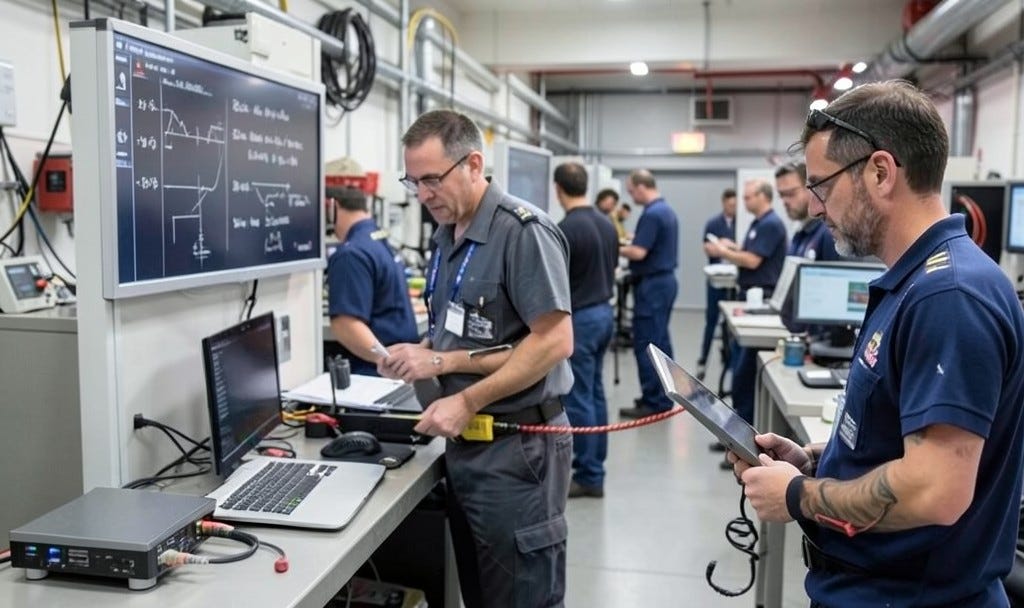
This shift revolves around the concept of “unlimited labor”. Driven by the deployment of fully autonomous agentic AI systems for knowledge work and “lights-out factories” for physical production, organizations can now execute complex operational tasks continuously with minimal human oversight. Because these systems do not experience fatigue or time constraints, output and growth can scale exponentially without a corresponding increase in human hiring or wages.
For business development and operational strategy, the New Labor Equation dictates several major transitions:
From Headcount to Autonomous Capacity: The primary driver of corporate growth is no longer human productivity, but rather the scaling of autonomous agentic capacity.
From Automation to Process Redesign: Instead of simply using technology to automate existing human tasks, businesses must fundamentally redesign their operations to be “agent-first,” building workflows specifically for a silicon-based workforce rather than forcing AI into legacy human processes.
Building a Hybrid Workforce: The workplace transitions from being strictly human-centric to a blended human-digital reality, where human workers collaborate with, supervise, and orchestrate AI systems.
Ultimately, this equation means that wealth, power, and income will increasingly concentrate around the organizations that own this automated capacity, rather than the individuals who sell their physical or cognitive labor. This is not merely a theoretical prediction about future job losses; it is a profound transformation that is already actively underway across both manufacturing and knowledge work sectors.
How do ‘lights-out’ factories impact global supply chain resilience?
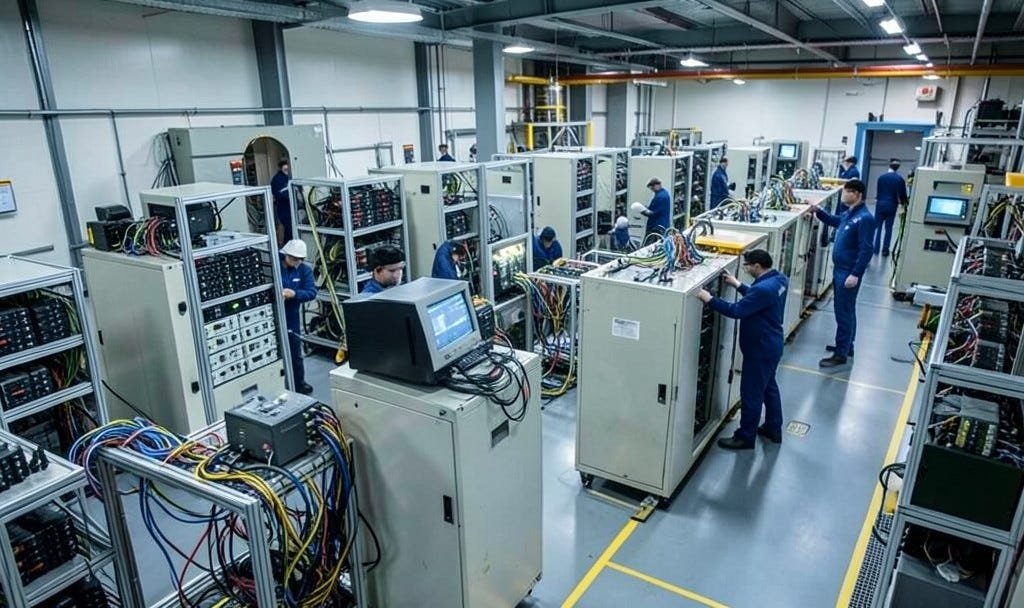
“Lights-out” factories—facilities designed from scratch to operate 24/7 as self-optimizing systems without a human presence—significantly bolster global supply chain resilience by eliminating traditional vulnerabilities and seamlessly integrating with adaptive logistics systems.
Here is how these fully automated facilities impact supply chain resilience:
Eliminating Human Bottlenecks: Traditional manufacturing and supply chains have historically been vulnerable to human limitations, such as fatigue, labor disputes, and shift constraints. By removing people from the factory floor, lights-out industrialism ensures that production can run continuously and scale on demand without the downtime associated with human-centric operations. For example, Xiaomi currently operates a fully autonomous factory in Beijing that leverages AI-driven software and advanced robotics to produce smartphones with minimal human intervention.
Enabling Hyperlocal Production: Fully automated manufacturing makes it economically viable to move production closer to the end consumer. Organizations are developing “nano-fulfillment centers” that combine advanced additive manufacturing (3D printing) with automated logistics to produce goods locally. By localizing production, businesses can drastically reduce their reliance on fragile, long-distance global shipping routes, directly mitigating the risks of international supply chain disruptions.
Integration with “Self-Healing” Networks: Lights-out factories do not operate in a vacuum; they are increasingly connected to autonomous “Liquid Logistics Networks”. These AI-driven networks continuously monitor vast data streams—including geopolitical shifts, extreme weather, and cyberthreats—to anticipate bottlenecks before they happen. If a disruption is forecasted, the system can autonomously reroute shipments, dispatch drone fleets, and rebalance inventory across automated warehouses to ensure the supply chain remains uninterrupted.
Continuous, Error-Free Output: Inside these facilities, technologies like continuous additive manufacturing allow for nonstop production without traditional pauses between layers. AI-powered real-time error detection systems instantly identify defects and adjust the machinery, significantly reducing material waste and downtime. This ensures a highly reliable and consistent flow of goods, even when external shocks hit the broader market.
How can business development teams apply the 'contribution credit' model?
The “Contribution Credit” model is a radical economic framework proposed by futurist Amy Webb to address the “New Labor Equation” and the transition to an unlimited, highly automated labor economy. For business development (BD) teams, applying this model means moving away from a one-way extraction of wealth and instead distributing a percentage of the earnings generated by corporate automation back to the humans who provided the visible and “invisible” labor—such as original creative IP, mentorship, caregiving, and community building—that made the economic value possible.
Business development teams can apply the contribution credit model through several strategic and tactical approaches:
Tie Payouts to Measurable Automation Gains BD teams should structure the contribution credit not as a tax, charity, or Universal Basic Income (UBI), but as a shared-success business model. The credit should be designed to trigger only when value is actually captured—specifically when automation or AI deployment generates measurable financial gains for the company. To avoid shocking capital markets and investors, BD teams can pilot these programs by writing small, single-digit percentage payouts into their partnership and automation strategies, phasing them in gradually across broad sectors.
Leverage Web3 and Smart Contracts for Automated Distribution To practically execute and track these payouts, BD teams can utilize blockchain and Web3 infrastructure. The Web3 ecosystem is already pioneering similar models, such as Retroactive Public Goods Funding, which rewards creators and developers after the value of their work is proven. BD teams can also look to quadratic funding platforms (like Gitcoin) or automated smart contracts to systematically direct a portion of corporate or protocol revenue back to the community, creators, and foundational infrastructure projects that support their business.
Implement Equitable IP Licensing and Revenue-Sharing As AI systems face the threat of “model collapse” from over-relying on synthetic data, high-quality human-generated data remains a premium competitive advantage. BD professionals negotiating AI training and data access must establish fair licensing models that compensate original creators. Examples of this in action include search platforms like Perplexity AI offering ad-revenue sharing agreements to publishers, and interactive platforms like Fable Studio paying studios to license their content for fan-driven AI storytelling. By treating historical and ongoing human contributions as an asset class, BD teams can secure vital data pipelines while fairly compensating creators.
Mitigate Social Backlash and Reputational Risk Applying the contribution credit model is also a vital risk management strategy. If companies implement agentic AI and “lights-out” automation without sharing the financial upside, they risk severe societal fracturing and civil unrest. This threat is illustrated by the projected “Everyday Hotel AI Workforce Strike of 2034,” a scenario where aggressive AI labor allocation leads to massive worker protests, reputational damage, and government intervention. By championing the contribution credit, BD teams can proactively ensure that their workforce transitions and automation strategies are viewed as socially responsible and sustainable, effectively sharing the wins of innovation so that both the business and society can functionally survive the transition.
Conclusion: From Observers to Architects
The collapse of the linear trend model is a wake-up call. In a chaotic system, traditional step-by-step corporate planning is a liability. As the economy detaches from human employment (the “New Labor Equation”) and biology becomes a programmable infrastructure, the gap between the leaders and the laggards will widen in months, not decades.
Corporate business development can no longer be about predicting the future; it must be about architecting it. By embedding strategic foresight into governance, actively practicing creative destruction, and rebuilding operations for a hybrid human-digital reality, organizations can harness the turbulent forces of this convergence era rather than being swept away by them.
Thanks for reading BizDev Circular! This post is public so feel free to share it.

Available for iOS and Android
Start writing today. Use the button below to create a Substack of your own
