


Intro
Welcome to the latest edition of the newsletter.
If there is one undeniable conclusion I took away from navigating the chaotic, exhilarating crowds at SXSW 2026 in Austin earlier this year, it is this: the era of isolated, predictable tech trends is officially dead.

Between dodging autonomous robotaxis prowling the downtown corridors, exploring bleeding-edge XR exhibitions, and testing out biohacking “rejuvenation chambers,” the festival felt less like a typical tech hype cycle and more like a profound global turning point. But the absolute defining moment of my time there was attending futurist Amy Webb’s keynote, where she symbolically held a funeral—complete with mourning music and tissues—for her own famous annual tech trend report.
About SXSW: SXSW dedicates itself to helping creative people achieve their goals. Founded in 1987 in Austin, Texas, SXSW is best known for its conference and festivals that celebrate the convergence of the interactive, film, and music industries. An essential destination for global professionals, SXSW features sessions, showcases, screenings, exhibitions, professional development and a variety of networking opportunities. For more information, please visit sxsw.com.
Her message was a massive wake-up call that fundamentally shifted my perspective. We are no longer observing linear, step-by-step technological advancements; we have entered the “Intelligence Supercycle.” We are now operating in a Convergence Era where artificial intelligence, programmable biology, advanced sensors, and massive macroeconomic shifts are colliding and accelerating simultaneously.
I idealized this newsletter to distill my boots-on-the-ground experiences, notes, and the most mind-bending conversations from SXSW 2026 into a practical survival guide for navigating this new reality.
As you read through my insights and takeaways from Austin, I want you to keep one critical theme in mind: surviving this convergence requires “creative destruction on purpose”. Let’s dive into what that means, and why the most valuable leaders of tomorrow will be those who possess the courage to deliberately burn down their own outdated legacy systems to architect the enterprise of the future.
Concurrently, Agentic AI has transitioned from a passive tool into an autonomous workforce capable of setting goals, formulating strategies, and executing complex decisions faster than any human team.
And suddenly, the entire traditional consulting model—built on billable human hours, armies of analysts, and expensive partners—looks painfully outdated.
The Melting of the Human Middleware

For decades, major consultancies relied on vast teams of junior analysts to process data, coordinate projects, and build presentations.
Today, the “middle office is melting” as AI actively automates the coordination and decision-making tasks that traditionally required human middleware.
We have entered the era of Large Action Models (LAMs), which do not just generate text but learn from behavioral data to break complex tasks into executable steps and act autonomously across digital ecosystems. AI is compressing corporate decision cycles from weeks to minutes, meaning organizations that cling to manual coordination and approval processes will find themselves structurally uncompetitive.
The New Labor Equation and “Unlimited Labor”
We are witnessing a fundamental shift known as the “New Labor Equation,” driven by the reality of “unlimited labor”. This represents the use of automated systems to produce work at scale and on demand, effectively removing natural human constraints like time, attention, and fatigue.
For the first time in history, economic output and GDP are completely decoupling from human headcount and wages.
In this new environment, consulting giants like McKinsey, BCG, and Accenture face a brutal reckoning.
Clients no longer need to pay millions for human-hours when agentic systems and a “silicon-based workforce” can run end-to-end composite projects continuously and autonomously.
The old assumption that high-value knowledge work strictly requires expensive human labor is collapsing.
The “New Labor Equation” is a fundamental structural shift in the economic logic of business and human compensation, defined by the complete decoupling of economic output and GDP from human work and headcount.
Introduced as a core convergence concept by futurist Amy Webb, this equation is driven by the reality of “unlimited labor”. For centuries, economic growth and social contracts relied on one primary assumption: human effort and access to large pools of labor were the essential inputs for production. The New Labor Equation inverts this historical model by using automated systems—specifically autonomous agentic AI in knowledge work and fully automated “lights-out” factories in manufacturing—to produce work at scale, on demand, and without human participation.

By removing natural human constraints such as fatigue, time limits, and attention spans, organizations can now achieve exponential scale without population growth, and drive output without paying wages.
Specifically, this new equation dictates several major paradigm shifts:
Labor is no longer the engine for economic growth: Because output can now scale exponentially without a corresponding increase in human headcount, the traditional link between paying people and generating economic value is severed.
The transition to a “Silicon Workforce”: The workplace model shifts from being human-centric to a hybrid human-digital reality. This requires organizations to stop merely automating old human tasks and instead fundamentally redesign their processes for an autonomous, agentic workforce.
A massive redistribution of wealth and power: Under this equation, income, power, and wealth will increasingly concentrate around the organizations that own the automated capacity, rather than the individuals who sell their physical or cognitive labor.
Ultimately, the New Labor Equation is not merely an abstract prediction about future job losses or a warning about automation.
It is an active, structural transformation of capitalism that is already underway across both the manufacturing and knowledge work sectors.
Creative Destruction in the Convergence Era
We are navigating the “Intelligence Supercycle,” a convergence era where technologies, capital, and geopolitical forces compound and accelerate simultaneously. Futurist Amy Webb notes that the greatest threat to any enterprise today is not external disruption, but the refusal to destroy its own outdated systems from within. To survive, leaders must practice “creative destruction on purpose”—having the discipline to view yesterday’s greatest strengths (like the billable hour and massive human deployments) as tomorrow’s most dangerous liabilities.
Firms that cling to legacy models risk becoming the next dinosaurs in an unlimited-labor economy.

Reinvention or Decline?
Will the big consulting firms successfully reinvent themselves with agentic AI, or are we watching the beginning of their decline?
To survive, consultancies must abandon the impulse to simply use AI to automate their existing, broken processes—a mistake that leads to inefficiency and is predicted to cause over 40% of agentic AI projects to fail by 2027. Instead, they must pivot to offering “agent-first process redesign” and help clients architect hybrid human-digital workforces.
The consultants of the future will not be selling armies of analysts; they will be selling specialized AI governance, multi-agent orchestration frameworks, and dynamic response strategies that balance human oversight with silicon-based execution. The winners of this apocalypse will be the firms brave enough to burn down their own legacy empires at the exact right moment to architect the agent-native enterprise of tomorrow.
How can Firms Successfully Reinvent Themselves?
To successfully reinvent themselves in the Convergence Era, firms must move beyond incremental, sequential improvements and fundamentally restructure their operations, technology, and strategic mindsets.
The most consequential threat to organizations today is not external disruption, but the refusal to destroy outdated internal systems.
Here are the critical strategies organizations must execute to achieve successful reinvention:
1. Practice “Creative Destruction” on Purpose Firms must possess the discipline to view yesterday’s greatest strengths as tomorrow’s most dangerous liabilities. Rather than clinging to legacy models and protecting current margins, leaders must ask, “What are we willing to let die on purpose so that something more valuable can live?”. The most valuable leaders will be those willing to deliberately dismantle their own empires at the exact right moment to build anew.
2. Redesign Processes, Do Not Merely Automate Them Many organizations fail because they attempt to apply advanced AI to broken, legacy workflows—a mistake described as “paving the cow path”. To reinvent themselves, firms must practice “agent-first process redesign”. Instead of solving for single pain points or automating tasks designed for humans, companies must examine their end-to-end composite processes and completely reimagine how work should be structured for an autonomous AI workforce. As one expert noted, “There is no progress in merely finding a better way to do a useless thing”.
3. Architect a Hybrid “Silicon-Based” Workforce Reinvention requires shifting from a purely human-centric model to a blended human-machine workforce. To manage this, firms must develop new organizational frameworks, including “HR for agents”. This involves:
Onboarding and Life Cycle Management: Training agents on enterprise data, assigning them digital identities, tracking their specific performance contributions, and eventually planning for their retirement or replacement.
FinOps for Agents: Implementing financial operations frameworks to rigorously monitor and control the compute costs and token-based pricing associated with continuous, autonomous agent activity.
Elevating Human Roles: As AI handles routine execution and code generation, human workers must be pushed “up the ladder” to focus on compliance, strategic governance, exception handling, and innovation.
4. Eliminate Technical Debt by Building “AI Factories” Organizations cannot simply layer next-generation AI onto legacy enterprise architectures. Instead of trying to retrofit outdated “brownfield” systems, leading firms are building greenfield “AI factories”. These are purpose-built infrastructure ecosystems featuring AI-specific processors, high-performance networking, and advanced data pipelines designed from scratch to run agentic AI stacks out of the box. Eliminating technical debt must be treated as a core part of AI strategy, not a separate IT initiative.
5. Adopt an “Always Beta” Dynamic Response Framework Firms must abandon static, linear planning in favor of perpetual evolution. This requires embedding adaptability into the corporate structure through dynamic response frameworks. The future-ready tech organization uses modular, API-first architectures and replaces slow, point-in-time oversight with continuous, AI-assisted governance cycles that adjust to real-time signals. Successful firms prioritize velocity over perfection, choosing to “fail fast” on small pilots rather than missing technological waves entirely.
6. Lead with Business Problems, Not Technology Hype To escape “pilot purgatory,” organizations must anchor all technology investments to measurable business outcomes. Reinvention fails when companies adopt technology for technology’s sake. Successful deployments demand strict ROI evaluations and a focus on solving the organization’s largest, most complex operational problems rather than chasing trendy headlines.
Ultimately, successful reinvention requires institutionalizing strategic foresight. Firms must continuously ask three questions to guide their transformation:
“Where is the world going? Where will value be created? And how will we participate?”.
What are the First Steps to Transition from Linear Planning?
To transition away from traditional, linear planning, organizations must recognize that relying on sequential, step-by-step improvements is no longer viable in an era of rapid technological convergence. The first steps require a fundamental shift in mindset, governance, and operational design to ensure the enterprise can adapt at the speed of modern innovation.
Here are the critical first steps organizations must take to make this transition:
Institutionalize Strategic Foresight and Scenario Planning: Instead of relying on linear forecasting, organizations must embed strategic foresight directly into their annual planning and corporate strategy to anticipate volatility and map out potential disruptions. This transition begins by continuously asking three deceptively simple questions: “Where is the world going? Where will value be created? And how will we participate?”.
Create Dynamic Response Frameworks: Leaders must move beyond traditional strategic planning to build dynamic response frameworks that allow the organization to pivot instantly as technological changes accelerate or decelerate. This involves adopting agile governance and flexible policies that can evolve right alongside global uncertainties and emerging technologies.
Redesign Processes, Don’t Just Automate: A major trap of linear thinking is attempting to apply advanced AI to broken, legacy workflows—essentially “finding a better way to do a useless thing”. The first step is to conduct value stream mapping and fundamentally redesign end-to-end operations for an autonomous, silicon-based workforce rather than just layering new tech over old human processes.
Anchor Technology to Specific Business Problems: Leaders must stop adopting technology for technology’s sake and avoid getting stuck in a cycle of endless proofs-of-concept. To break out of linear IT management, organizations must tackle their largest operational problems first and ensure that every new technology investment is tied to measurable business outcomes and ROI.
Mandate Tech Literacy and Shift Capital Allocation: To guide this transition, organizations must require tech literacy at the board level to ensure informed decision-making regarding disruptive innovations. Concurrently, leadership must adjust capital allocation models to balance short-term returns with crucial long-term investments in emerging technologies.
What Specific Tools are Replacing Excel for Risk Detection?
DeepFM is a prominent hybrid AI model replacing traditional spreadsheets and past financial reports for financial risk prediction. Instead of relying solely on numerical data, DeepFM acts as a continuous “risk detective” by combining structured data (like sales figures) with massive volumes of unstructured text (like news stories, CEO speeches, regulatory filings, and customer complaints) to detect complex patterns and predict economic downturns faster and more accurately than static models.
Beyond DeepFM, various industries are adopting highly specific AI platforms and agents to replace manual, Excel-based risk management:
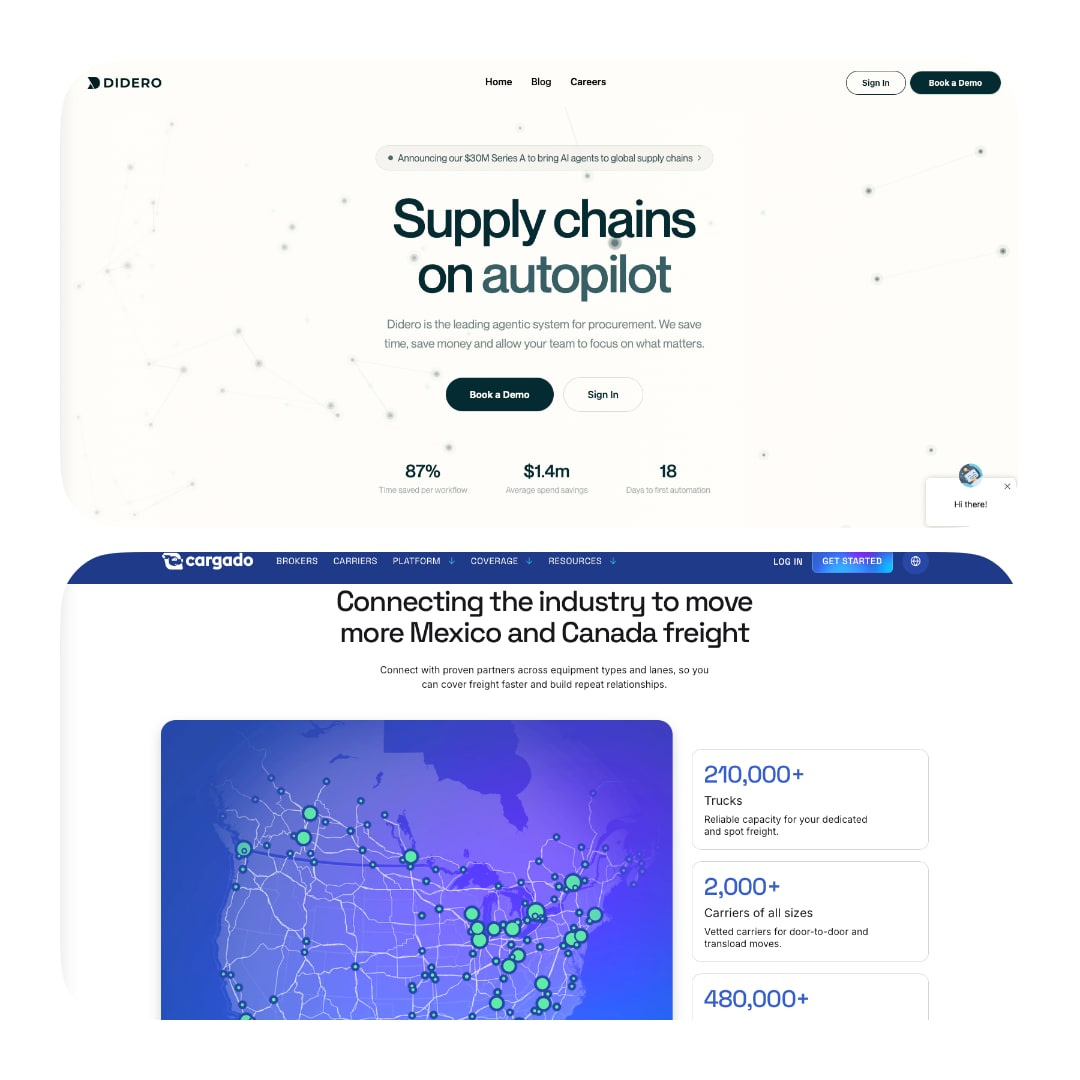
Supply Chain and Logistics: Recognizing that running global supply chains on endless Excel spreadsheets is “inefficient, chaotic, costly, suboptimal and completely unfit for the modern world,” the industry is shifting toward omni-channel management platforms. Tools like Didero help midsize companies automate cost analysis and supplier negotiation, while platforms like Cargado mitigate regulatory risks and complexities in cross-border freight.
Insurance and Fraud Detection: Manual claims and underwriting checks are being replaced by AI-driven technologies. Clearspeed utilizes AI-powered voice analytics to assess claim legitimacy and instantly flag high-risk cases. FICO, in partnership with firms like Solutis, provides targeted AI risk assessment tools for midsize banks and insurers. Furthermore, ForMotiv and FRISS have partnered to analyze thousands of digital behavioral data points during the application process to spot inconsistencies and potential fraud in real time.
Corporate Operations: To bypass the grueling manual work of operational performance reviews, enterprises are deploying autonomous agents. HPE, for example, developed an AI agent named Alfred that bypasses manual data entry by pulling information directly from enterprise resource planning systems to conduct data analysis, build charts, and translate insights into comprehensive, structured reports.
Construction and Project Management: To mitigate physical and financial project risks, estimators are using cloud-based solutions like the Sage BidMatrix platform to manage bids and assess subcontractor risks. Additionally, Clearstory uses AI to automate the review of thousands of change orders to minimize costly errors, and Trunk Tools deploys an AI-powered Schedule Agent that proactively identifies and resolves potential project timeline issues before they escalate.
Conclusion: Architecting the Enterprise of Tomorrow
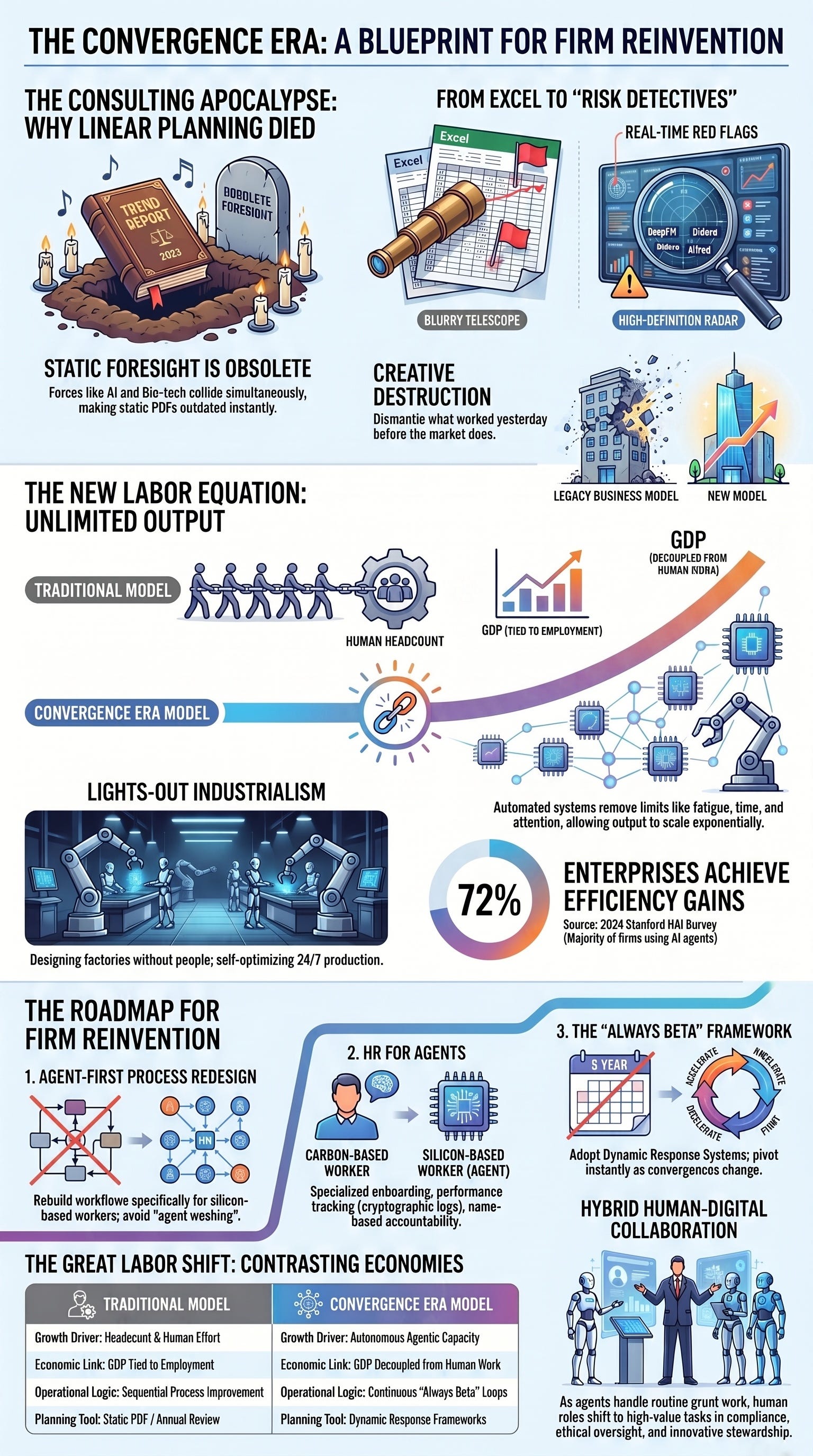
The survival of the modern enterprise now hinges on a radical departure from the past. As we’ve explored, the traditional consulting model and linear, spreadsheet-based planning are rapidly becoming obsolete “Old Economy” relics. We have officially entered the era of the “New Labor Equation,” a structural economic shift where output and GDP are fundamentally decoupling from human headcount. Driven by the reality of “unlimited labor”—powered by autonomous agentic AI and lights-out factories—organizations can now achieve exponential scale without relying on traditional human constraints.
To thrive in this Intelligence Supercycle, leaders must avoid the trap of “paving the cow path,” which merely layers new technology over broken, legacy workflows. Instead, successful reinvention requires “agent-first process redesign” and the courage to practice “creative destruction on purpose”—deliberately dismantling outdated internal empires to architect a hybrid, silicon-based workforce.
The practical first steps toward this transformation require a total operational and cultural shift:
Institutionalize Strategic Foresight: Mandate tech literacy at the board level and ensure every technology investment is anchored to solving a specific, measurable business problem rather than chasing hype.
Deploy AI “Risk Detectives”: Replace static Excel spreadsheets with dynamic, AI-driven tools. Whether it is using DeepFM for complex financial forecasting, omni-channel platforms like Didero and Cargado to manage cross-border supply chains, or autonomous agents like HPE’s Alfred to instantly synthesize corporate operations data, organizations must leverage continuous, real-time analysis to outpace volatility.
Adopt an “Always Beta” Mindset: Move away from slow, sequential planning toward dynamic response frameworks that prioritize velocity, iterative learning, and perpetual evolution.
Ultimately, the gap between leaders and laggards is now widening in months, not decades. The winners of the Convergence Era will not be those who passively observe disruption to protect their current margins, but those who boldly burn down their legacy systems at the exact right moment to become active architects of the future.—Frank P. Neuhaus, founder of iMB.Solutions Ltda., business development - reorganization - international project missions
Thanks for reading BizDev Circular! This post is public so feel free to share it.

Available for iOS and Android
Start writing today. Use the button below to create a Substack of your own