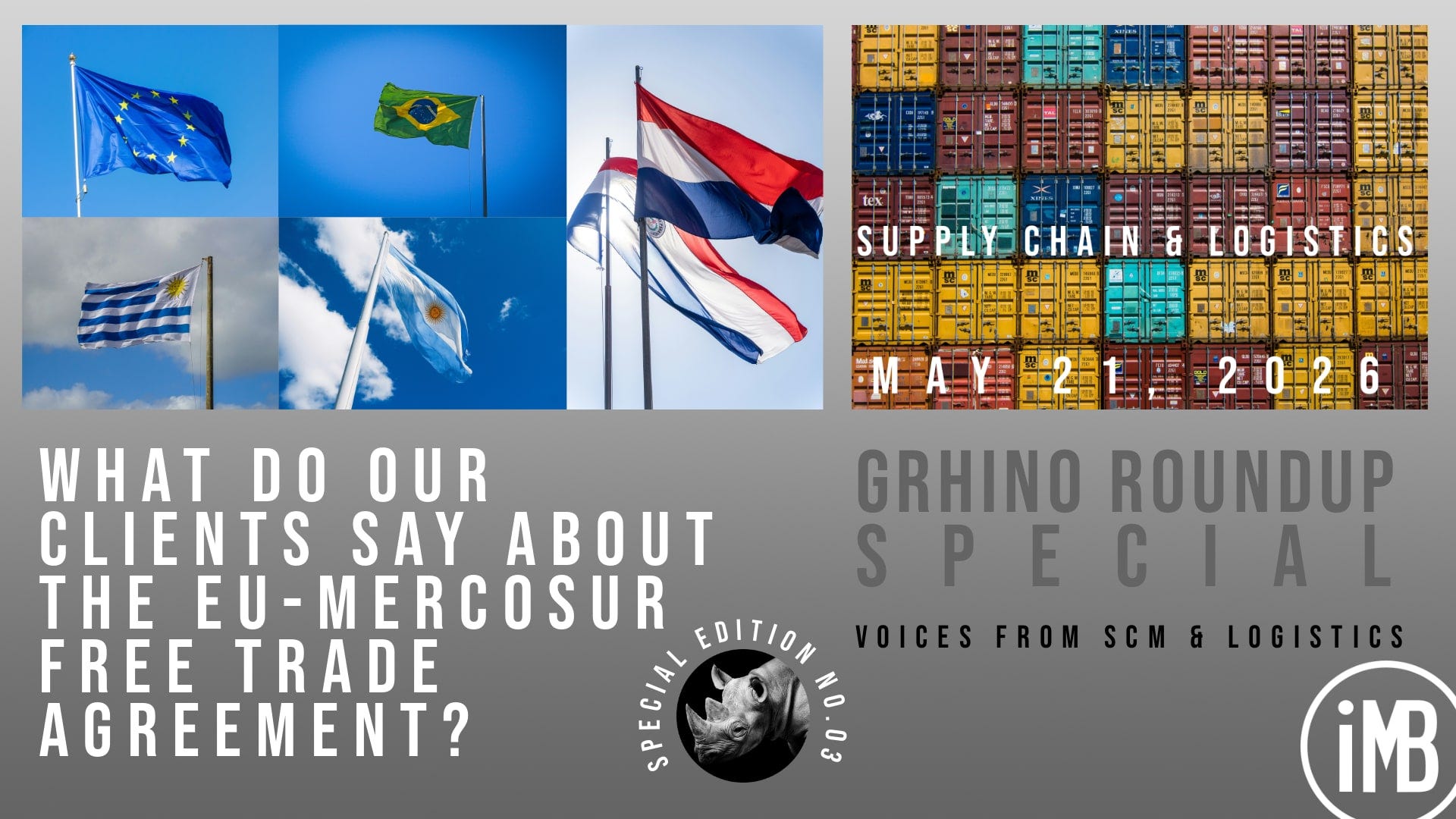
The January 2026 signing of the EU-Mercosur Trade Agreement in Asunción signaled more than just a tariff reduction; it launched a Modernization Mandate for a market of 700 million people. Following our analysis of the automotive and data center sectors, this third edition turns to Supply Chain Management and Logistics—the physical arteries of this new transatlantic corridor.
In this arena, complexity is the baseline. As the agreement impacts virtually every industrial sector, success requires a dual-track approach: a rigorously defined long-term strategy paired with a highly efficient tactical first-response teamto manage day-to-day operational volatility.
At iMB.Solutions, we are already operating at the heart of this logistical shift. Since the second half of 2025, we have been supporting European firms in mastering these new complexities:
The Realignment: We are guiding established European companies through profound organizational restructuring to adapt legacy supply chains to the new, duty-free competitive realities of the Brazilian market.
The Newcomers: We are currently advising firms entering the region for the first time, helping them establish Brazil as a high-efficiency Mercosur logistics hub to capitalize on the free trade framework, including two project missions in Argentina
As the European Court of Justice finalizes the legal “splitting” of the agreement, the demand for sophisticated logistics and agile management is accelerating. Leveraging our deep network across the South American value chain, we provide the “boots on the ground” expertise required to transform these new trade routes into a competitive advantage.
The bridge is built. For those managing the flow of goods and services in this new era, the time to optimize your supply chain is now.
Navigating the New Logistics Era: The EU-Mercosur Agreement 2026
The landscape of South American trade has fundamentally changed. As of February 2026, the EU-Mercosur Trade Agreement is provisionally active, offering a roadmap to dismantle the bureaucratic hurdles that have long defined the “Brazil Cost”. For supply chain leaders, this is a call to move from isolated operations to integrated, digitalized systems.
Reducing the “Landed Cost”
The elimination of tariffs on 91% to 97% of industrial goods is set to drastically reduce the landed cost for high-tech components. This allows local subsidiaries in sectors like automotive and mechanical engineering to import specialized equipment duty-free, transforming Brazil from a protected, isolated market into a competitive export hub.
The Digital Product Passport
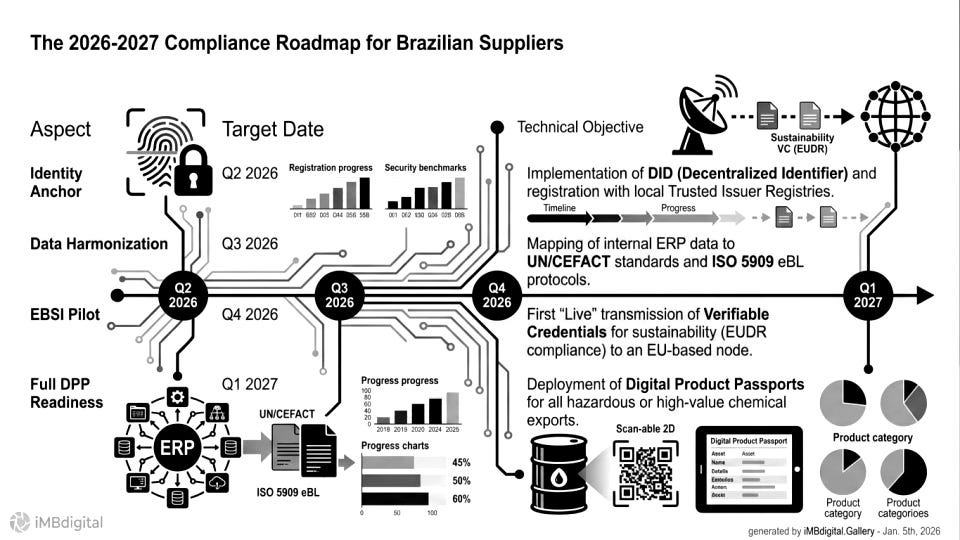
Competitiveness in 2027 and beyond will be determined by data. The agreement enshrines digitalization and traceability as core elements of trade. Supply chains must now provide auditable proof of sustainability and origin to meet European regulatory requirements. Logistics providers that fail to adopt internationally recognized electronic documentation and interoperable IT systems risk total exclusion from these new value chains.-Kai Schwarz for iMB.Solutions Ltda.

The Great Realignment: Why European Industry is Moving to Brazil in 2026
For decades, the global supply chain was tethered to the East. However, by 2026, the conversation in European boardrooms has shifted from “Shanghai opportunistic” to “Brazilian resilient”. As industrial output in the EU faces energy volatility, Brazil has ascended as a sovereign partner, combining green energy certainty with a modernized trade framework.
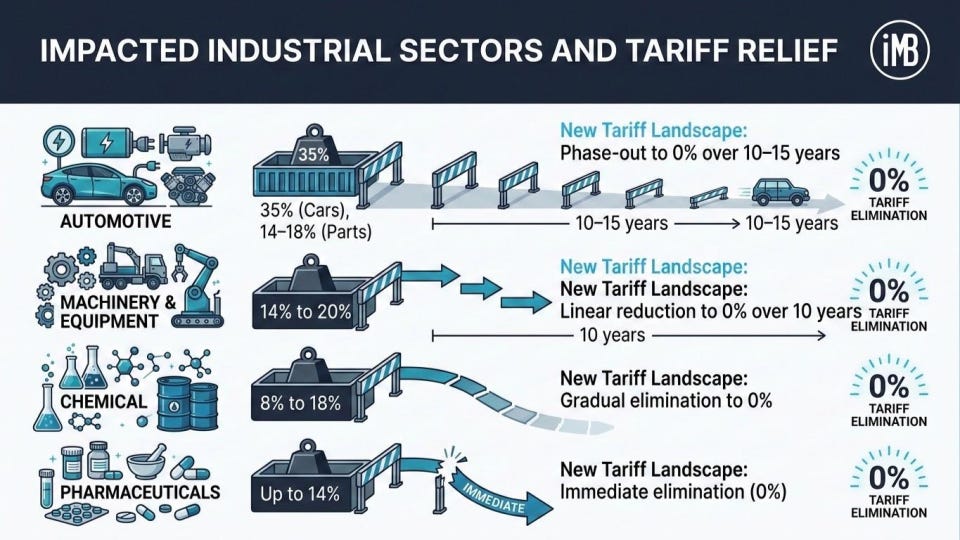
The End of the “Brazil Cost” The most significant deterrent to Brazilian investment—the complex tax code—cracked in 2026 with the introduction of the Dual VAT model. This, combined with the Interim Trade Agreement (iTA), has dismantled high barriers:
Automotive: 35% tariffs are phasing out to 0%.
Machinery: Previous 14-20% duties are seeing a linear reduction to zero over 10 years.
Pharmaceuticals: Achieving immediate to short-term tariff elimination.
The Powershoring Revolution While Europe struggles with natural gas volatility, Brazil’s 89.8% renewable gridallows for “green-shoring” energy-intensive production. Producing in Brazil is no longer just a cost-saving measure; it is a strategy to meet the EU’s strict environmental mandates at the source. With business electricity prices significantly lower than those in Germany, the “renewable arbitrage” is the new industrial gold standard.
Bridging the Skills and Logistics Gap Brazil is not just providing the space; it is providing the speed. The Port of Santos is undergoing an R$1.6 billion expansion to support “just-in-time” manufacturing for the automotive and machinery sectors. Simultaneously, firms like Unilever and Midea are using VR and GenAI to slash technical qualification times by up to 63%, proving that Brazil’s labor force is ready for the high-tech transition.-Auricio dos Santos for iMB.Solutions Ltda.

From Molecules to Metadata: Navigating the 2026 Atlantic Trade Corridor
The signing of the EU-Mercosur iTA in January 2026 signaled the end of a 25-year diplomatic marathon, but for the modern C-suite, it is the start of a technological sprint. While the 35% duty on automobiles is dying, a new barrier has emerged: the requirement for verifiable, digital-first documentation.
The End of “Bureaucratic Purgatory”
The old era of “Non-Automatic Licensing”—where shipments sat for weeks awaiting manual stamps—is being replaced by risk-based inspections and Smart Contracts. By utilizing Decentralized Identifiers (DIDs), partners in Brazil or Argentina can now present Verifiable Credentials to European customs, proving compliance with labor and environmental laws in real-time.
“REACH 2.0” on the Blockchain
For chemical and medical manufacturers, the agreement’s Trade and Sustainable Development (TSD) chapter represents the new gold standard. European firms must now lead with “Green Corridors” that leverage Brazil’s 90% clean energy matrix while maintaining an immutable blockchain ledger to defend against sustainability audits.
Strategic Takeaway
To thrive by 2027, leaders must treat their supply chains as single, end-to-end digital nervous systems. Those who lay the first blocks of the ledger now will own the trade for the next fifty years.-Frank P. Neuhaus for iMB.Solutions Ltda.

Read full Special Edition on Supply Chain Management and Logistics in the new Era of the EU-Mercosur Free Trade Agreement

Stay tuned and watch out for the upcoming special edition?