


Preface
A Letter from Austin: The Chaos That Inspires
In March 2026, I returned to Austin, Texas, for my third consecutive SXSW—an event that has become something of a personal pilgrimage. My first visit years ago was pure electricity:
I arrived with no expectations and left transformed. The panels didn’t just inform; they ignited. The conversations didn’t merely connect people—they forged alliances that continue shaping what’s possible.
What makes SXSW unlike any other gathering is the way it collapses time. In a single week, you’re immersed in a near-futurist lens on the world: emerging technologies, shifting cultures, radical ideas, and bold visions all colliding at once. It’s never a linear education. It’s a non-linear surge—a exhilarating ride through a hyper-accelerated reality. It’s chaos theory applied to your own perspective: the thrill of discovery mixed with the productive unease of asking, What does this mean for our business? How do we adapt? And most importantly, how do we turn these insights into real, meaningful value for the people we serve?
This year, I landed in Austin carrying all those questions. What unfolded was not just another inspiring week—it was a genuine disruption, every bit as powerful as SXSW itself.
In the newsletter that follows, I’m excited to share the breakthroughs, the unexpected connections, the provocative ideas, and the hard-won lessons that emerged from those whirlwind days. Because in the beautiful chaos of Austin every March, we don’t just witness the future—we get the rare chance to help shape it.
Welcome to this special SXSW 2026 edition.
Amy Webb just dropped a bomb at SXSW
At South by Southwest (SXSW) this year, futurist Amy Webb delivered a blunt verdict that should be required reading for every CEO, board member, and strategy lead:
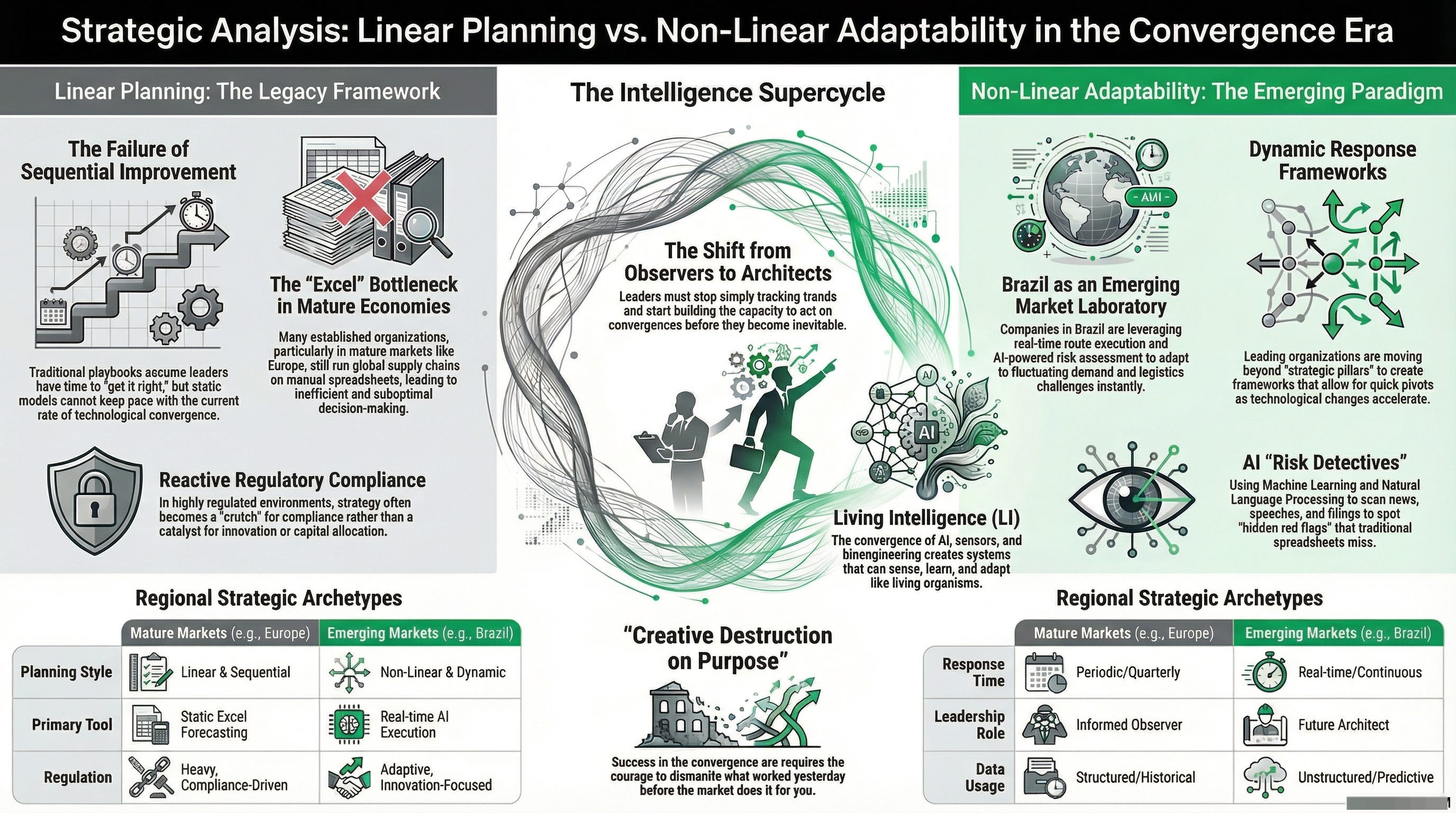
The traditional “linear model no longer fits reality.” Technologies, economies, and geopolitical pressures are no longer evolving in neat, sequential steps. They are colliding and compounding simultaneously, creating massive “storm systems” of change that traditional step-by-step strategic planning simply cannot weather.
For business development teams, this is not abstract philosophy—it is an existential operating reality. Companies that cling to three-to-five-year roadmaps, annual budgeting cycles, and linear risk registers are watching their growth pipelines shrink, their market windows slam shut, and their competitive moats erode overnight. The organizations that will dominate the next decade are those that treat strategy as a dynamic, real-time system rather than a static document.
Let’s examine the consequences through two sharply contrasting lenses: Europe’s regulatory straitjacket and Brazil’s chaotic advantage.
Amy Webb Launches 2026 Emerging Tech Trend Report
The European Challenge: When Heavy Regulation Collides with Non-Linear Reality
The European Union has positioned itself as a global leader in responsible AI governance through the landmark AI Act. The intent is clear and admirable: build public trust, mitigate systemic risks, and set ethical guardrails for a technology that will reshape every industry. Yet the very mechanisms designed to deliver safety—comprehensive conformity assessments, layered compliance obligations, and high-risk classifications—are creating a structural handicap for European business development.

Consequences for growth pipelines are already materializing:
Capital and time erosion. Startups and scale-ups face multi-year, multi-million-euro compliance journeys before they can even ship a minimum viable product. In a non-linear world where model capabilities double every few months, that delay is not merely inconvenient—it is fatal. A competitor in a lighter regulatory environment can iterate, deploy, capture market share, and compound advantages while European teams are still filling out risk questionnaires.
Talent and investment flight. Top AI engineers and founders are voting with their feet. The compliance tax disproportionately burdens smaller players who lack the legal and bureaucratic infrastructure of Big Tech incumbents. Early data from European venture ecosystems already shows a measurable uptick in “regulatory arbitrage” relocations—companies incorporating in more agile jurisdictions while keeping engineering talent in Europe. The result? Fragmented innovation clusters and slower ecosystem velocity.
Lost first-mover premiums. Non-linear AI deployment demands rapid experimentation and real-world feedback loops. When regulation forces linear, sequential testing, European firms risk ceding entire verticals—autonomous logistics, personalized medicine, real-time financial services—to faster-moving regions. The long-term consequence is not just lower GDP contribution from AI; it is a permanent downgrade in Europe’s position within global value chains.
Mature economies built on predictability are discovering that predictability itself has become a liability. The AI Act may protect citizens, but it risks protecting them from the very economic dynamism needed to fund those protections.
Brazil’s Advantage: Primed for Chaos, Built for Non-Linear Execution
Contrast Europe’s experience with Latin America’s largest economy.
Brazilian executives have spent decades operating in environments of chronic volatility—hyperinflation cycles, political turbulence, currency swings, and infrastructure gaps. That lived experience has forged an instinctive comfort with non-linear problem-solving.
Rather than fighting chaos, they have learned to surf it. The payoff for business development is striking.

Two concrete examples illustrate the edge:
Financial Agility via Pix. Brazil’s instant payment system, launched in 2020, now processes over 36 billion transactions annually and has become a global benchmark for real-time infrastructure. Traditional banks, fintechs, and even informal merchants adapted in months, not decades. The system leapfrogged legacy card rails and ACH networks, enabling micro-entrepreneurs to receive funds instantly, supply chains to settle in real time, and new business models (embedded finance, instant credit scoring, dynamic pricing) to emerge overnight. For business development leaders, Pix is proof that infrastructure built for non-linearity accelerates inclusion, lowers transaction friction, and creates entirely new revenue layers that linear economies struggle to replicate.
Dynamic Logistics at Solar Coca-Cola. One of Coca-Cola’s largest bottlers in Brazil no longer relies on static delivery routes planned weeks in advance. Instead, field teams use mobile platforms and real-time data streams—traffic, weather, demand signals, even driver availability—to re-sequence routes on the fly. What looks like operational detail is actually a profound strategic advantage: higher asset utilization, lower fuel and labor costs, dramatically improved on-time delivery, and the ability to absorb shocks (a sudden storm, a road closure, a demand spike) without cascading delays. In a world of compounding disruptions, this capability translates directly into margin expansion and customer stickiness.
Brazilian firms are not theorizing about non-linear systems; they are living them. The consequence for business development is a faster innovation-to-revenue cycle, greater resilience to global shocks, and an ability to attract capital that values adaptability over polished spreadsheets.
The New Mandate: Dynamic Response Frameworks Over Static Plans
The leaders who will thrive are those who move beyond simple risk assessment and traditional action planning. They are building dynamic response frameworks—organizational operating systems that treat strategy as a living, sensor-rich network rather than a fixed document.

Practical consequences for business development include:
Org design overhaul. Silos between strategy, product, finance, and operations collapse. Cross-functional “storm response cells” staffed with real-time data analysts, ethicists, and frontline operators become the new power centers. Decision rights shift closer to the edge of the organization.
Capital allocation velocity. Annual budgets give way to rolling, scenario-triggered funding pools. Capital is deployed in days, not quarters, when early signals indicate a compounding opportunity or threat.
Talent and culture recalibration. Linear thinkers are replaced or retrained. Reward systems now value rapid experimentation, intelligent failure, and pattern recognition in chaotic data over flawless execution of yesterday’s plan.
Partnership ecosystems. Companies that once sought stable, long-term suppliers now cultivate networks of modular, plug-and-play partners who can be swapped or recombined as conditions evolve.
The organizations that fail to make this transition will not simply grow more slowly—they will become structurally uncompetitive. Their business development funnels will clog with stalled pilots, their M&A pipelines will chase yesterday’s opportunities, and their valuations will reflect the market’s assessment of strategic obsolescence.
The Bottom Line: Adapt or Be Stormed

Amy Webb’s SXSW message is not a call for panic; it is a call for precision. The collision of technologies, economies, and geopolitics has created a new physics for business.
Linear planning is the corporate equivalent of navigating a hurricane with a paper map and a sundial.
European leaders must find creative ways to honor regulatory intent without sacrificing deployment speed—perhaps through regulatory sandboxes that scale with capability or outcome-based rather than process-based compliance. Brazilian leaders, already fluent in chaos, must now codify and export their non-linear playbook to capture global market share.
For every executive responsible for growth, the mandate is urgent: audit your strategic processes today. If they still assume sequential cause-and-effect, you are already behind. The winners will be those who treat change not as a series of manageable steps but as a continuous storm—and who build the ships, the crews, and the navigation systems capable of thriving inside it.

The era of linear business development is over. The era of dynamic, compounding advantage has begun.
Thanks for reading BizDev Circular! This post is public so feel free to share it.
About the writer: Frank P. Neuhaus is one of the founding partners of iMB.Solutions Ltda., São Paulo, Brazil. To date, he has already founded three start-ups and is also active as a seed investor. He worked for European companies in Europe (Germany, Spain), Southeast Asia, China and Latin America, including Brazil. He studied mechanical engineer with majors in hydrodynamics and industrial plant engineering. Furthermore, he studied international business management. He also holds an International Executive MBA with a focus on Brand and Service Management. As a result of the steady increase in project content related to automation and digitization, Mr. Neuhaus has completed advanced studies as a Certified Digital Engineer. Since a couple of years, Frank P. Neuhaus executes international business development and reorganization projects missions.

Available for iOS and Android
Start writing today. Use the button below to create a Substack of your own